KDVA and KUSA Honors

Nominations For the KDVA and KUSA Honors Will Be Accepted Through 7 October 2021.

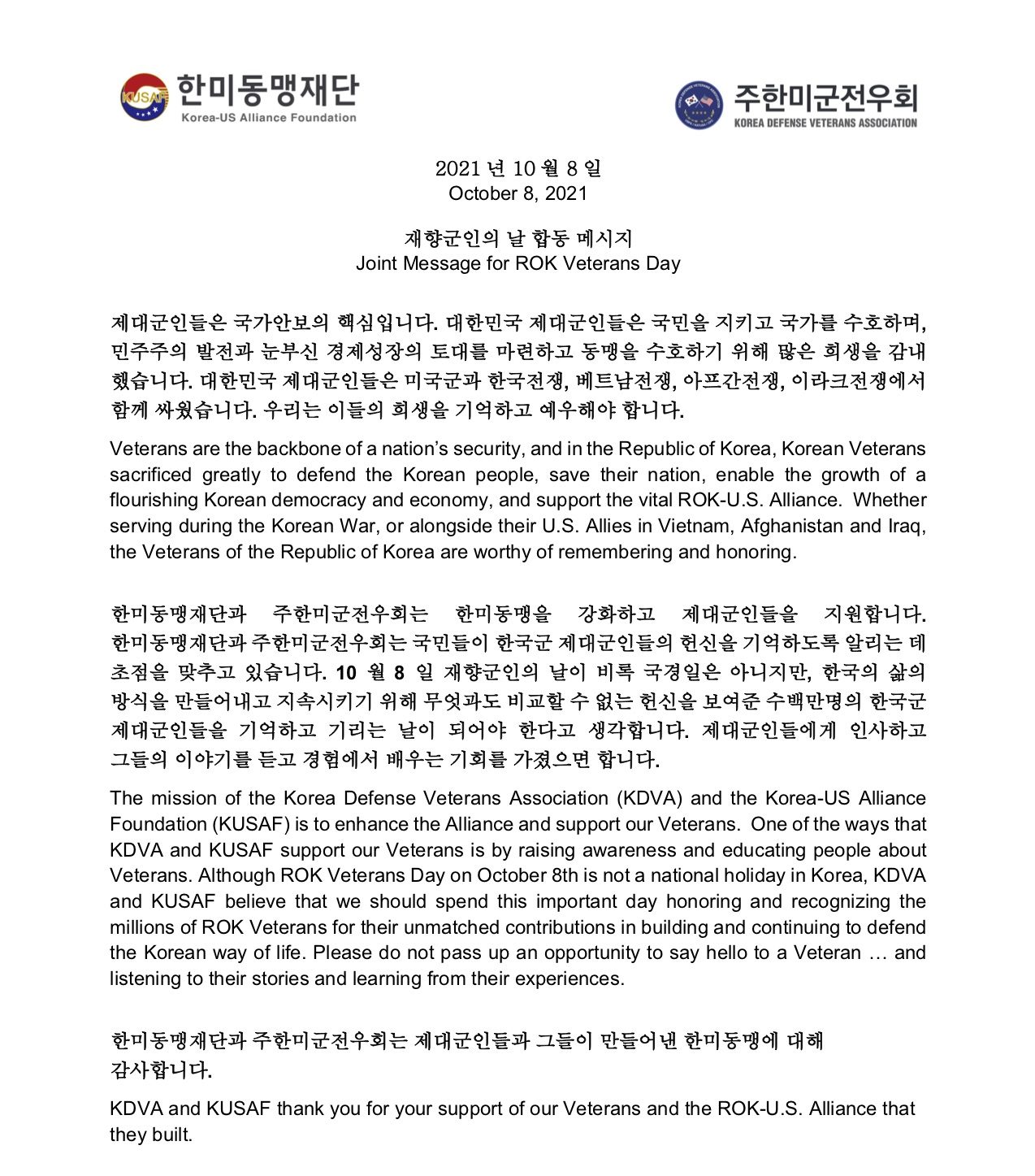
“KDVA & KUSAF Honors” recognize outstanding members for their contributions to the ROK-U.S. Alliance and to inspire making a difference for the Alliance’s future.

한미동맹재단 및 주한미군전우회 “Honors ” 한미동맹에   대한   기여와   미래 한 미동맹 발전에   헌신한   분들께   감사를   표하고자   합니다 .

Honors Categories:

수상 부문: 

  • ROK Veteran Honoree.   한국 예비역 장병
  • U.S. Veteran Honoree.    미국 예비역 장병
  • ROK Service Member Honoree.   한국 현역 장병
  • U.S. Service Member Honoree.    미국 현역 장병
  • ROK Civilian Honoree.    한국 민간인
  • U.S. Civilian Honoree.     미국 민간인

Criteria for Honoree Nominees:

수상   후보자   추천   접수   안내 :

  • Nominations due by 7 October 2021.
  • Nominee must be a KDVA regular member as of 30 September.
    • Because active duty ROK service members cannot join professional organizations like KDVA under ROK law, the nominee for ROK Service Member Honoree, instead, must be serving in the United Nations Command, Combined Forces Command (CFC) Headquarters and its components, ROK Embassy in the United States, other R OK–U.S. Combined Commands, ROK Ministry of National Defense, ROK Joint Chiefs of Staff, and/or ROK Service HQs.
  • Nominator can be anyone.
  • Covers the time period of 1 October 2020 to 30 September 2021.
  • It is expected that a nominee is a person of sound character.
  • Nominee’s list of accomplishments or support for the ROK-U.S. Alliance.
  • Nominee’s list of volunteer efforts..
  • Short (less than 250 words) biography from nominator that highlight nominee’s background.
  • Statement (less than 250 words) from the nominator about the nominee’s qualities to include:  selfless service, passion for the Alliance and Veterans, and how the nominee might use this Honor to contribute further to the Alliance.
  • Nominee must have been discharged honorably.
  • Submitted in Korean or English.
  • 접수 마감일: 2021년 9월 30일.
  • 후보자는 2021년 10월 7일 기준으로 주한미군전우회 정회원이어야 함.
    • 대한민국 현역 장병들은 대한민국 법률에 따라 주한미군전우회 (KDVA)와 같은 비영리법인 가입이 제한됩니다. 따라서, 한측 후보자들은 유엔사(UNC), 한미연합사(CFC) 및 예하부대, 주미한국대사관, 기타 한미 연합사령부, 국방부, 합동참모본부, 각 군 본부에 소속된 인원이어야 합니다.
  • 추천인 자격제한은 없음.
  • 후보자 활동 기간: 2020년 10월1일 ~ 2021년 9월 30일.
  • 후보자는 건전한 성격을 보유해야 함.
  • 한미동맹을 위해 후보자가 이룬 성과 또는 기여 내용.
  • 봉사 내용.
  • (250 자 이내) 추천인 작성, 후보자의 배경을 설명하는 간단한 약력.
  • 후보자 자질을 포함한 추천인 작성 후보자 추천서 (250 자 이내): 헌신적인 복무, 한미 동맹 및 복무장병을 향한 기여, 본 상 수상시 향후 한미동맹을 위한 기여 방안.
  • 후보자는 정상 전역자여야 함.
  • 한국어 또는 영어로 제출 가능.


SUBMISSION FORM: https://kdva.member365.com/publicFr/form/index/2e25d3d6fb950927bc406038e85959e81af622dd

Read more

KDVA’s Congratulatory Letter for the 30th Anniversary of the Korea America Friendship Society June 26, 2021


Download: KDVA’s Congratulatory Letter for KAFS 30yr Anniv 20210626_SIGNED_Dual_Language

Read more

Brigadier General Milford H. Beagle, Jr. (Beags)

Brigadier General Milford H. Beagle, Jr. (Beags)

From my service in Korea, I learned the value of what “We Go Together” truly means (Katchi Kapshida). The bond and connections that were made with the Korean Army, the country, and community were invaluable to me and my family. Everything from daily life to training involved being with, working with, or standing shoulder to shoulder with your Korean counterparts. Learning how to truly partner and be a great partner is a lesson that I have carried with me since my time in Korea.

저는 대한민국 복무 경험으로 부터 “같이갑시다”라는 모토의 진정으로 의미에 대한 가치를 배웠습니다. 대한민국 육군과 대한민국 그리고 대한민국의 사회와의 연대와 의리는 저와 제 가족들에게 소중한것이었습니다.  일상에서부터 훈련까지의 모든것들은 한국인들과 함께 어깨를 나란히 하며 이뤄낸것들입니다. 어떻게 진실되고 훌륭한 파트너가 되는지를 배운것이 제가 대한민국에서 근무를 시작한 이후 제 자신이 얻게된 교훈이었습니다.

I developed great relationships with not only Soldiers and other leaders, but within the community that were absolutely priceless. The people that my family and I grew to know in Korea, cared deeply about others and took the additional steps to foster and cultivate great relationships. In training with the Korean Army, I valued the singular focus on readiness and being ready to fight at a moment’s notice. It is a rarity to see not only a nation’s military force as well as their entire country ready to mobilize or fight at a moment’s notice. The motto of the 2nd Infantry Division; “Fight Tonight” is in my opinion, a lesson learned from working with our Korean counterparts, that evolved into a mindset. I value the mindset changes that my experience in Korea provided me by having the privilege of living with and among the great people of Korea.

저는 한국군 장병들과 지휘관들과 훌륭한 관계를 맺은 것 뿐만 아니라 대한민국 사회와도 값어치를 매길 수 없는 귀중한 관계를 얻게되었습니다. 대한민국에서 저의 가족과 제가 알게된 사람들은 타인들에게 깊은 관심을 가지고 좋은관계로 나아갈 수 있는 일들을 행하였습니다. 대한민국 육군과의 훈련에서 저는 빠른시간내로 전투준비테세를 갖추는 것을 최우선과업으로 여겼습니다. 대한민국 군대 뿐만 아니라 대한민국의 모든이들이 단 한 차례의 경보에도 모두 전투준비와 동원테세에 들어간다는 것은 절대 흔치 않은 일입니다.  제 생각에, “언제든지 나가 싸운다(Fight Tonight)”라는 미 2사단의 모토는 한국군으로부터 배우게된 하나의 마음가짐이라고 봅니다. 저는 대한민국의 훌륭한 이들과 함께 생활하는 특권을 누렸던 한국에서의 경험이 저에게 준 변화된 마음가짐을 소중히 생각합니다.


VR,

Beags

빅스 준장 근배


“VICTORY!…STARTS HERE!”

“우리는 승리한다!”


Milford H. Beagle, Jr. (Beags)

Brigadier General, U.S. Army

Commanding General

US Army Training Center and Fort Jackson

밀포드 H. 비글 주니어 (빅스)

미 육군 준장

미 육군 훈련소 및 포트 잭슨 사령관

Read more

MG Charles R. Hamilton

MG Charles R. Hamilton, Assistant Chief of Staff G4 had multiple tours in Korea which positively influenced his career.  Over the course of his career, MG Hamilton served as a Company Commander, a Battalion Commander, and the Deputy Chief of Staff C/J4 for United Nations Command/Combined Forces Command/United States Forces Korea.

지상 군참부장 찰스 R. 해밀턴 소장은 한반도에서 수 회 근무한 바 있으며, 군생활에 큰 보탬이 되었다고 한다. 해밀턴 소장은 중대장, 대대장에 이어 유엔사/연합사 군참차장/주한미군사 군참부장으로 근무하였다.

“From my service in Korea (on three separate occasions), I learned in an environment filled with strict standards, deep traditions, and an unmatched culture of generosity and humility.

“세 번에 걸친 한반도 근무 경험을 통해 엄격한 기준과 오랜 전통, 그리고 관용과 겸손이 가득 찬 뛰어난 환경에서 성장할 수 있었습니다.

My first experience in Korea was as a senior First Lieutenant/junior Captain.  This assignment to Korea was my first tour overseas and exposed me to different traditions and cultures.  I trained alongside the Republic of Korea (ROK) Army on numerous exercises at the tactical point of contact learning the value of communication and teamwork.  I also learned to work with a coalition partner with differences that ranged from language to tactics.

한반도 첫 근무는 중/대위때 하였는데, 이는 제 첫 해외파병 근무였으며 다른 전통과 문화를 경험할 수 있는 기회였습니다. 대한민국 육군과 많은 전술훈련을 같이 하며 소통과 팀워크의 중요성을 알게 되었습니다. 아울러 언어부터 전술까지 다른 점이 많은 동맹 파트너와 같이 협업할 수 있게 되었습니다.

My second tour was as a Lieutenant Colonel, Battalion Commander.  Korea had transformed since my last tour but the ROK Army and the generous Korean culture had not.  The ROK leadership that I had trained with a decade earlier was just as fit, experienced, and disciplined as U.S. Army Soldiers they trained with.

이후 두 번째 한국 파병 때, 중령으로서 대대장직을 수행했습니다. 대한민국은 제 첫 근무 이후 큰 변화를 겪었으나, 대한민국과 그 육군의 따뜻함은 한결같았습니다. 대한민국 군인들의 강인함과 경험, 근무태도 등은 10년 가까이 전에 같이 훈련했던 바 그대로, 미군과 견주어도 부족함이 없을 정도로 잘 벼려져 있었습니다.

My last tour was as the C/J4 at the rank of Brigadier General.  This was an extraordinary time in both the United States and Korea’s history.  I am particularly proud of the C/J4 staff’s role in meeting the increasingly demanding needs of logistics operations in Korea for both real-world operations and exercises.  My tour as the C/J4 served as a culminating event where I used the training, experience, and knowledge gained working with my Korean partners to achieve monumental success across the Korean Peninsula.

마지막 세번째 근무는 준장으로서 연합사/주한미군사/유엔사 군참부에서 임무를 수행했습니다. 연습이나 실제상황에 상관 없이 원활한 작전을 보장하기 위해서는 매일 더욱 뛰어난 군수작전을 펼쳤어야 했으며, 이를 성공적으로 지원한 군참부를 특히 자랑스럽게 생각합니다. 군참부를 이끄는 과정에서 그 간 대한민국 파트너들과 같이 일하며 배웠던 훈련과 경험, 지식 등을 총동원하여 한반도 일대에서 많은 성공을 거두었습니다.

I am very proud of my service in Korea.”

저는 대한민국에서 근무했던 사실을 매우 자랑스럽게 생각하고 있습니다.”

Read more

SERGEANT ROBERT F. GRANDFIELD, U.S. Army, Korea – 1950 to 1951

By James L. Grandfield

On November 17, 1950, Private Bob Grandfield debarked the troop transport in Wonsan. The son of a Cape Cod physician, the 20-year old medic was serving with the 7th Infantry, 3rd Infantry Division. Bob graduated from high school in 1948. Rather than take the chance of being drafted for three years of active duty, at the advice of his father, Bob enlisted in the Army under a program for 18-year old men; he would spend one year on active duty followed by six years in the reserves. While stationed at Fort Hood, Texas, Bob volunteered for medic training, by his own admission, to avoid assignment to the motor pool. Upon completion of his year in Texas, Bob enrolled at Tufts University, just outside Boston.

When President Truman committed American forces to defend South Korea in the summer of 1950, Bob was recalled to active duty and faithfully honored his commitment. He reported back for duty at Fort Dix, New Jersey, then completed refresher training at Camp Breckenridge, Kentucky. He took a train to Seattle, then flew to Tokyo via Alaska. Like many who served long ago, Bob remembers the lighter moments. Landing in the Aleutians for a layover, the troops disembarked the aircraft and were directed to a mess hall. The weather was cold and windy, a precursor of what he would endure in Korea. As an officer counted heads getting off the plane, a Soldier said, “Don’t worry sir, ain’t nobody going AWOL in this place.”

Arriving in Korea with other replacements, Bob was assigned to the 7th Infantry’s heavy mortar platoon. The regiment had established defensive positions north of Hungnam to support the withdrawal of the 1st Marine Division and Regimental Combat Team 31 from the fighting at the Changjin (Chosin) Reservoir. In addition to combat wounds, Bob and his fellow medics treated many Soldiers for frostbite.

At the beginning of the war, American troops were probably overconfident, and the slogan of “home by Christmas” was popular with the troops. The entry of the Chinese into the conflict changed all that. To this day, Bob has always been complimentary of the Army’s efforts to get a hot Thanksgiving meal to the front lines in 1950. He vividly recalls eating mashed potatoes out of his helmet liner in the rain. To his daughter-in-law in Virginia Beach, he has assured her many times that no matter what food item didn’t turn out “just perfect” for the family Thanksgiving meal, it’s always nicer than his meal in 1950. To this day, Bob has been an easy-to-please, appreciative, nothing rattles him person. His experiences at age 20 gave him a unique perspective for the rest of his life.

When X Corps was ordered to evacuate through the port of Hungnam, the 7th Infantry defended the perimeter that facilitated the evacuation of 105,000 UN forces, an estimated 91,000 North Korean refugees, and over a quarter million tons of equipment and supplies during the “Miracle of Christmas.” In his medical bag, Bob carried two mortars over 20 miles as the 7th Infantry withdrew to Hamhung, only to be told to throw them overboard as he embarked the troop ship. The 7th Infantry Regiment was the last unit to leave Hungnam, departing the port on Christmas Eve.

The 7th Infantry Regiment unloaded in Pusan on December 30. The following day, the 3rd Infantry Division was assigned to the Eighth Army’s I Corps. After being reequipped, the division took its position in the western section of the UN line south of Seoul. Bob continued to serve with the mortar platoon as the 7th Infantry Regiment advanced north. By mid-April, the regiment had established positions north of the Imjin River.

On April 22, the Chinese People’s Volunteer Army began the Spring Offensive, forcing the division to withdraw to positions south of Uijongbu. The division returned to the reserve following heavy losses during this period. In mid-May, the division moved east to assist units defending the central sector. By the end of June, the 3rd Division occupied the Chorwon- Kumhwa Line.

Armistice negotiations began on July 10, 1951. As noted in the division’s official history, the character of the war changed from “one of movement and major offensives to a fairly static defensive conflict.” Later that summer, Bob was assigned to an infantry platoon. He still recalls the mortar platoon as easier duty. “With the mortar platoon, when it was time to change positions, we packed up the trucks and moved. In the infantry platoon, we walked.”

Bob finished his tour in Korea as a sergeant on September 7, 1951. He was awarded the Bronze Star Medal for “meritorious service in connection with military operations against an armed enemy in Korea.” He jokingly tells his children that “the Army flew me to Korea, by way of Seattle to the Aleutian Islands to Tokyo, and then by ship to Korea. On the way home, it was 14 days on a slow troop ship. And I had contracted malaria, to boot.” He returned to Massachusetts and attended law school under the G.I. Bill, where he met his future wife, Mary Cunningham. Bob and Mary were married for 51 years, until her passing in 2005. Bob was a devoted caregiver in the last years of Mary’s life, when she was in poor health.

After her passing, he sought opportunities to serve his community. Bob began volunteering with the Princess Anne Rescue Squad in Virginia Beach, where he currently serves as the chaplain. His medic days behind him, Bob doesn’t ride the ambulance, but serves a variety of administrative functions for rescue squad. He recently celebrated his 91st Birthday.

Bob and Mary raised five children. Today, he is a proud Grampa to seven grandchildren and two great grandchildren.

About the Author: Jim Grandfield is Bob’s youngest son. He is a 1986 graduate of the U.S. Naval Academy who served five years as a surface warfare officer.

Read more

COLD WARRIORS: American Father and Son Serving the Korean People

By: Brian Edward Malnes

Harry

The Korean War was the first major salvo of the Cold War, which lasted from 1947 to 1991. During the entirety of the Cold War, American military men and women have served the South Korean people. Under the United Nations flag flown by the United Nations Command (UNC), peaceful conditions through an armistice have been earned and maintained for nearly 70 years. Two of these Cold Warriors are father and son, and both served the South Korean people. This is the story of 1st Lt. Harold “Harry” Malnes, U.S. Air Force, and Sgt. Brian Malnes, U.S. Army.

Harry joined the service in 1951 and rose to the rank of 1st Lieutenant in the U.S. Air Force. His service included direct support for the Korean War as an Air Intercept Controller. Although Harry did not serve in South Korea during the war, he received the Occupation

Medal and the National Defense Service Medal for being a part of the mobilization of men and materiel for the war effort.

After the Korean War, Harry spent the remainder of his military service in West Germany with the 10th Tactical Reconnaissance Wing. The Wing was established at the beginning of the Cold War in 1947 as a tactical reconnaissance and weather observation unit. The 10th Tac-Recon Wing evolved to include day and night, and multi- sensor capabilities. Today, the unit is designated as the 10th Air Base Wing and is the host wing for the United States Air Force Academy.

Brian

Brian was raised during the Cold War to believe in service and country. His father, Harry, instilled in him the value of giving oneself for something greater. That greater calling brought Brian to the United States Army in 1985. The Cold War was at its peak, and nowhere were the tensions higher than on the Demilitarized Zone (DMZ) that separates the two Koreas. Brian’s first duty assignment was with the 2nd Infantry Division, where he volunteered to serve in the Western Corridor with the 4th Squadron, 7th Cavalry Regiment.

The 4th Squadron, 7th Cavalry Regiment was responsible for accomplishing reconnaissance and security missions and engaging in offensive, defensive and retrograde operations on the DMZ. While assigned as the divisional cavalry squadron, the 4-7th Cavalry was the “eyes and ears” of the 2nd Infantry Division. Part of Brian’s job as an ImJin Scout was to do patrols on the DMZ and reaction force operations of which he did over 20.

Brian’s service in South Korea has had a lasting effect on his life. It was with great honor that Brian guarded the peace in the Joint Security Area, and along the 155 miles that make up the DMZ between the Koreas. After his tour in South Korea, Brian returned to finish his regular Army service at Fort Carson in Colorado. Brian reached the rank of Sergeant in the Washington National Guard.

The Cold War ignited into the Korean War, and with it the need for the UNC. And when the Cold War ended in 1991, it could be argued that the DMZ between the Koreas was the most dangerous place on earth. The end of the Cold War did not end the need of the UNC. That will only be achieved through unification. Until then, I believe in the UNC and my brothers and sisters in the ROK Army to keep the peace on the Korean Peninsula.

Today, the father and son Cold Warriors enjoy peace and harmony. They have earned that peace, along with the millions of people across the globe who would stand against the ills of humanity. Today, the Cold Warriors can take solace in the fact that their service has not been forgotten. And will never be lost to time.

Read more

MY KOREA EXPERIENCE – Ray Huecker


By Ray Huecker

Shortly after North Korea invaded South Korea in 1950, General Douglas MacArthur called for a Division of Marines to mount an invasion at Inchon Harbor. When told the Marines didn’t have a Division, he said “Call up the Reserves”! I got the message by radio to report to active duty at our unit in Pearl Harbor. I was 19 years old.

After a week or so, we boarded a MATS sea-plane equipped with JATO bottles under the wings… Jet-Assisted-Take-Off was the extra power needed to get the plane into the air. We all sat on the floor, back to front, legs crossed, leaning on the guy in front. The sound was deafening and scary. When the jet-packs activated, we all thought the engines had blown up. We landed after the 10-hour flight and were bussed to Camp Pendleton where the lieutenant in charge of us was asked: “how many warm bodies do you have?” We were there for two weeks; there was no boot camp for us. Then we boarded ship in San Diego, headed for Korea.

The 1st and 5th Marines had already made the Inchon landing; our 7th Marine Reserve Unit was backup. We arrived at Inchon harbor at night; it was pitch black, no lights in the city. We went over the side of the ship on cargo nets into landing craft. When we pulled up to the dock, we saw wounded Marines being loaded onto landing craft, heading out to the hospital ship. Then we knew … this was a real war.

We were deployed outside Seoul, in the northwest sector. We were told to dig in along the trails, thinking the North Koreans would travel along that trail. The first night was a little weird; as you looked out from the foxhole, you could see the moonlight dance between the leaves in the trees and in your mind, you just knew a Korean was out there hiding. But it was just the eyes and the mind playing tricks.

There was house to house fighting in Seoul; our progress was slow because this was our first fight and we did not know much about this kind of a fight … or any kind of fighting.

We ate our “C” rations sitting on the streets. There were bodies of dead Koreans there, covered with a woven mat-like material. The first one that I saw was an old man sitting in the street with his right hand on the wheel of a wagon. His eyes were open, and he had a bullet hole in the center of his forehead. I smoked the Lucky Strike cigarette from my C ration. We were at war in Korea.

Soon we were ordered to pull out to the outskirts of Seoul because our artillery was going to drop shells on the city. Our unit was to move out to a new location; there were Koreans on the road, a few of them had burp guns. The World War II Marines in the unit took the guns and turned the guys to the back of the column … after they kicked the North Koreans’ butts. We moved with caution up Hill No. 168.

I was in the open, directing mortar fire when the enemy on a higher hill, opened fire with small arms. I rolled over on my stomach and was hit

in the right heel. My boot flared out at the heel; I made my way down the hill and a corpsman put a helmet cover on my foot. The Marines were taking a beating; the wounded were evacuated to a MASH (Mobile Army Surgical Hospital) unit. I could see the military doctor trying to save a Marine but about five minutes later he covered the Marine with a white sheet. The wounded were flown from Korea to the Yokuska Hospital in Japan. I was given a “flying twenty dollar bill”; no more money was given out until your pay records caught up with you.

Earlier we had been told there was no need for winter boots or winter socks. “You will be back home for Christmas” was the official word. However, when we returned to Korea from Japan in November, winter was setting in and the ground was frozen. We were issued wind-breaker trousers and a parka coat but no socks or boots. Our gloves were so thick they were in three sections: one for the trigger finger, one for the thumb, and the third for the other three fingers. We slept with our boots on and M-1 rifle tucked into the sleeping bag to keep them from freezing. The sleeping bags were zipped up halfway, the parkas covered the opening with our faces covered with the hood of the parkas.

As we advanced toward the Chosin Reservoir, there were sporadic firefights and skirmishes with the enemy. We had been told that 140,000 Chinese troops were hiding during the day and would attack at night. They hit us on the night of November 27. They wanted to silence our 105mm canons. We could hear the enemy crawling in the grass and weeds. We threw our hand grenades toward the sounds; there would be silence and then we could hear them crawling again. We did not fire our rifles at this time; that would have given away our position.

We regrouped at the bottom of the hill; we were lying down on our stomachs in a skirmish line. The Chinese were coming up on the other side of the hill; the moon was full and behind them. As we began our advance up the hill, we could see them clearly in the moonlight. At one point, I paused to reload my M-1 rifle and when I looked up, there was a Chinese soldier coming at me. I yelled “get him, Charles!” and Charles did. It was an all-night fight; next morning the hill was covered with their dead and ours.

Many of us wondered what drove those Chinese soldiers to keep pouring over the hill into certain death. Were they on drugs … or just brain- washed into that kind of action? I have to say, that although they were our enemy, I have respect for them being the kind of soldiers they were.

When it became obvious our troops would have to push their way south to the ships docked at Wasong Harbor (“RETREAT HELL… WE’RE JUST FIGHTING IN A DIFFERENT DIRECTION”), I saw our dead on trucks, their bodies frozen and laid in different positions, being delivered to the final location. I was tagged as a casualty; I could hardly walk due to ulcers on both feet. At Hamhung, I got on a plane with other wounded and flew to Japan. It was a wonderful feeling to have heat, a good night’s sleep and hot food. God bless America.

Read more

MY GRANDFATHER AND ME IN KOREA: OUR TIME IN KOREA WAS WORTH IT

By Jared B. Law, Captain, U.S. Army Retired

The story is somewhat short, as we only have a few details. My grandfather, PFC David U. Law, was a mortarman with Headquarters and Headquarters Company, 116th Infantry Regiment, 45th Infantry Division during the last months of the Korean War. One week prior to the cease fire, a North Korean rocket barrage landed on his position and killed his mortar section. He survived, but the Mobile Army Surgical Hospital (MASH) unit he was initially sent to (unknown) had to pry his helmet out of his skull from the impact. He spent some time at the 121st Combat Support Hospital (CSH) and in Japan before returning home. If it weren’t for the docs in that unknown MASH unit, my grandfather would not have survived. He never spoke of his time in Korea. My father, aunts, and uncles still have no idea what happened to him over there beyond what I’ve been able to find out from the National Archives. I set foot in Korea almost 60 years to the day later as a Captain in the U.S. Army and proudly served the Korean people and the U.S. for three years after that. I can only think of the sacrifice of those men, the skill of the doctors in the MASH unit, the 121st, and the generosity and camaraderie that I felt during my time in Korea to know that both his time in the war and my time as part of USFK were worth it.

Read more

Korea-US Alliance Foundation Newsletter – June 2021

Download Complete: KUSAF June Newsletter

Read more

KDVA June 2021 Newsletter – Issue 21-4

2021: “Defense and Diplomacy, Together for the Alliance”

Now available to view or download in English and Korean.

Korean Version: KDVA Newsletter Issue 21-4 June 2021 Korean English Version: KDVA Newsletter Issue 21-4 June 2021 English


Read more