


FEATURING STORIES AND ARTICLES BY KDVA MEMBERS AND SUPPORTERS OF THE ROK-U.S. ALLIANCE.
Download PDF Version: KDVA ROK-U.S. Alliance Journal 2020-4

Download PDF Version: KDVA ROK-U.S. Alliance Journal 2020-4
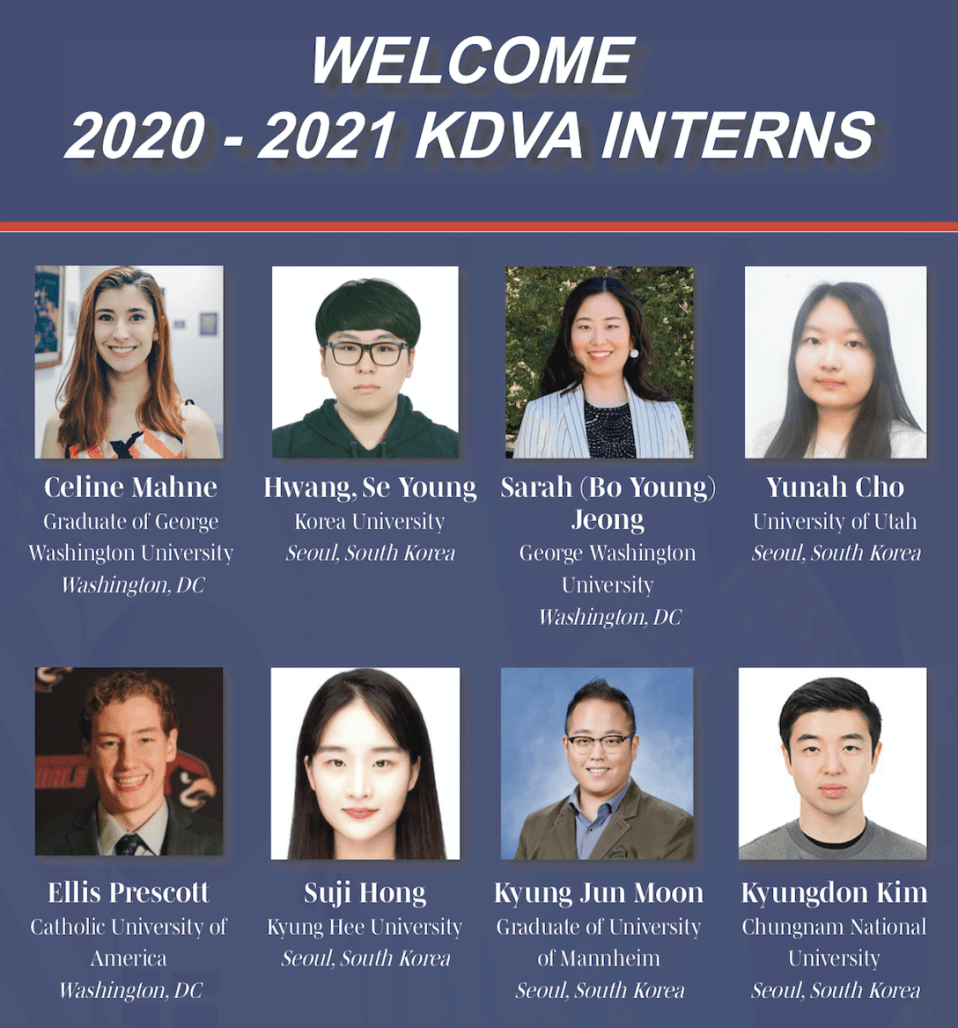

The KDVA Interns will have opportunities to learn more about the ROK-U.S. Alliance and its diverse topics, gain invaluable professional experience, develop skills, make professional contacts, and make contributions to the ROK-U.S. Alliance. They will be involved in diverse research and activity projects to include:
We look forward to their efforts “Together for the ROK-U.S. Alliance.”

View the full webinar recording and short clips on KDVA’s Digital Library page and YouTube channel.
On September 17, 2020, the Non Commissioned Officers Association (NCOA) and the Korea Defense Veterans Association (KDVA) provided Korean Defense Veterans and their families an opportunity to talk about their assignments in Korea, raised awareness about their vital, irreplaceable mission in Korea, and highlighted how Korea really is an assignment of choice!
“Together for the ROK-U.S. Alliance”
RECORDING:
This webinar series follows the webinar series that KDVA started in June 2020 for Korean War Veterans. Please see the webinars in the KDVA Digital Library at https://kdva.vet/digital-library/.
Later on, KDVA will conduct a webinar about ROK and U.S. Defense Veterans of the De-militarized Zone or DMZ.
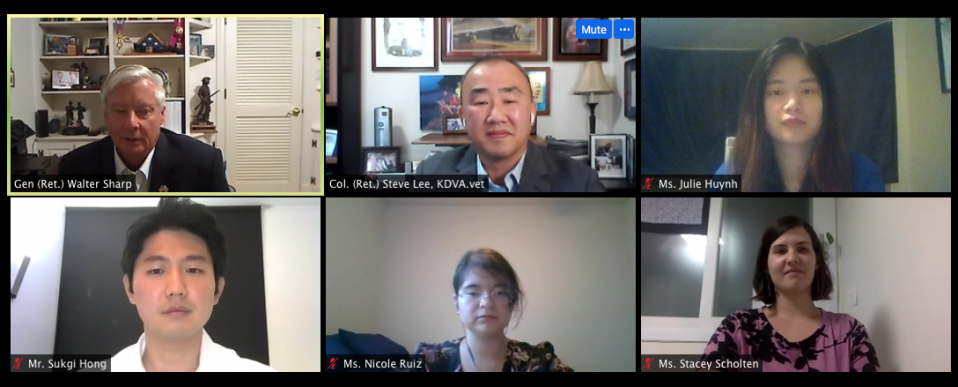
View recording on KDVA’s Digital Library page and YouTube channel.
On September 10, 2020, KDVA held a webinar about the KDVA Internship Program to give our members and supporters insights into the program and to answer questions from anyone interested in applying for the next internship group which will start on October 1, 2020.
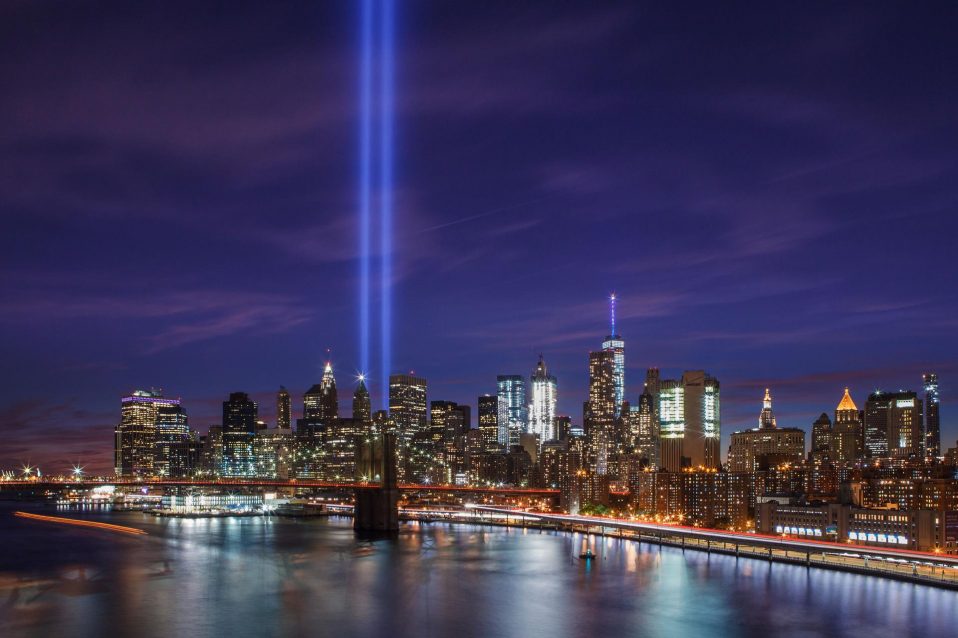
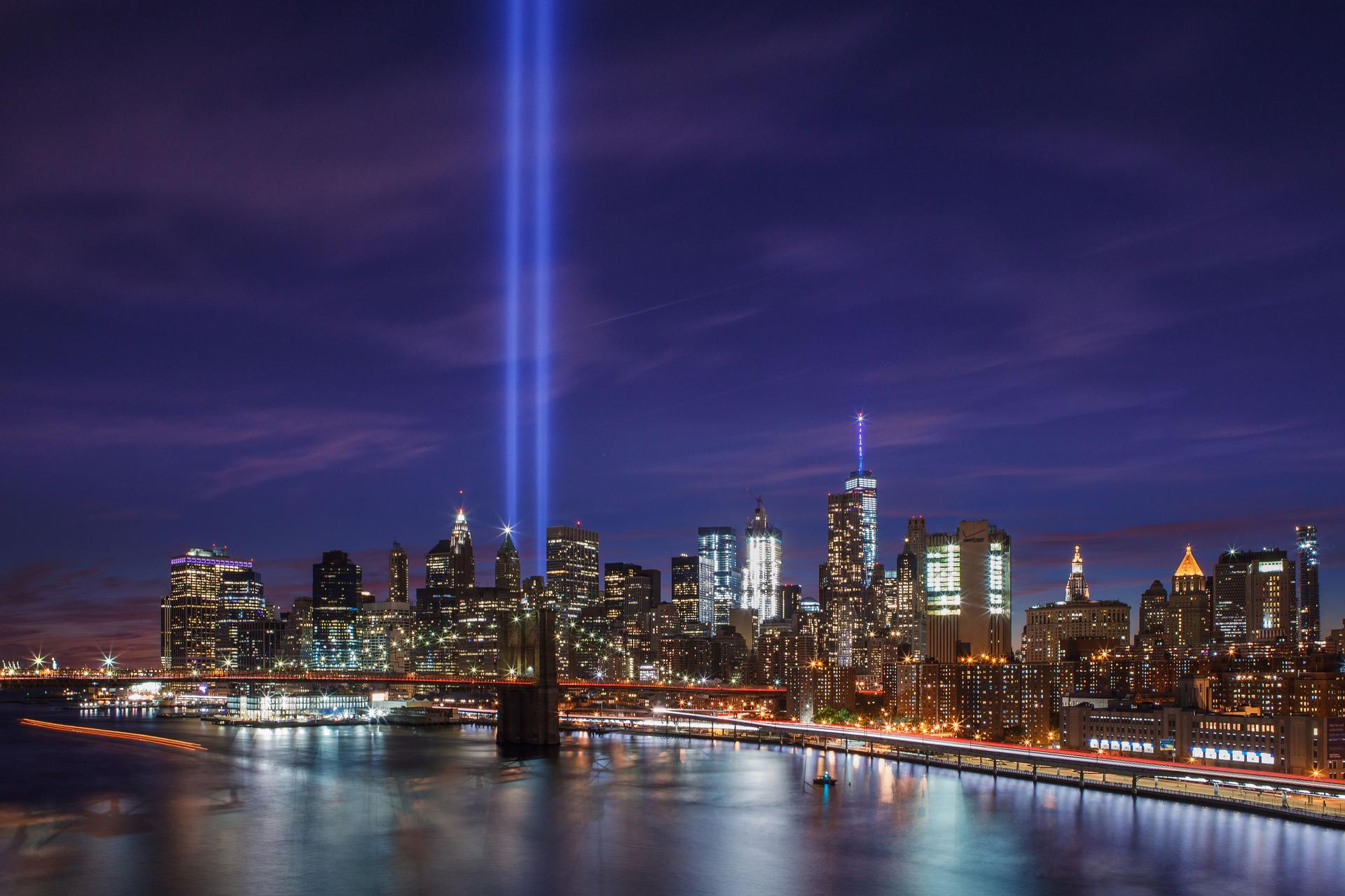
“Terrible Tuesday” on 9/11 started as a beautiful day for the east coast of the United States. But after three attacks within 77 minutes, the lives of all Americans changed. And U.S. Service Members have been in combat operations since.
Most of the world mourned with the United States and many pledged support as the U.S. embarked on the War on Terrorism. South Korea was one of the United States’ staunchest allies who supported with troops and resources. They have been with the United States in Iraq, Afghanistan, and the Persian Gulf. Their national support has been invaluable on many fronts in this long war.
As we remember everyone who fell in New York City, in the Pentagon, in Shanksville, Pennsylvania, and in all battlefields around the world, KDVA is very thankful for South Korea’s support. This support is sometimes overlooked because so much about the Korean Peninsula is overshadowed by North Korea’s threats. Defending against North Korea’s threats is the mission of the ROK-U.S. Alliance. KDVA will continue to support our Veterans and this irreplaceable Alliance to keep it the strongest and best in the world.
Thank you sincerely for all you do “Together for the ROK-U.S. Alliance.”

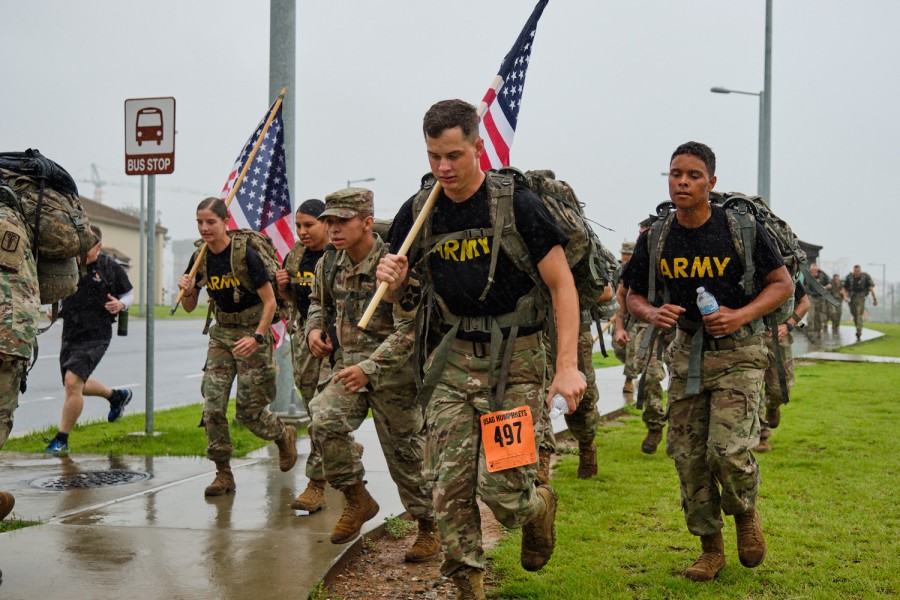 Soldiers from across South Korea participate in the 9/11 Memorial Ruck March at Camp Humphreys, South Korea, Wednesday, Sept. 11, 2019. MATTHEW KEELER/STARS AND STRIPES
|
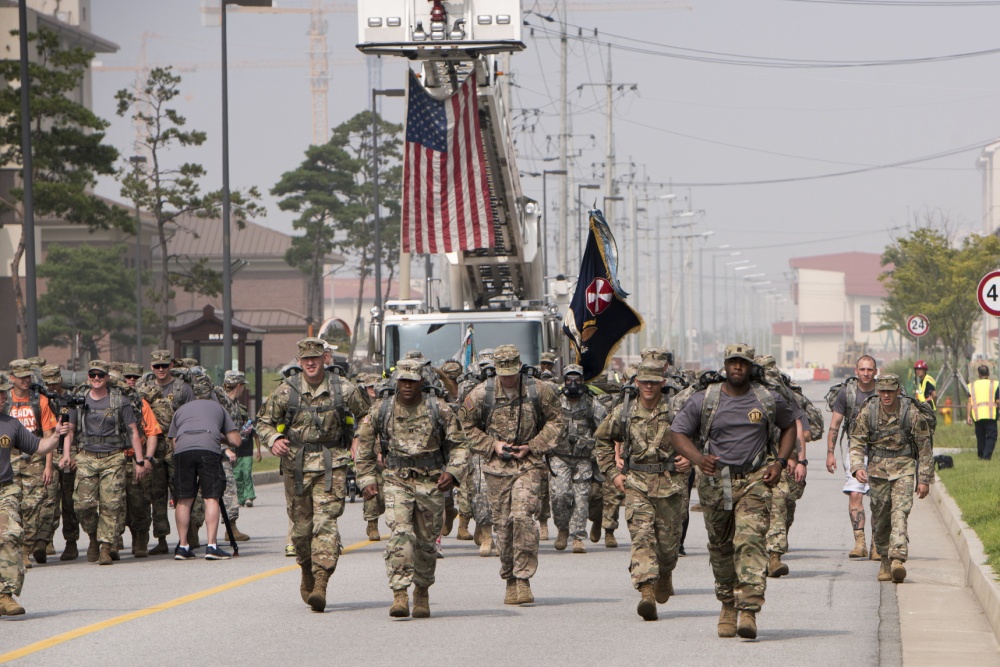 CAMP HUMPHREYS, Republic of Korea: Soldiers and civilians took part in the 9/11 Memorial Ruck March in remembrance of those that lost their lives on September 11, 2001 and those who have gave their lives for freedom since. Photo by Sgt. Patrick Eakin 09.09.2017 |


Download English Version: KDVA Newsletter Issue 20-6 Sept. 2020
KDVA’s Mission:
The Korea Defense Veterans Association’s mission is to enhance the ROK-U.S. Alliance by advocating for the Alliance and supporting the people who built and serve the Alliance.
Why Become a KDVA Intern?
The KDVA Internship Program provides volunteers opportunities to learn about the ROK-U.S. Alliance and its diverse topics, gain invaluable professional experience, develop skills, make professional contacts, and make contributions to the ROK-U.S. Alliance.
Research Assistant Internship:
Event Management and Support Internship:
Eligibility:
Experiences and Skills:
Internship Length:
Academic Credit?
Academic credit will depend on your school’s requirements.
—–
Questions? Email: kdva.internships@gmail.com.
Please submit your application and resume by September 18, 2020. We plan to announce the KDVA Internship Team on September 25, 2020.
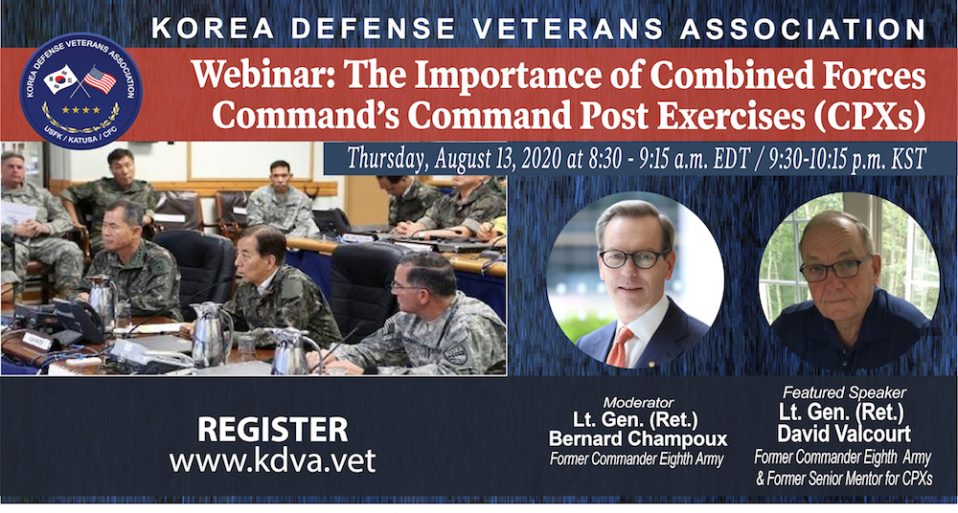
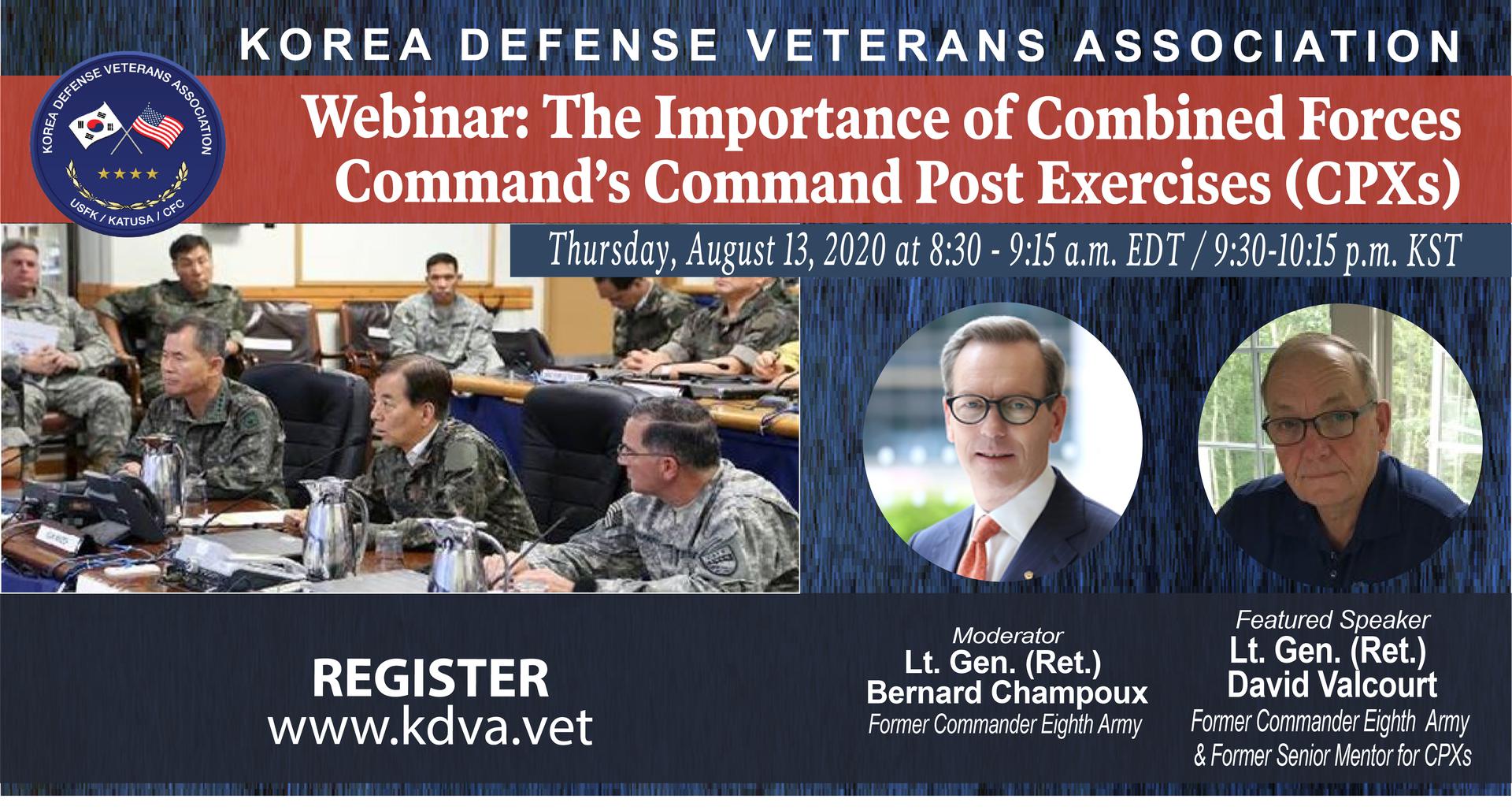
KDVA Webinar: The Importance of Combined Forces Command’s Command Post Exercises (CPXs) Webinar
On August 13, 2020 KDVA hosted a webinar on the Importance of Combined Forces Command’s Command Post Exercises (CPXs). LTG (Ret.) David Valcourt, former Commander Eighth Army & former senior mentor for CPXs discussed a very unique perspective on why these exercises matter in building the CFC warfighting team, growing a stronger Alliance, and maintaining an important deterrence against North Korea.


By Lieutenant Colonel James F. Durand, U.S. Marine Corps (Ret.)
Major General Shin meets with General Lemuel Shepherd, Commandant of the U.S. Marine Corps, in his December 1952 visit to U.S. Marine Corps bases.
At 06:10 on September 27, 1950, Republic of Korea (ROK) Marines raised the flag in front of the Seoul Capitol. Three months earlier, the ROK Marine Corps faced skepticism from the other services and doubt within its own ranks. Created without American advisors or equipment, the nascent ROK Marine Corps was a product of the determined efforts of its founder and first Commandant, Colonel Shin, Hyun-joon. The Marines’ superb performance in the early battles of the Korean War is a testament to his leadership.
In the wake of the failed amphibious assault at Yosu, Rear Admiral Son, Won-il tasked Shin with forming a ground combat unit within the ROK Navy. Shin had participated in the October 1948 military in which four navy cutters attempted to land ROK Army Soldiers to suppress the rebels who occupied the port city. After the operation, Shin submitted a combat report arguing for the creation of a specialized unit within the Navy responsible for amphibious operations. Admiral Son assigned Shin to lead the new unit on February 1, 1949.
Shin found few takers as he sought officers and noncommissioned officers for the new unit. Those with knowledge of the Imperial Japanese Navy knew ground combat units as backwater assignments relegated to garrison defense duties by war’s end. Kim, Seung-un rebuffed Shin’s first two requests to transfer to the unit before accepting an offer to serve as chief of staff. Navy commanders withheld sending their model sailors in response for a call for noncommissioned officers, instead sending “those who were brave with a strong sense of justice, but occasionally caused some trouble in their units.” Despite these challenges, Shin assembled 80 officers and noncommissioned officers to lead the new unit. Three hundred sailors from the Navy’s 13th Recruit Class began training as the 1st Marine Corps Class.
On April 15, 1949, the ROK Marine Corps was activated in a simple ceremony at the Deoksan Air Base in Chinhae. The Marines assembled before the dignitaries were a humble lot, wearing an assortment of discarded uniforms and helmets; Japanese leggings were worn over oversize American boots. Those issued weapons carried Arisaka Type-99 rifles; others carried wooden drill rifles.
A veteran of fighting in Manchuria, Colonel Shin was accustomed to material deficiencies. He demanded tough, physical training. Noncommissioned officers drilled the new Marines on Deoksan’s cement landing strip and marched them up the 1,800-foot Chonja Peak so often that the mountain quickly became a symbol of the new Corps.
In late August, the ROK Army Chief of Staff requested that Colonel Shin send Marines to Jinju to protect the town from guerillas who had operated in the nearby mountains since the Yosu rebellion. In exchange for dispatching a battalion-sized unit to Jinju, the Army agreed to leave its equipment to the Marines. Over the next four months, Marine patrols restored security to the region.
On December 28, Colonel Shin and 1,200 Marines landed at Jeju City where a protracted insurgency had shattered the peace of the tranquil island. The Marines were as aggressive in earning the trust of the people as they were ferreting out remaining guerillas, assisting farmers with spring planting, and arranging free medical care. Colonel Shin worked to establish the Corps’ ethos, establishing an NCO Training Unit to instill a fighting spirit in the new Marines. He pressed Navy Headquarters for more Marines and equipment.
Despite success in early operations, Navy Headquarters refused to expand the Corps. This led to a sense of despair among the Marines. On June 23, the Corps’ senior officers resigned en masse. Two days later, North Korean Army units attacked south to start the Korean War.
The Korean War transformed the Marine Corps. Resignations were withdrawn as the Marines prepared for war. Colonel Shin’s efforts to restore trust among the people of Jeju were reflected in over 3,000 islanders joining the Marine Corps; the 126 women who served would be the only women to earn the title “Marine” for nearly half a century. A battalion-sized unit landed at Kunsan on July 16. They fought the North Korean People’s Army’s 13th Regiment for four days, delaying the attack south. Marines under the command of Lieutenant Colonel Kim, Seung-un earned the war’s first unit-wide promotion for their actions at Chindong-ni, and received international acclaim as the “Ghost-Catching Marines” following their amphibious landing at Tongyoung.
On September 3, the U.S. Far East Command approved the attachment of the ROK Marine Corps — organized into three infantry battalions, a reconnaissance company, and a headquarters element — to the 1st Marine Division. Initially assigned as the landing force reserve, the ROK Marines were tasked with clearing Incheon and the Kimpo Peninsula following the Incheon landing. ROKMC battalions were attached to the 1st and 5th Marine Regiments as they began their final assault on Seoul.

President Syngman Rhee awards Major General Shin the Order of Military Merit, Taeguk, on October 15, 1953 in a change-of-command ceremony for the commandant.
Colonel Shin invited Major General O.P. Smith, Commanding General of the U.S. 1st Marine Division, to review the Korean Marines following the liberation of the capital. The battle-tested Marines who paraded before the division commander were a sharp contrast to those assembled 18 months earlier. All wore complete uniforms, packs, and web equipment; their rifles, machine guns, and mortars were “spotless.” Writing in his log, the veteran of fierce fighting on Cape Gloucester, Peleliu, and Okinawa noted, “These Korean Marines were quite remarkable.”
After leading the ROK Marines in the defense of Wonsan, Colonel Shin turned over command of the newly established 1st ROK Marine Regiment and focused on training and equipping the rapidly expanding Corps. As Commandant, General Shin forged a relationship with the United States Marine Corps and instituted training and education practices modeled on the American system. The relationship between the two Corps would continue throughout the Korean War and Armistice, including deployments to Vietnam and Iraq. General Shin served as commandant throughout the war, remained in uniform until 1961, and served two assignments as an ambassador. He holds the distinction of being South Korea’s longest serving general officer and longest serving ambassador.
About The Author:
Lieutenant Colonel Durand is a graduate of the 31st Marine Corps Course at the ROK Naval War College. He has worked with General Shin’s children to translate their father’s autobiography, “Memoirs of an Old Marine.” His article, General Shin Hyun-joon, “Father of the Marine Corps,” is available at http://icks.org/n/data/ijks/2017FW-6.pdf.
See this and other stories of our Veterans in KDVA’s “I Know a Korean War Veteran Campaign” webpage at https://kdva.vet/i-know-a-korean-war-veteran-campaign/.

By Fred Lash, from an interview with George V. Lampman
In June of 1950, Sergeant George V. Lampman, USMC was a member of the Marine Security Guard (MSG) Detachment at the newly established U.S. Embassy in Seoul, Korea. The detachment numbered 20 Marines in all.
George was at the U.S. Embassy when, on June 25, 1950, North Korean forces crossed the 38th Parallel and invaded South Korea.
Backtracking a bit, these 20 Marines who would eventually serve in the first MSG detachment at the U.S. Embassy in Seoul, Korea were selected from approximately 70 Marines, mostly veterans of World War II.
They reported to Henderson Hall in Arlington, Virginia on November 10, 1948 and were trained for several weeks by State Department security officers in Washington, DC, then taken to a local clothing store to be fitted for civilian clothes (suits, overcoats, hats, shirts, etc.).
George should know—he is the only living member of that 20-Marine MSG detachment. The reason they had to be outfitted with civilian attire is that they would not be able to wear Marine Corps uniforms where they would be going. They were also ordered not to tell anyone where they were to be assigned.
The 20 Marines arrived at the U.S. Embassy in Seoul on January 9, 1949. It is interesting to note that they arrived in Korea without uniforms, military identification cards, or dog tags. On November 10th of that same year, the detachment held its first Marine Corps Birthday Ball in Seoul, with more than 300 guests.
Next came routine security duties and time passed rather quickly—until Sunday, June 25, 1950, when at 8:45 a.m., the MSG learned that North Korean forces had crossed the 38th Parallel at approximately 4:00 a.m.
The following is an account by CWO George V. Lampman, USMC (Retired) of the actions and events that occurred on the 25th, 26th, and 27th of June 1950.
On Sunday, June 25th, I was the Embassy Security Officer and had the midnight to 8:00 a.m. watch. About 4:30 a.m., I started getting telephone calls from various people asking me what was going on in the north and what had I heard. Even newspaper reporters were asking the same questions and I just told them that I did not know anything. I and other two Marines who were on watch with me went back to our quarters. However, we were not there long when our “room boy” came into our room, woke us up, and told me that I was wanted on the phone right away. I went down to the phone and spoke with Paul Dupre who relieved me and said, “George, get all the guys, bring any weapons you have, and get down here right away. We are sending a Jeep to pick you up.” As we were driving down a main street and some aircraft were flying extremely low over us. Gus said, “Look at those damn P-51s and how close to us they are flying. It’s very dangerous.” We had recently heard that the first class of the Korean Air Force had graduated from flight school, and we thought these new pilots were just showing off. As we continued down the street, it became clear that these planes were not our P-51s but instead were Russian Yaks, flown by North Korean pilots. We found out later that the Yak has the same silhouette as American P-51s. The Yak started strafing us, and we had to do a lot of dodging and stopping quite often to get protection behind the stone pillars of government buildings.
Finally, we made it to the Embassy and our NCOIC (noncommissioned officer in charge) told us there were pre-prepared evacuation orders that we had never heard about. At that point, we learned that we were among the lead people in these evacuation orders. However, the orders were up-to-date and extremely precise, telling us exactly where to go, what to do, and when to do it.
After we received our instructions and knew what we had to do, we drove to all the quarters in the city occupied by embassy staff personnel, advising them of the evacuation plans. The evacuation went quite smoothly, considering the circumstances. The personnel were all driven in busses to the port of Incheon, southwest of Seoul where there was a fertilizer ship on which everyone boarded. The Seventh Fleet escorted this ship to Japan.
After they were all evacuated, we still had work to do. The Ambassador directed us to destroy all the communications equipment in the embassy. All we did was to go from floor to floor, grabbing all the telephones and throwing them out of windows. Now, it was Monday and we began wondering just how remaining personnel would be evacuated.
The embassy had inherited all the 24th Corps’ vehicles, and they were in our embassy motor pool. We took a couple of M-1 rifles, a couple cases of armor piercing ammunition, and destroyed perhaps two hundred jeeps and other vehicles. We devised a system to make this operation go more smoothly. One guy would open the hood and another guy would then fire two or three rounds into the flywheel. That way, the North Koreans would not be able to cannibalize them. We did all of that in about three to four hours.
We then continued to destroy classified and sensitive material. The Army Attaché’s office had tons of training manuals marked “Restricted,” and all that fell into the category of burning. There was so much burning of various documents that the furnaces became overloaded, and we needed to erect a burning bin in the parking area made from chain link fencing. With the use of lots of gasoline, we were able to get everything destroyed.
After that, I was given the task of getting the two code machines to the sidewalk in front of the embassy. We got everyone back to safety, hooked up the code machines to Jeep batteries, and then put an electrical charge into them. Within about 10 to 15 minutes, we had two football-size lumps of molten metal.
After finishing with the code machines, we drove to the airfield at Kimpo. There were very few transport aircraft available for the evacuation since General MacArthur was using them to bring in the 24th Division. Task Force Smith was at Osan, with a reinforced company of the 24th.
The last planes for evacuating embassy personnel and U.S. citizens had supposedly landed while we were still shaking the bushes to locate ambassadors of other countries who we could evacuate. We found most of them; however, there were so many people they overloaded the planes.
After what we were led to believe was the last plane had departed, four or five of us got ready to drive our Jeeps to anywhere south of Seoul. Just as we were departing Kimpo, someone let us know that there was to be one more plane coming in. It was a C-54 that was being flown to Suwon from Inosuke in Japan. When the pilot reached Suwon, he was informed that there were more people at Kimpo to evacuate, including several Marines, so he headed there. Meanwhile, while we waited for this plane to land, more people arrived and wanted to board the plane. The crew chief said the plane was grossly overloaded; however, everyone got aboard. I never knew how many people a C-54 was supposed to carry, but there were approximately 110 aboard.
As we were taxiing down the runway, I heard the pilot tell the crew chief, “I don’t know if I’ll be able to get this SOB off the ground, so we better open the doors and throw anything out that’s not nailed down.” The Marines assisted in tossing lots of stuff out the doors—life rafts, weapons, cargo boxes—and we were just barely able to lift off.
I was responsible for the Great Seal of the United States that was used at the embassy for passports. Because of International Law, the Great Seal of the U.S. was not to go into another country. My instructions from the embassy security officer were to throw the seal out the window of the aircraft after we were over the Straits of Tsushima. I got the crew chief to open the navigator’s window, and I threw it out of the plane.
We landed at Inosuke, Japan, where the Air Force wives had set up a nice reception for us with refreshments. A few days later, 19 of us (MSG detachment) were assigned to different posts at embassies throughout the Pacific area. Later, after we retook Seoul in September, six of us would be recalled to the U.S. Embassy in Seoul. We would be together again until the Chinese Communists invaded South Korea later that same year—but that’s a different story.
About The Author:
Fred Lash works with Military Historical Tours Inc. They are the finest, custom-designed tour program for Veterans, Family Members, Historians, Educators or Students. For 30 years they have followed the vision of providing opportunities to visit battlefields of past conflicts.
See this and other stories of our Veterans in KDVA’s “I Know a Korean War Veteran Campaign” webpage at https://kdva.vet/i-know-a-korean-war-veteran-campaign/.
The Korea Defense Veterans Association (KDVA) is a nonpolitical, nonprofit organization dedicated to enhancing the ROK-U.S. Alliance and supporting the people who built and serve the Alliance.
Join the Largest Korea Defense Veterans Network
KDVA’s mission is to enhance the Republic of Korea – United States Alliance by advocating for the Alliance and supporting the people who built and serve the Alliance.

JOIN THE MISSION
Membership is FREE for all ROK-U.S. supporters.