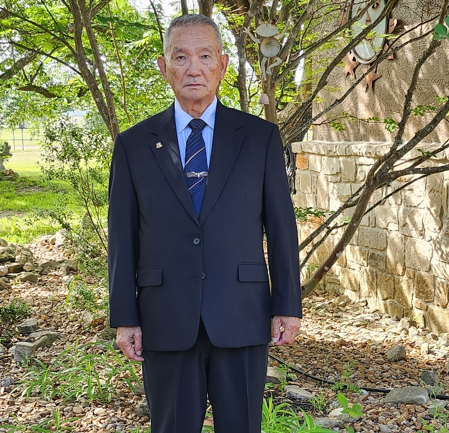
Eiji Teragouchi – From My Service in Korea, I learned…

From My Service in Korea, I learned…

Eiji Teragouchi

1965 – 1966

During my time stationed at Fort Carson, Colorado, in January 1965, I received orders to relocate to South Korea for a 13-month tour of duty. In February of the same year, I found myself enroute to Kempo Air Force Base, where I would begin my assignment. Upon arrival, we were directed to a military bus where we received our individual assignments for the next 13 months. I was assigned to the 5th CAV/1st CAV Division and 2nd Infantry Division mid 1965, near Paju, South Korea.

Leaving behind the cold of Colorado, I soon discovered that the winter chill near the DMZ was far more intense. As I acclimated to the cold temperatures, I also experienced the onset of the monsoon season. Despite these seasonal challenges, our duties often involved late-night searches for North Korean infiltrators crossing the frozen Imjin River, especially during the winter months. We, American soldiers and KATUSA (Korean Augmentation to the United State Army) conducted night foot patrols along the south side of the Imjin River’s dirt path, braving the elements.

During the warmer months, both American soldiers and KATUSA troops collaborated to construct concrete bunkers atop the mountains. It was during this time that I immersed myself in Korean culture, learning over 100 Korean words and the traditional song “ARIRANG” from my KATUSA counterparts.

One afternoon, while exploring a local village, I had the opportunity to observe elderly women making winter kimchi. With their permission, I sat and watched as they prepared the spicy dish, realizing that its heat came from the addition of copious amounts of crushed hot peppers. Throughout my time in South Korea, I forged many friendships with the local community.

Upon returning to the United States, I found myself working in Pittsburgh, Pennsylvania, where I had the pleasure of meeting a Korean gentleman who was a former two-time Korean Judo Champion, Mr. Kim. Our friendship blossomed as we shared stories and bonded over our shared experiences. It was during these gatherings that I would often use Korean words and join Mr. Kim in singing “ARIRANG.” Despite moving on to different projects, our friendship endured for over 50 years.

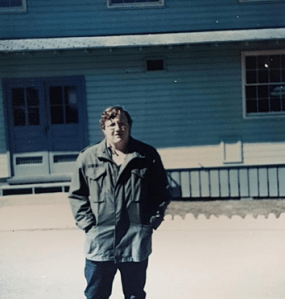
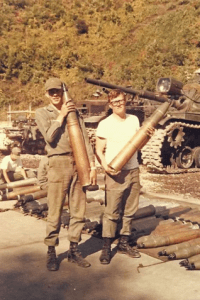
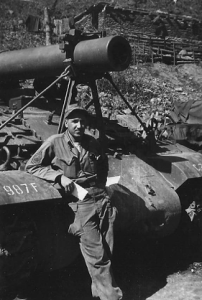
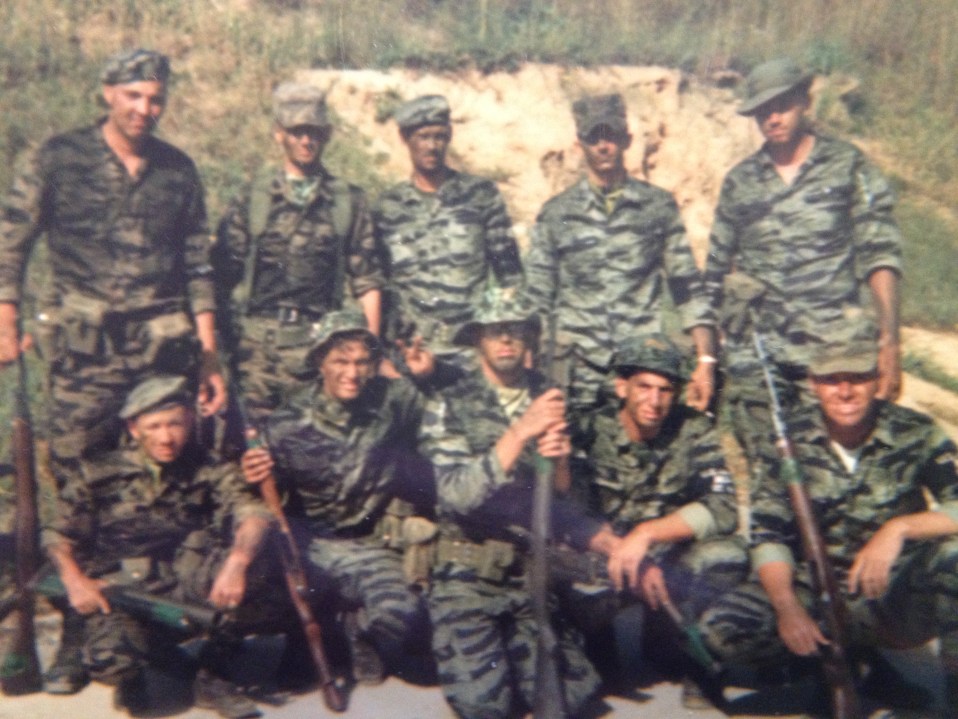
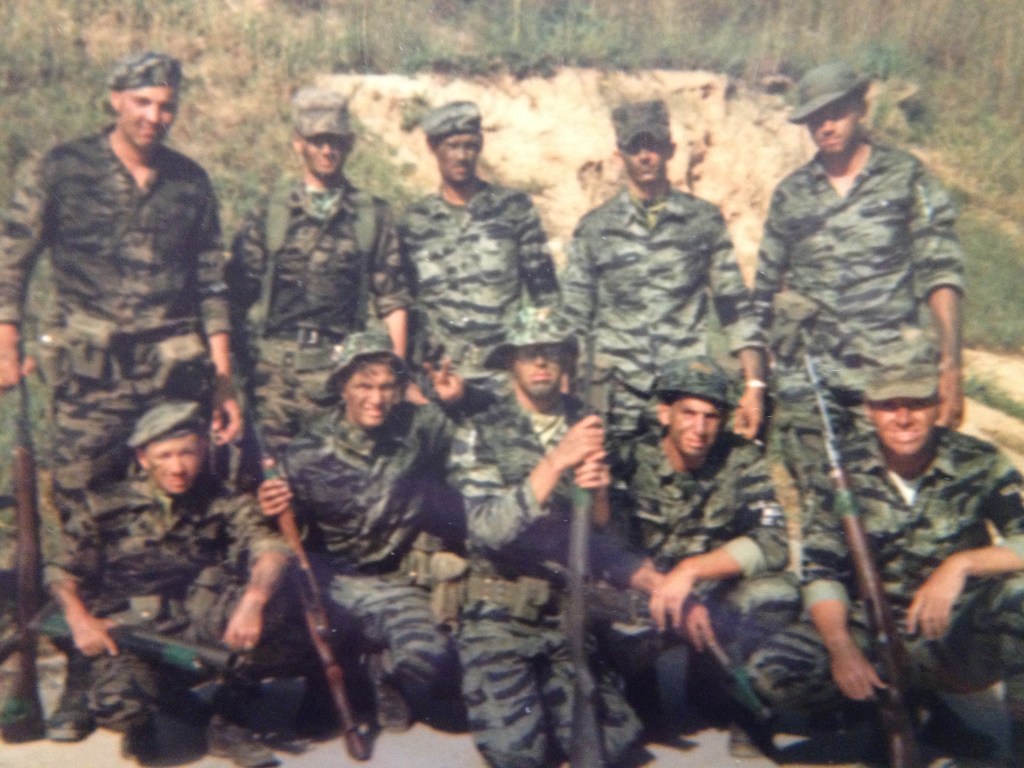
I have included pictures of me, Eiji – sp4, in the pictures with fellow soldiers, American and KATUSA.


What did you learn from serving in Korea? Let us know –

Sharing your experiences from serving in Korea can be a powerful way to connect with others who have had similar experiences. By sharing your story, you may be able to help others who are currently serving in Korea or who are preparing to do so. You can share insights about the culture, the people, and the challenges you faced while serving. Your story can also help to shed light on the sacrifices that service members and their families make in order to protect our freedoms. So, if you have a story to share, we encourage you to take the time to put it down in writing and send it to KDVA.MyServiceInKorea@gmail.com along with any photos that help to tell your story.


READ MORE STORIES HERE.

Read more

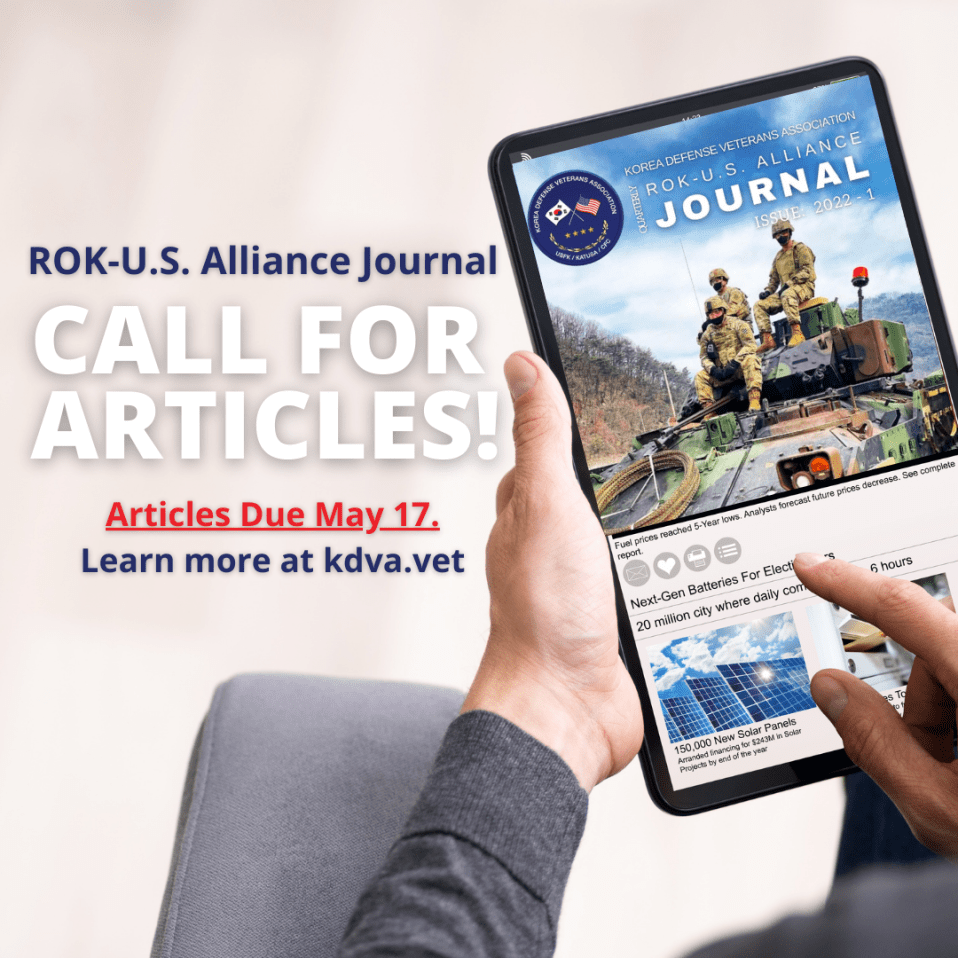
Call for Articles

KDVA’s 2024 2nd Quarter ROK-U.S. Alliance Journal articles are due
by May 17, 2024.

This quarter’s journal will be dedicated to Korean War Veterans and their Families. Please share your stories and articles with KDVA for this special edition! 

By sharing Korean War Veterans experiences and articles, we can honor their legacy and ensure that their contributions are remembered for generations to come.


The digital journal features stories and articles by KDVA members and supporters of the ROK-U.S. Alliance. It allows our members and supporters a way to voice their expertise and opinions that add to discussions about the Alliance.

The journal will go to our members, our partner organizations, potential sponsors, Alliance experts in the ROK and U.S. governments, and U.S. and ROK think tanks.

Submission Guidelines: 

  • Articles can be submitted in English and Korean.
  • Topic areas are: 
    • Korean War and Korea Defense Veterans
    • Security and Strategy
    • Korean and American Culture
    • Serving in Korea
    • ROK – U.S. Alliance
  • Articles should be less than 1,500 words, 1,000 words if submitting photos for your article.
  • If your article is longer, please indicate what parts you would like us to publish and provide a link or contact info where our readers can get the full article or story.
  • If providing photos, please provide photo captions and photo credits. Photos should be sent in separate attachments and be in jpg. or png. format. 

Please send any questions or articles to kdva.journal@gmail.com by May 17. If your articles are selected for publication, we will contact you for further steps.

Check out KDVA’s latest ROK – U.S. Alliance Journals – Click here.


Read more

Dave Nutter – From My Service in Korea, I learned…

From My Service in Korea, I learned…

Dave Nutter

1970’s & 1980’s

My Name is Dave Nutter, I retired from the Army in 1993 as a SFC with 20 years of service. I quit high school the summer before beginning my senior year and enlisted in the Army in September of 1973, one day after my 17th birthday. My father a Command Sergeant Major who had only been back from Vietnam a little over a year only asked if I was sure that was what I wanted to do. I arrived in Korea in April of 1974. I was assigned to C Company 1/72 armor and began as the driver on the platoon sergeants’ tank; going to the field for a month for gunnery/tank crew qualifications a few days after I reported in. When my high school class was graduating, my unit was on Chipori range firing tank table VIII.

17 is an interesting age, not quite a boy and not quite yet a man. During my 18 months in the 2d Infantry, I learned a lot about myself, structure, self-discipline, and teamwork. Many of those lessons, that took a while to take, and my experiences during my military service have served me quite well in life and the corporate world.

Quite honestly, the Army immediately post-Vietnam was quite a mess and the leadership had quite a challenge on their hands and 2d ID was no different except that we had General Emerson (Gunfighter) as the division commander. Who excelled in meeting those challenges. We spent an awful lot of time training, and I would guess that between us and 2/72 armor, we expended all the 105mm, 7.62mm and 50 cal ammo in the ammo dump at Tobong Son and kept the folks there quite busy with incoming shipments. The physical training was quite challenging as well, especially during the winter as PT was not canceled unless the temperature went below zero. For a period in the summer of 74 during the fuel shortage, we were also trained as infantry.

7 years later I was serving with the 38th ADA Bde on an isolated missile site applying those lessons. Much of military service is learning how to deal with sleep deprivation and that tour was no exception to the rule. In the last couple of months of that tour, my maintenance section was down to three people with a requirement to have 2 of us on the missile site 24/7. During the Cold War air defense units pulled their wartime missions. Hawk missile systems were in various stages of alert all over the world. Systems were up, and running, and manned 24/7, 365 days a year unless in a maintenance state. Maintaining that state of readiness is quite challenging for everyone in the unit from the clerks to the tactical control officers.

During both tours, I learned to love Korea and have said many times I would have been quite happy if I could have spent all my service there. Both times it was obvious that Korea was still recovering from the war. In 1981 progress was evident. I observed how resilient and resourceful the Korean people are. There is an old saying about slaughtering a pig and using everything but the oink. I am convinced they found ways to use the oink as well. Nothing went to waste that I saw. From the less fortunate souls we had out on our ranges trying to collect what metal they could from napalm casings to shrapnel and shell casings to the street merchants using discarded paper from the base as containers for the street food they sold. Things we should be doing in today’s throwaway world. All the people I met were exceptionally nice. There were many times when we traded our c-rations with the locals for Korean food. In 1981-1982 my friends and I made it a point to try and go off the beaten path where most Americans would not.

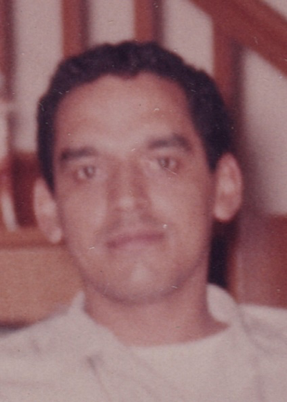
Interestingly many members of my family served in Korea. One of my father’s brothers was assigned to Korea in 1948. Dad spent almost the entire war in Korea arriving in the late summer of 1950, his unit was attached to the 2d ID and they were up north when the Chinese entered the war, he was with the units that had to run the gauntlet to get back south. His brother was a Marine WWII veteran who was in the reserves and was called up and arrived in Korea before my father, he was at the Chosin Reservoir, and I know that haunted him for the rest of his life. The picture below is of my father at age 22 just before the armistice.

When I was in Korea the 2d time, 81-82 my older stepbrother was assigned to 2d Aviation and stationed at Camp Casey, we did manage to spend one weekend together.

Having recently visited Korea in October, it is quite evident that the alliance between in U.S and Korea has revolved exponentially, growing stronger over the years. The changes I saw in Korea make me wish I could bring my father and his brothers to Seoul so they could see what they have been a part of.


What did you learn from serving in Korea? Let us know –

Sharing your experiences from serving in Korea can be a powerful way to connect with others who have had similar experiences. By sharing your story, you may be able to help others who are currently serving in Korea or who are preparing to do so. You can share insights about the culture, the people, and the challenges you faced while serving. Your story can also help to shed light on the sacrifices that service members and their families make in order to protect our freedoms. So, if you have a story to share, we encourage you to take the time to put it down in writing and send it to KDVA.MyServiceInKorea@gmail.com along with any photos that help to tell your story.


READ MORE STORIES HERE.

Read more

KDVA Announces AUSA Member Benefits For KDVA Members

The Korea Defense Veterans Association (KDVA) and Association of the United States Army (AUSA) are excited to announce a new partnership and free AUSA Digital Membership for ALL KDVA members!

With the opportunity to receive a free AUSA Digital Membership, KDVA members can now access more valuable resources, more networking opportunities, and more support from both organizations!

Together, KDVA and AUSA are dedicated to serving those who have served, providing a platform for veterans to thrive and continue their legacy of service in new and meaningful ways.


AUSA’S DIGITAL MEMBERSHIP INCLUDES:

  • A no-cost digital AUSA Membership.
  • Access to AUSA savings and discounts. Please see www.ausa.org/benefits for a list.
  • Education and professional development. Some of the educational products include:
    • ARMY Magazine (Digital)
    • AUSA Extra
    • Soldier Today Newsletter
    • Education discounts
  • Member access and pricing to professional development and networking opportunities, like:
    • AUSA’s Annual Meeting
    • Warfighter Summit
    • Global Force
    • AUSA Hot Topics
    • LANPAC
  • Access to digital products, like:
    • AUSA Noon Reports (Livestream)
    • Podcasts
    • Army 101
    • Profile of the United States Army
  • Employment assistance through AUSA Jobs Central.
  • Additional AUSA benefits include:
    • Access to more than $340,000 in scholarships.
    • Comprehensive free SAT and ACT Test Prep Materials.
    • Free legal document service to create wills, trusts, powers of attorney and much more.

BEGIN USING YOUR SAVINGS AND FREE BENEFITS RIGHT NOW AT www.ausa.org/savings.

All KDVA members will be AUTOMATICALLY enrolled into AUSA’s free Digital Membership, and will receive more information from AUSA in May.

If you are already an AUSA member this will not affect your current membership. If you have questions about AUSA membership, please contact membersupport@ausa.org.

OPT-OUT OF AUSA’S FREE DIGITAL MEMBERSHIP – If you prefer not to utilize these amazing free benefits, KDVA Members can choose to opt-out of AUSA Digital Membership by completing the Opt-out form provided below before April 17, 2024. OPT-OUT->


WHO IS THE ASSOCIATION OF THE UNITED STATES ARMY?

The Association of the United States Army is a nonprofit educational and professional development association serving America’s Army and supporters of a strong national defense. AUSA provides a voice for the Army, supports the Soldier, and honors those who have served in order to advance the security of the nation. Website ->

Read more

KDVA Introduces the 1st KDVA Campus Club

KDVA Introduces the 1st KDVA Campus Club

April 3, 2024

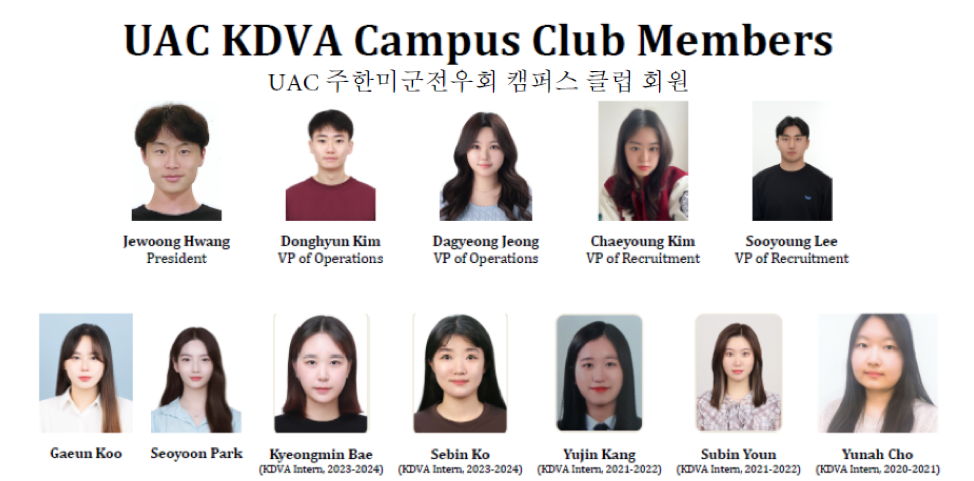
The Korea Defense Veterans Association (KDVA) is very excited to announce the 1st KDVA Campus Club at the University of Utah, University Asia Campus (UAC), located in Incheon, South Korea.  The KDVA Campus Club is led by Club President Jewoong Hwang with support from Mr. Sunghee Kim, Assistant Professor, School of Accounting, and Mr. James Park, Director of External Relations and Alumni Affairs.  The Club members include several former and current KDVA Interns.

The UAC KDVA Campus Club is excited to bring together students with common interests to increase awareness and advocacy of the ROK-U.S. Alliance and our Veterans. With the support of KDVA, they will host Meet and Greets, Webinars, Conferences, Korean Cultural Experiences, and more.

Mr. Sunghee Kim, one of the Club Advisors said, “I am very excited that the very first KDVA Campus Club has been established at the University of Utah Asia Campus (UAC), empowering the Club to have a global setting from the beginning. The University of Utah provides students with the opportunity to become global leaders by studying in multiple nations, including South Korea. The KDVA Campus Club established at the University of Utah Asia Campus plans to extend its operations to the main campus in Salt Lake City.”

Club Advisors

Sunghee Kim

James Park

The UAC will hold its KCC Launch Meet & Greet in April.  Whether you are a KDVA member or not, you are invited – for free!  So, please look for an announcement soon.

KDVA Campus Clubs are our “Boots on the Ground” on college campuses in the United States and Korea.  KCCs support KDVA’s mission of enhancing and supporting the ROK-U.S. Alliance and our Veterans on college campuses. Anyone can start a KCC and run the Campus Club as its President.  KDVA HQ provides all the funds, social media support, and senior Alliance leaders to participate in events in person or by Zoom.  You just need to register the KCC at your school and come up with ideas for activities and events.

If you’re interested in learning more about starting a KDVA Campus Club at your school, please contact KDVA Campus Club Coordinator Ambrie Jones at ambrie.kdva@gmail.com.  And join KDVA for free, yes for free, at kdva.vet/join-kdva.

PDF Announcemount: KDVA CC Announcement_20240402_Dual Language

Read more

Robert Jenkins – From My Service in Korea, I learned…

From My Service in Korea, I learned…

Robert E. Jenkins

March 1953 – December 1956

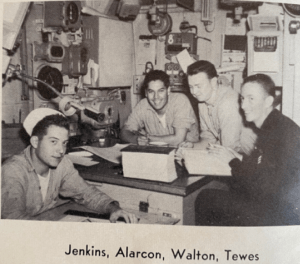
My name is Robert E. Jenkins.  I served in the U.S. Navy in the Korean War from March 1953 till December 1956.  I was in the waters around Korea on two different ships (USS Fechteler DDR870 and USS Isherwood DD520).  I was a radarman 3rd class.   It was the job of the radar crew to keep track of all the boats and planes in the area and to protect the aircraft carriers.  I learned a lot of responsibility and how to meet challenges.

I never set foot on the ground until this Revisit Korea program. So what an honor and opportunity for me to visit South Korea, especially since I have a grandson that lives in Seoul and teaches English.   I learned how much the Korean people honor our service to their country.  There were young people and their parents that wanted to shake my hand.  I was very impressed with how clean, beautiful and modern the country of South Korea is today. This trip was a dream of a lifetime and something I will always cherish.  I was treated with such honor.


What did you learn from serving in Korea? Let us know –

Sharing your experiences from serving in Korea can be a powerful way to connect with others who have had similar experiences. By sharing your story, you may be able to help others who are currently serving in Korea or who are preparing to do so. You can share insights about the culture, the people, and the challenges you faced while serving. Your story can also help to shed light on the sacrifices that service members and their families make in order to protect our freedoms. So, if you have a story to share, we encourage you to take the time to put it down in writing and send it to KDVA.MyServiceInKorea@gmail.com along with any photos that help to tell your story.


READ MORE STORIES HERE.

Read more

MacArthur Memorial and KDVA Partner on Korean Translation Project

PRESS RELEASE

For immediate release

March 28, 2024

Contact: Amanda Williams  amanda.williams@norfolk.gov   


MacArthur Memorial and KDVA Partner on Korean Translation Project

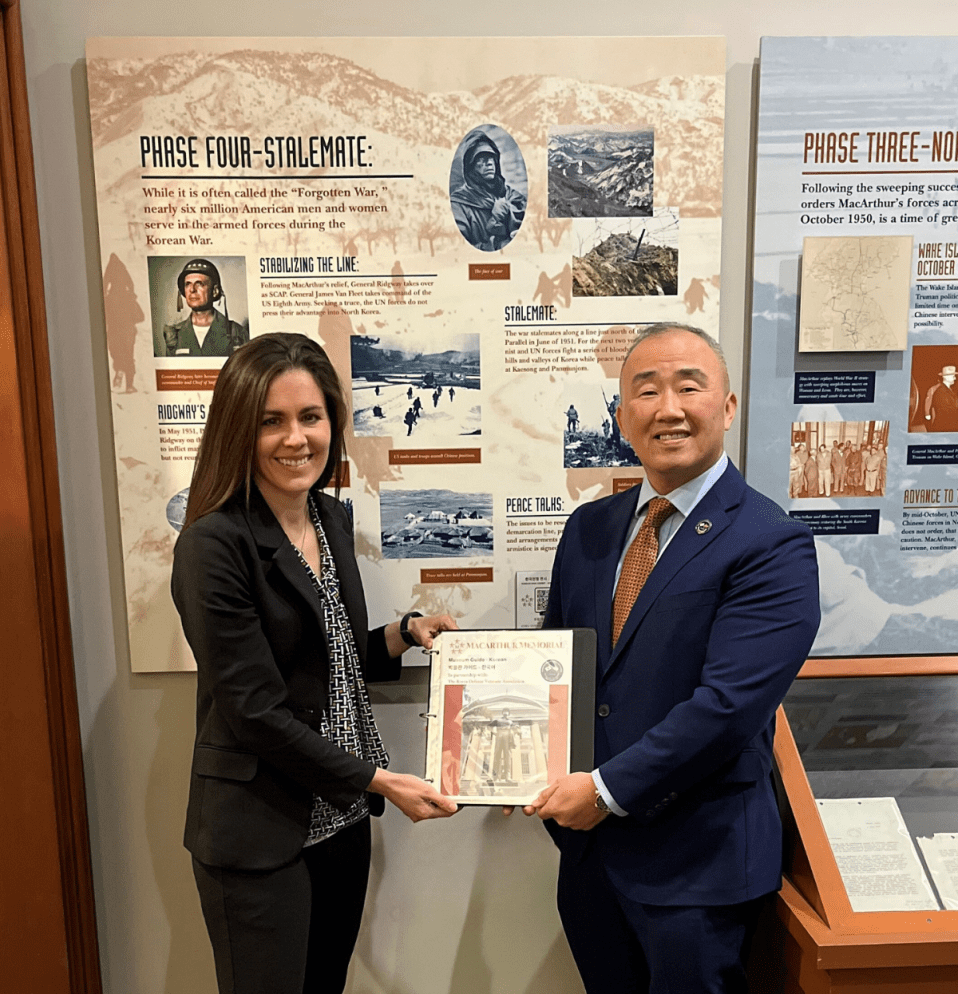
NORFOLK, Va – The MacArthur Memorial and the Korea Defense Veterans Association (KDVA) are proud to partner to provide Korean language translation for the MacArthur Memorial’s permanent Korean War exhibit. This project increases accessibility for Korean visitors and is also available virtually for those unable to travel to the MacArthur Memorial.

Museum visitors can scan a QR code in the Korean War exhibit to access Korean translations of the exhibit panels and captions. Virtual visitors can view this gallery guide on the MacArthur Memorial’s website at https://www.macarthurmemorial.org/592/Gallery-Guides. The MacArthur Memorial is committed to the preservation and presentation of Korean War history and is grateful for KDVA’s partnership on this project.

KDVA is honored to fund and provide Korean translation of the MacArthur Memorial’s Korean War Gallery so that Korean speakers can understand the role that General Douglas MacArthur, as United Nations Commander, played in defending South Korea from North Korea’s invasion in 1950.

This is the start of “KDVA’s Museum and Memorial Korean Translation Project” that provides Korean translation to memorials and museums with galleries and displays about Korea Veterans. The webapp for this project is on the KDVA webpage at www.kdva.vet/kdva-museum-translation-project/.

About The MacArthur Memorial: The MacArthur Memorial was founded in 1964 as a museum and library dedicated to the life and times of General of the Army Douglas MacArthur. The Memorial also honors and tells the stories of the millions of men and women who served with General MacArthur in World War I, World War II, and the Korean War. Today the Memorial is an internationally recognized center for the study of military history, leadership, and diplomacy. The City of Norfolk operates the Memorial in close partnership with the nonprofit General Douglas MacArthur Foundation. The museum serves 100,000+ people annually and is open free of charge. For more information, please visit www.macarthurmemorial.org.

Korea Defense Veterans Association (KDVA): The Korea Defense Veterans Association is a U.S. nonprofit organization that enhances the ROK-U.S. Alliance and supports the people who built this great Alliance with multi-generational programs including the annual Korea Revisit Program, annual General Paik Sun-yup Webinar, KDVA Internship Program, and educational conferences and webinars.  Since its founding in 2017, KDVA has grown to over 13,000 members (and over 86,000 social media followers) with local chapters in South Korea, Hawaii, and Georgia as well as 22 virtual Common Interest Groups.  KDVA is thankful for its 32 partners in four countries (on four continents) who meet quarterly in the KDVA Networking Forum to support Korea programs and activities. KDVA membership and events are free, so please join us at www.kdva.vet.

PRESS RELEASE MM KDVA ->

MORE MEMORIAL AND MUSEUM TRANSLATIONS ->

Amanda Williams, MacArthur Memorial Director (left), and Steve Lee, Senior Vice President of Operations, KDVA (right) at the MacArthur Memorial.

Read more

Bill Castro – From My Service in Korea, I learned…

From My Service in Korea, I learned…

Bill Castro

From my service in Korea, I quickly learned how to become a man of Men. Let me explain, I was 18 years old when I volunteered for service in the Far East Command, the government’s fancy name for service in the “Korean Police Action”. After 16 weeks of Basic Combat Training at Schofield Barracks Hawaii, graduating “Bravo 940” “Cum Laude”, I found myself landing at Haneda Airport, Tokyo, Japan where we were bussed to Camp Drake, the Main Replacement Depot for all assignments in the “Far East Command” and after a few days of loading us with Pile Jackets, Snow Boots, Winter Sleeping Bags and Oh yeah, Rifles with no Ammo, we were loaded unto a train to Sasebo, the southernmost Japan port and gateway to Pusan, Korea. The date was around the first week of January 1951.

After landing in Pusan, we were immediately, again, boarded onto Train Cars and sat all day without moving because, we were told, that the route we were supposed to travel on was in repairs after an attack on the train traveling before us. We all were disturbed the biggest part of the night with a Train that arrived late into the night and unloaded what seemed to us as bags of trash since they were throwing it from the top of train cars onto the platforms below. The next morning as we were heading out to breakfast with our mess kits and canteen cups, we saw that the contents in the bags were not trash but human bodies they were just unloaded and left there on the platforms and most were well on the way to decay where the stench was unbearable. We all turned around and headed to the other end of the train, most declaring, “So much for breakfast”. 3-4 days later we were in Suwan and the 3rd Infantry Division Replacement Center where we were further assigned and I went to Co. C, 1st Bn., 15th Regiment. My platoon, like the others, was extremely short-manned since they had just regrouped from being over-run and in re-treat (ops, I mean withdrawn) from the Chosin Reservoir in the North.

I was assigned as assistant B.A.R. man and carried the ammo for the B.A.R. Man. We were on a hill and the next day marched over heavy snow hills and lowland rice patties for 3 or 4 days with only the food we carried which ran out after 3 days. We had no contact that I could see with other allied units.

March 1951 with a B.A.R.

On the very early morning of the 4th day around 2 am, we were attacked and after 15 to 20 minutes under constant rifle and machine gun fire the B.A.R. man jumped out of the foxhole and left saying, we’re down here alone and can’t hold, let’s go up to the next higher position. I got so excited that when trying to put my rifle on lock, I accidentally removed the trigger housing and my rifle fell in two parts on the snow. I shouted to my partner to wait but he just kept moving on. By the time I finally dug up the two parts of the Rifle and trigger housing and put them all together the Enemy was all around my position firing all around so wildly that one of them fell into my hole with me, looked at me with a Burp gun in hand and jumped out yelling in Chinese, what, I don’t know. After that little incident, I got my wit together and stayed in the hole just firing all around, sometimes at shadows, sometimes at their white uniforms shown clearly with the help of a lighted flare from time to time. Daylight came all of a sudden, I was all alone with what seemed like dead bodies all over the place. My platoon Leader came up to me and said, “How come you didn’t follow your Gunner’s orders and moved your position” and I replied, “I thought we were supposed to remain and cover from this position you assigned us, Sir.”  He smiled and said, “Yes, you’re right.. and by the way, pick up the B.A.R. from my CP (CommandPost), you are now the B.A.R. Man for 2nd Squad. Two or three days later on, the offense attacked a hill around Uijeongbu I was bringing up the left rear of the point when Johnson, a young new replacement fresh from the States, started retreating on his own and upon passing me dropped and left the rifle. I picked it up and ordered my assistant, also fresh from the States but he followed orders to cover Johnson’s position. About a couple of hours or so later reaching the top of the hill and seeing our enemy now on the retreat I saw Johnson approaching my position and I handed him his rifle, which I was carrying along with my heavier B.A.R. The Squad Leader looked back at us and asked, “What happened?” and Johnson replied, “Well I was scared and was going back to the vehicles down the road when this guy yelled at me, “Hey you there, get your ass back up that hill to your outfit or so help me I’ll shoot you myself.”  The Man was not young or wearing a helmet instead he had this pile hat with Stars all around it and he looked like a huge giant. He scared me even more so I turned and hurried back.”

The next morning after successfully defending our position from a counterattack, at breakfast the squad Leader says, “Castro you now Assistant Squad Leader so give your BAR stuff to Johnson”….. Johnson became a pretty good B.A.R. Man, and wondered who that giant man was with the star-studded pile cap?

Several days later going through a village I heard the men shouting our Leader got hit and fell into this crater. I ordered Johnson to cover the rear field of fire I had and hurried up front to our fallen Leader, and he lays there, right arm slit open bone showing and bleeding profusely. I immediately applied a tourniquet and held it until the medics arrived. Our Platoon Lt. also arrived and told me, “You’re Squad Leader now, so get your men in order and stand by.” I always never get asked, just told and in less than 45 days in Combat, I am a Squad Leader, no longer a boy I am now responsible for the lives and actions of 9 men and our achieving success in all our combat missions. That my friend is the Mark of a Man. 1951-1952.
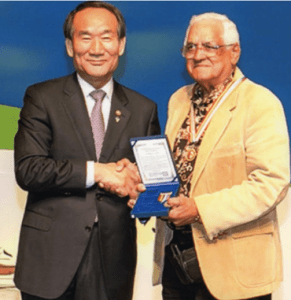
The Secretary of Veterans Affairs for South Korea

Then Gov. of Hawaii.


What did you learn from serving in Korea? Let us know –

Sharing your experiences from serving in Korea can be a powerful way to connect with others who have had similar experiences. By sharing your story, you may be able to help others who are currently serving in Korea or who are preparing to do so. You can share insights about the culture, the people, and the challenges you faced while serving. Your story can also help to shed light on the sacrifices that service members and their families make in order to protect our freedoms. So, if you have a story to share, we encourage you to take the time to put it down in writing and send it to KDVA.MyServiceInKorea@gmail.com along with any photos that help to tell your story.


READ MORE STORIES HERE.

Read more

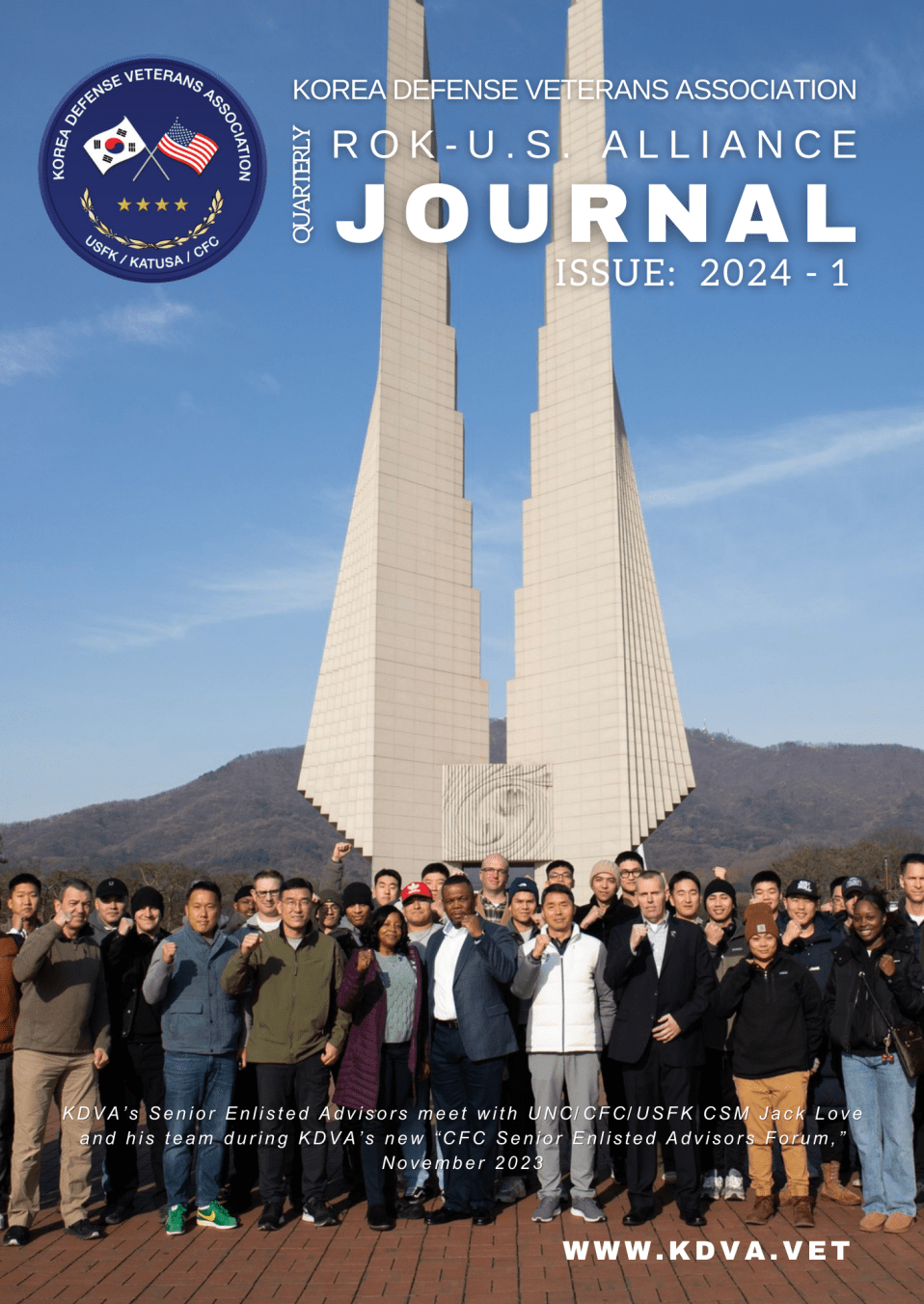
KDVA ROK-U.S. Alliance Journal 2024-1

2024 1st Quarter Edition

Featuring stories and articles by KDVA members and supporters of the ROK-U.S. Alliance.

In this collection, readers will gain insights into the rich history and enduring partnership between the Republic of Korea and the United States. Through the captivating narratives shared by KDVA members and supporters of the ROK-U.S. Alliance, readers will have the opportunity to explore the multifaceted aspects of this important relationship. From personal accounts to in-depth analyses, this compilation offers a diverse range of perspectives that highlight the significance of collaboration and friendship between these two nations. Get ready to be inspired and informed as you delve into the stories and articles that celebrate the strong bond that unites the ROK and the U.S.

Download: KDVA Journal 24-1 (English)

Download: KDVA Journal 24-1 (Korean)

Read more

Daniel McPharlin – From My Service in Korea, I learned…

From My Service in Korea, I learned…

Daniel McPharlin

7th Infantry Division, 1st Battalion 31st Regiment HHC Recon platoon

As an infantryman serving with the 7th Infantry Division in the summer of 1968 up on the DMZ, I saw and experienced the aggression towards South Korea by North Korean soldiers.

On one of our stakeouts inside the DMZ to intercept North Koreans heading south of the Military Demarcation Line a firefight started. We killed two of them feeling for our trip flares and Claymore mine wires. The other North Koreans fired at us but we were not hit. We detonated a Claymore mine and threw grenades at them and near dawn they withdrew from us.

On October 5th that night a call came over the radio that a squad inside the DMZ had been hit and they requested extraction of their wounded. The first vehicle to go through the barrier fence gate was an Armored Personnel carrier followed by a machine gun jeep. Next was an Army field ambulance then a machine gun jeep. The APC bulldozed into the woods and brought the wounded man out to the road. Two medics carried the stretcher to the ambulance. I was the driver of the rear jeep and could see they performed CPR on him before closing the ambulance doors. All three vehicles raced back to camp two miles away. Sp4 Stephen Nassani died from a North Korean grenade explosion that night.

In the winter we got ordered to go to the barrier fence where a North Korean infiltrator was killed. He was lying in a small trailer and on his face was a grimace of pain frozen in death. Rifle fire blew out his shoulder blade and knee cap. When a squad went to get him, he took his grenade and blew his chest out. They would not be taken alive if possible. Our South Korean KATUSA soldiers remarked his family must be wealthy because he was wearing thermal insulated under garments. Most other infiltrators were found with straw under their clothes to try keeping warm.


What did you learn from serving in Korea? Let us know –

Sharing your experiences from serving in Korea can be a powerful way to connect with others who have had similar experiences. By sharing your story, you may be able to help others who are currently serving in Korea or who are preparing to do so. You can share insights about the culture, the people, and the challenges you faced while serving. Your story can also help to shed light on the sacrifices that service members and their families make in order to protect our freedoms. So, if you have a story to share, we encourage you to take the time to put it down in writing and send it to KDVA.MyServiceInKorea@gmail.com along with any photos that help to tell your story.


READ MORE STORIES HERE.

Read more