From My Service in Korea

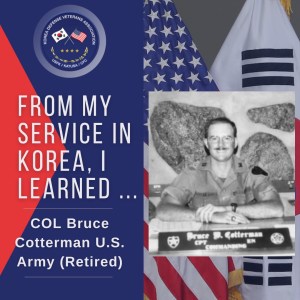
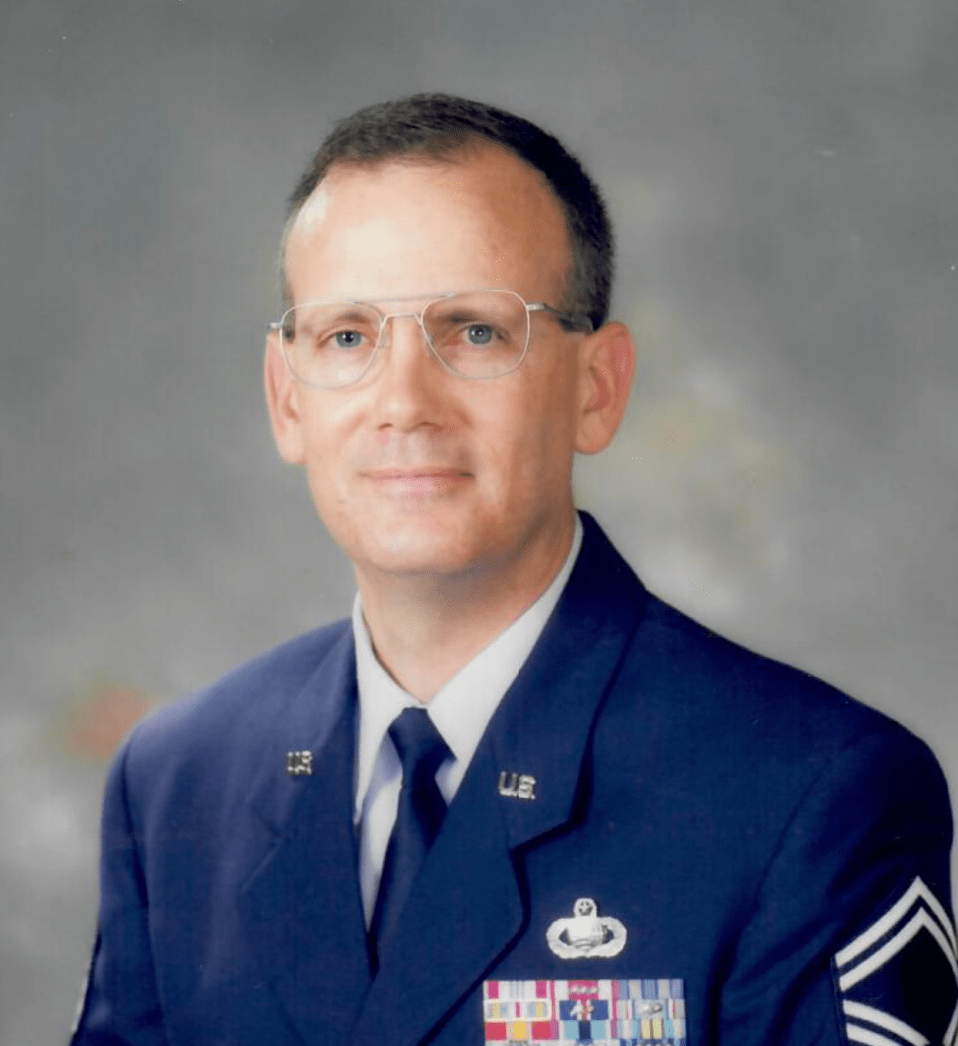
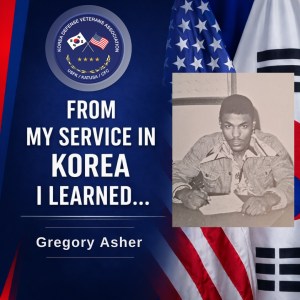
From My Service in Korea, I Learned – Joel Reynoso

All in all, my experience underscored the significance of our mission in South Korea: upholding a strong alliance to maintain regional security, deter aggression from North Korea, and encourage economic and industrial cooperation. My participation in joint military exercises served not only to enhance operational capabilities but also to strengthen diplomatic relations and promote mutual prosperity and robust supply chain resilience.

In October of 1975, I levied out of the 9th Infantry Division from Fort Lewis, Washington, to the Republic of South Korea, arriving at Osan Air Force Base, then finding myself en route to the 2nd Infantry Division via Camp Casey’s Replacement Center known as the Turtle Farm. Once there, assigned to Charlie Company, 1st Battalion (Mechanized), 17th Infantry at Camp Howze. The unit had been operating up on the 38th Parallel, the DMZ, the world’s most dangerous border.

Serving as an infantryman, my initial post was Guard Post Ouellette, providing a close vantage point—approximately 300 yards—from Communist North Korea. Our rotational living arrangements included underground bunkers fortified with sandbags above ground, interconnected by trenches and multiple firing positions. These structures offered both shelter and rapid movement routes within the perimeter, which was comprehensively secured by Claymore mines placed for complete coverage.

The outpost was located mere yards from the boundary dividing North and South Korea. Our platoon, consisting of 45 soldiers, remained highly aware of the immediate threat posed by pre-plotted artillery positions on both sides—enemy and friendly forces alike.

I rapidly familiarized myself with my duties, which primarily involved generating SALUTE reports regarding North Korean activities for intelligence purposes. Night guard duty was challenging, often requiring solitary vigilance in a bunker exposed to severe winds and sub-zero temperatures, with only sandbags for shelter and ammunition cans at my feet as I responded to any anomalies from the wood line.

At 20 years old and holding the rank of E-4 Corporal, I was regularly tasked with early morning responsibilities. This typically involved selecting two junior enlisted personnel to assist me in clearing the only access road into our outpost before sunrise. This was done while the remainder of the platoon performed a Stand-To, each soldier manning fortified positions with weapons ready to provide suppressive fire if necessary.

Our short patrols inspected the mile-long entry route for tripwires or suspicious objects, enabling the safe delivery of daily hot meals from a chow hall south of the Imjin River. Following this, I would inspect the outpost perimeter for breaches in fencing and ensure that defensive Claymore mines were correctly oriented and undisturbed.

I learned the responsibilities that came with the job. I earned the position as a team leader, leading a small team, ensuring the welfare of soldiers, and maintaining accountability for all equipment—training for direct tactical movements, leading by example, providing that crucial link between soldiers and squad leaders, and handling administrative and logistical needs for the team.

In addition to my duties, in 1976, I attended the very first 2nd Infantry Division’s PNOC-CA Course at Camp Casey (Primary Non-Commissioned Officers Course – Combat Arms).

In 1976, in a graduation ceremony, I was promoted to the rank of E-5 Sergeant by Lt. General John H. Cushman, who commanded the I Corps (ROK/US) Group, a Korean-American field army formation defending the Western Sector of Korea’s DMZ.

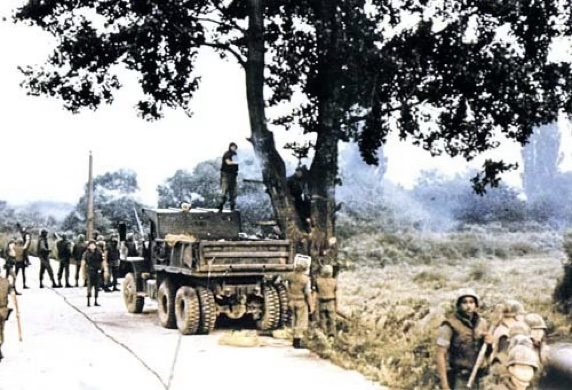
In 1976, I was present at Camp Casey during Operation Paul Bunyan.

I left the Army in 1977. With a break in service, I returned, serving with the 82nd Airborne Division from 1980–1983.

In 1985, I enlisted into the U.S. Air Force, retiring in 2012 as an E-9 Chief Master Sergeant.


What did you learn from serving in Korea? Let us know –

Sharing your experiences from serving in Korea can be a powerful way to connect with others who have had similar experiences. By sharing your story, you may be able to help others who are currently serving in Korea or who are preparing to do so. You can share insights about the culture, the people, and the challenges you faced while serving. Your story can also help to shed light on the sacrifices that service members and their families make in order to protect our freedoms. So, if you have a story to share, we encourage you to take the time to put it down in writing and send it to KDVA.MyServiceInKorea@gmail.com along with any photos that help to tell your story.

Your contribution may be just what someone needs to hear in order to feel connected and supported.
Read more

From My Service in Korea, I Learned – Lawrence Hooser

From My Service in Korea, I Learned – Lawrence Hooser

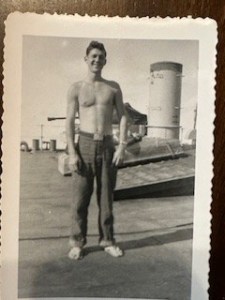
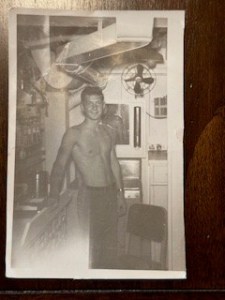
I was part of the amphibious force of the U.S. Navy during the early part of the war. I served on a Landing Ship Tank (LST) 840. I worked my way up as a medic on the ship. We were based in Sasebo, Japan, but docked at other ports in Japan. Our purpose in the amphibious operations was to reach & land on North Korean enemy locations & board North Korean and Chinese Communist POW’s. We were always at our battle stations. The POW’s were guarded by ROK soldiers and these soldiers were very strict and had a heavy hand with the POW’s. That was one of the events I learned in Korea. Another, was the fact that many of POW’s were father& son, perhaps more than one son, but definitely families realizing a subsistence. I will never forget witnessing the young teenagers. After loading up all the POW’s on topside and also the tank deck, we transported them to an island off the south coast of Korea. I believe it was called Komodo Island, but not sure of the spelling, but we had POW camps there. We actually were part of this operation for months and made dozens of trips. It was quite the operation.


What did you learn from serving in Korea? Let us know –

Sharing your experiences from serving in Korea can be a powerful way to connect with others who have had similar experiences. By sharing your story, you may be able to help others who are currently serving in Korea or who are preparing to do so. You can share insights about the culture, the people, and the challenges you faced while serving. Your story can also help to shed light on the sacrifices that service members and their families make in order to protect our freedoms. So, if you have a story to share, we encourage you to take the time to put it down in writing and send it to KDVA.MyServiceInKorea@gmail.com along with any photos that help to tell your story.

Your contribution may be just what someone needs to hear in order to feel connected and supported.

Read more

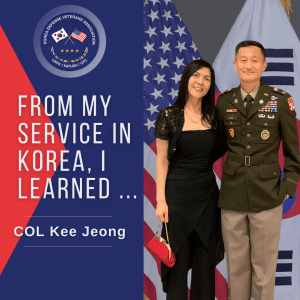
From My Service in Korea, I Learned – COL Kee Jeong

From My Service in Korea, I Learned – COL Kee Jeong

It doesn’t come up often, but I can still remember the few times my aunts (now in their 80s) spoke about the war. They would describe watching bridges collapse along the Han River as they fled south, away from the fighting. I imagine them then – young and probably clutching what little they could carry. Maybe it was food, maybe clothing, maybe something small that reminded them of a life that once was.

American soldiers often mentioned in those stories, not as abstractions but as real people. Their presence, their sacrifice, must have left a lasting mark. As I am preparing to leave Korea at the end of my tour, I find myself reflecting on their stories, and what they mean to me now.

The ROK & US Alliance is frequently described in diplomatic or strategic terms. We talk about it as a cornerstone of regional stability, or a bulwark against aggression. All of that is true. But there’s more, something human – a personal connection.

I sense that connection is deeper with Korean Americans that serve this great nation. We are both witness and participant in this Alliance. We carry the legacy of one homeland while serving the defense of another. We are, in a way, a living bridge – connecting a nation born from the fire of war with a nation defined by opportunity, hope, and freedom.

Korea is not the same as it was when I last served here over a decade ago. The region has changed too – some of it for the better, much of it more uncertain. Competition with China and Russia is intensifying. The gap with North Korea continues to grow. The strategic environment in Northeast Asia has become more complex, more volatile, more unpredictable.

Still, I believe the Alliance is up to the challenge. Not only because we’re ready, but we are more committed – we cover each other’s blind spots. That’s not to minimize the challenges ahead. The threats are real, and the stakes are certainly high.

As a career intelligence professional, I’ve spent much of my time looking at maps – analyzing, planning, preparing. And from a map’s perspective, the center offers flexibility, speed, and advantage.

When you look at a map of this region/Northeast Asia – any direction/any scale, there is only one true center: the Korean Peninsula.

No piece of ground is more relevant, no land more significant.


What did you learn from serving in Korea? Let us know –

Sharing your experiences from serving in Korea can be a powerful way to connect with others who have had similar experiences. By sharing your story, you may be able to help others who are currently serving in Korea or who are preparing to do so. You can share insights about the culture, the people, and the challenges you faced while serving. Your story can also help to shed light on the sacrifices that service members and their families make in order to protect our freedoms. So, if you have a story to share, we encourage you to take the time to put it down in writing and send it to KDVA.MyServiceInKorea@gmail.com along with any photos that help to tell your story.

Your contribution may be just what someone needs to hear in order to feel connected and supported.
Read more

From My Service in Korea, I Learned – Harold H. Nicklas Jr.

From My Service in Korea, I Learned – Colonel Harold H. Nicklas Jr. (US Army Retired)

The Army assigned me to Korea after a few weeks of Berlitz Korean language training. I served 1963- 1964 with US Forces Korea (USFK) and B Company, 502d MI Bn stationed at Tracy Compound, just south of Yongsan.  As an Army “Butter Bar” (2d lieutenant) I worked several positions, initially preparing staff reports from our field offices involving in-country domestic disturbances which included providing the price of rice and its availability from our field offices to USFK daily.  I quickly learned the great importance of rice to Koreans, its availability and how it gauged the mood of the country.

While also working as the principal liaison officer with the Korean National Police (KNP) investigative services, I learned the value and professionalism of a centralized police force, the importance of the KNP fingerprint section in doing our investigations. I also learned the value of my basic phase Korean.to open partnerships. I also learned how our KNP contacts returned our small favors with unforgettable Harley Davidson motorcycle escorts to the airport for departing members of our unit.  I still recall how the officers would do acrobatics all the way to the airport and standing on the seat of the motorcycles.

Despite the language differences every KNP officer I worked with was so grateful for our in-country presence, technical advice and logistical support.  In return we learned new procedures from the Korean exchange officers and Korean Augmentation to US Forces (KATSUA) working on our bilaterial security operations.

I was fortunate to volunteer conversational English lessons to high school students and learned about their dedication to study and hopes for higher education in the USA so they could return to help build a better Korea.

I was also our unit “Orphanage officer” and I learned how Korean value children, and was happy to learn about and find willing Korean business to supplement our monthly unit donations.  These kids would melt our hearts and I learned how fortunate we were to work with Korean agencies to foster adoptions by Korean and US foster parents.

I was the pay officer so each month I rode the “UN train car” on the Korean National Railroad train thru the country to our field officers and to Buson and return, so I learned how deforested much of the country side was 10 years after the war, but I could see great progress everywhere and see segments of new highways being built. Since I carried several briefcases of won and I learned about inflation since most of Korean workforce had basic substance wages, so if extra money was available from the rapidly inflating won, our staff would add additional gold on their rings to counter inflation. And I also learned the hard impact of inflation on the buying power and costs of daily living of our staff when the Army reissued our Military Payment Certificates and the Korean government devaluated the won.

I was greatly honored when on May 28th, 1964 by being invited to the then – Ministry of Home Affairs, to receive a “Letter of Appreciation” presented to me by Minister Yang Chan Yang (with my leadership Majors’ Lally, Ayres, Captain Freeman and my KNP representative Mr. Lassiter in attendance).

At the time I thought I would never see the Far East again, so I took thirty days leave towards the end of my tour to visit Hong Kong, Singapore, Malaysia, the Philippines, Taiwan, and Japan. This deepened my love of Asia and I learned what Korea could and did accomplish in the last five decades by mirroring these Nation’s achievements as free democracies.

I visited Korean again in 1974-1976 when stationed in Japan with US Army Japan. We had among our missions being the US Army “rear” for US Korea Forces and I had the opportunity to continue working intelligence activities in Korea, I happily learned how much those ten years had changed Korea for the better: there were trees, domestic produced vehicles, a better economy, infrastructure and how the Korean Intelligence agencies and KNP had progressed,

During my first tour in Vietnam in 1968, I was assigned to a small base camp near the Cambodian border. We were honored by a visit of the Korean National Judo team which flew in for a demonstration.  I was amazed at their skills and willingness to make visits to small outposts which I learned represented the Korean Government returning our support to Korea by supporting US activities in Vietnam.

During my second tour in Vietnam IN 1970, I was in a neighbor unit to the famous Korean “White Tiger “Division and addition to feeding my “addiction” to Kim Chi by trading our C – ration peanut butter cups for the Korean Kimchi ration, I learned how Korea paid back our years of mutual defense assistance by shedding Korean blood supporting the US.

While assigned over twenty-five years with the US Army Staff, the US Army Intelligence Command, Defense Intelligence Agency as an action officer with the Joint Chiefs of Staff and even in my last assignment in the Army part of “Star Wars,” I continued working operations to support Korea, shared intelligence and continued to learn from and be impressed by the dedicated, professional and highly proficient Korean Intelligence agencies.

In these assignments, I also supported the DOD POW/MIA Accounting Agency by providing intelligence to recover US Servicemen remains in North Korea and in 2003 as a Staff member of the Senate Select Committee on POW/MIAs in Vietnam helped expand our mission to Korea and our delegation visited North Korea to learn about both US and Korean fallen heroes in the north.

My last visit to Korea was passing through the five-year-old Inchon Airport in 2007 while working police training projects in Mongolia.  I learned again how advanced Korea has become exemplified having the world’s best international transit airport.

It has been a lifetime honor and privilege to support Korean defense for almost half a century. I was so proud to learn in 2002, DoD recognized our service and authorized the Korea Defense Service Medal for US Korean Vets who supported the defense of South Korea retroactive to 1954. I have mine proudly on my retired uniform. If you have not request yours, the details on and how to request this medal are on the KDVA website.


What did you learn from serving in Korea? Let us know –

Sharing your experiences from serving in Korea can be a powerful way to connect with others who have had similar experiences. By sharing your story, you may be able to help others who are currently serving in Korea or who are preparing to do so. You can share insights about the culture, the people, and the challenges you faced while serving. Your story can also help to shed light on the sacrifices that service members and their families make in order to protect our freedoms. So, if you have a story to share, we encourage you to take the time to put it down in writing and send it to KDVA.MyServiceInKorea@gmail.com along with any photos that help to tell your story.

Your contribution may be just what someone needs to hear in order to feel connected and supported.
Read more

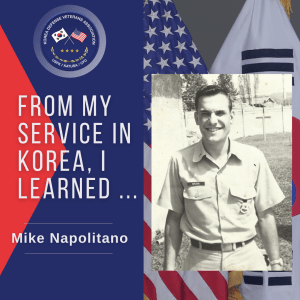
From My Service in Korea, I Learned – Mike Napolitano

From My Service in Korea, I Learned – Mike Napolitano

I actually started learning about Korea before I ever set foot in the country.  As an Air Force 1st Lt. with a new bride in the spring of 1966, stationed at Richards-Gebaur AFB near Kansas City, MO, my orders came down assigning me to a 13-month tour in Korea.  Turned out,  this was a “plum” assignment for a junior officer, as I would be going over as an advisor with the 6146th Air Force Advisory Group (the outfit made famous by Col. Hess – think the film “Battle Hymn” with Rock Hudson), Operating Location Taejon, about 110 miles south of Seoul.

The assignment was unaccompanied (more about that later) and involved a four-week orientation in July 1966, covering the Military Assistance Program, in general, and the culture, traditions, and language of Korea, in particular.  This was held at the Military Assistance Institute in Arlington, VA.  It also involved securing a diplomatic passport (“abroad on an official assignment for the U.S. Govt.”), rendering me outside the Status of Forces agreement.  I would have to be on my best behavior!  My bride, Sandy, was with me in Arlington and socialized some with me when we were invited to “hobnob” at the Korean Embassy in Washington with the Ambassador and his staff.

After this training, I got my wife settled in with her parents in Council Bluffs, IA, and I made port call at McChord AFB near Seattle for the flight to Kimpo on a “redtail” (NWA).  I was met at Kimpo by a WWII veteran Major who would be my roommate at our “hooch” on the Army Compound known as Stonestown where our outfit was billeted.  Maj. Peterson had lots of stories about flying P-38’s over Europe more than 20 years earlier, and he also gave me the “skinny” about our mission as advisors and some “poop” about the country.

My duties involved my counterpart, a ROKAF Lt. Col. who ran the Air Technical Training Wing at K-5 Air Base.  My AFSC was Communications Officer, and the base was sort of the ROKAF version of our Keesler AFB (think hundreds of young airmen and officers getting second-level training in their future military specialties).  As it happened, one of my main duties turned out to be teaching conversational English to a few dozen young ROKAF officers who hungrily devoured every lesson.  The hardest thing for me was trying to explain American idioms such as “New York’s finest,” “up the creek without a paddle,” and “bite the bullet!”

Fast forward a few months to winter, 1966.  I decided to have my wife join me at my expense to share the Korean experience with me “on the economy.”  She was able to stay at a “fancy” hotel (for the mid-60’s, little more than 10 years after the ravages of war).  I think it was called the Manyongjong Hotel, and it was where Pres. Park Chung Hee stayed when he visited the area.  Sandy enjoyed being in the country with me, made some friends despite the language barrier, and helped me with my additional duty as Civic Action Officer.  Our unit sponsored an orphanage in town, and my wife helped a great deal with our “supply runs” with me as driver and her as coordinator.

She was also a great partner when it came time to socialize with my counterpart and his staff “after hours.”  Koreans are nothing if not sociable, and we became quite familiar with local drinking customs and beverages such as soju and maekgeolli.

So, to summarize, what I learned from my service in Korea, was simply that the Korean people are proud, industrious, and respectful of Americans while anxious to extol the virtues of their culture always expressing gratitude for our efforts during the war and for our presence post-war while their economy grew into the successful one that it is today.


What did you learn from serving in Korea? Let us know –

Sharing your experiences from serving in Korea can be a powerful way to connect with others who have had similar experiences. By sharing your story, you may be able to help others who are currently serving in Korea or who are preparing to do so. You can share insights about the culture, the people, and the challenges you faced while serving. Your story can also help to shed light on the sacrifices that service members and their families make in order to protect our freedoms. So, if you have a story to share, we encourage you to take the time to put it down in writing and send it to KDVA.MyServiceInKorea@gmail.com along with any photos that help to tell your story.

Your contribution may be just what someone needs to hear in order to feel connected and supported.

Read more

From My Service in Korea, I Learned – James R. Kinney

From My Service in Korea, I Learned – James R. Kinney

As an enlisted Air Force Chinese linguist trained at the Defense Language Institute Foreign Language Center in Monterey, California, I served sixteen years on four tours of duty to Osan Air Base, Korea from 1976 to 1998.  Regrettably, as a 19-year-old E-3 during the first part of my first tour, I was quite reckless and irresponsible.  I did not properly capitalize on the great opportunities afforded to me.  This fact continues to be a great regret for me.  However, given a second chance by my Air Force mates and a patient front-line supervisor, I was able to thrive during the final months of that first tour.

Throughout that first tour I worked alongside a group of dedicated Korean civilian professionals who displayed the hard work and dedication of the Korean people.  Their drive and level of expertise was inspiring.  Additionally, while escorting Korean laborers working outdoors inside our fenced Restricted Area, I observed their ingenuity and problem-solving skills coupled with their physical strength and mental acumen in the harshest winter and summer conditions.

On a personal note, during the final months of that tour, I fell in love with my Korean soulmate after being introduced to her by some of my fellow linguist mates.  Many visits to her in Myongdong in Seoul and eventually her family in Mukdong in Seoul and a marriage proposal later, we were married at the military chapel at Osan Air Base.  We remained married until her passing in 2023.

During the other three tours to the same Air Force squadron at Osan Air Base, my wife and I toured throughout Korea on Morale, Welfare, and Recreation (MWR) tours.  As a history buff, my wife taught me so much about 5,000-year Korean history over those many years.  During those years I became very close to every member of her family, and I learned that her mother, father, and older brother had all been evacuated from Hungnam, North Korea to Pohang, South Korea when the US Marines were evacuated by the US Navy during the Korean War.  Her family’s story of those years and all of the years after relocating to and settling in Taegu was both amazing and inspiring.

The highlight of my military duties over those two decades of service in Korea was my brief work as one of two USAF Chinese translators during the ROK-US negotiations during the resolution of the situation concerning the hijacking of a People’s Republic of China Civil Aviation Administration of China  (PRC CAAC) Hawker Siddeley Trident 2E aircraft (REGNR B-296) from the PRC to Camp Page, Chunchon, Korea on 5 May 1983.  It was such a relief to know that we were able to help ensure the safety of Chinese civilian passengers on the aircraft that was on the ground at Camp Page that afternoon and evening in May 1983.

Finally, working alongside Korean civilian linguists and analysts continue to serve as an inspiration to me.  Through the years and after forging friendships at work, at unit picnics, combined unit sports days, and a fantastic Combat Dining In, I was left with tremendous admiration and respect for the Korean people which remains with me to this day.  There isn’t a day that goes by that I do not reflect back on those years and those experiences in Korea working alongside the Korean people.  I remain grateful for all of those experiences and friendships in Korea.

Sincerely,

James R. Kinney, CMSgt, USAF (Retired)

UNQUOTE

Hawker Siddeley Trident 2E


What did you learn from serving in Korea? Let us know –

Sharing your experiences from serving in Korea can be a powerful way to connect with others who have had similar experiences. By sharing your story, you may be able to help others who are currently serving in Korea or who are preparing to do so. You can share insights about the culture, the people, and the challenges you faced while serving. Your story can also help to shed light on the sacrifices that service members and their families make in order to protect our freedoms. So, if you have a story to share, we encourage you to take the time to put it down in writing and send it to KDVA.MyServiceInKorea@gmail.com along with any photos that help to tell your story.

Your contribution may be just what someone needs to hear in order to feel connected and supported.

Read more

From My Service in Korea, I Learned – Brian L. Goldbeck

From My Service in Korea, I Learned – Brian L. Goldbeck

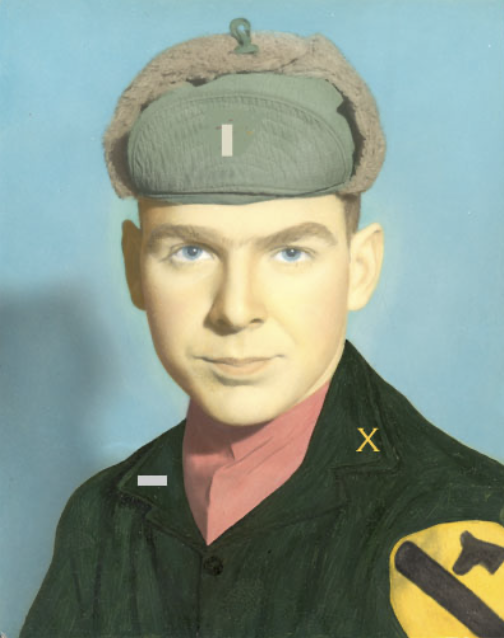
Seems I was destined to serve in Korea even though my first assignment in the mid-1970s was shifted from Korea to Hawaii where I painted rocks.  Almost went again from Hawaii on  “Operation Paul Bunyon” in 1976  when North Korean soldiers chopped up two American officers in the Demilitarized Zone ( DMZ). My next actual assignment to the ROK was as an Army Reserve officer in the 1980’s. On arrival, I was told, “Geez, you’re here already. (Common experience for reservists.) Go away and come back tomorrow.” The next day I was asked if I’d serve on the executive staff of a newly re-activated Military Police Battalion. My reply:  “Sure. I’m a reservist so whatever you want for two weeks.” Tasked with writing some security standard operating procedures (SOPs) over my remaining 12 days, I found another similar  MP battalion, copied their SOPs, tweaked them to fit the new unit’s mission, and was done in two days. Felt like I’d seen the unit’s number before during my personal genealogy search. Sure enough, it had been my father’s unit in Cairo during WWII. Sadly, he passed decades earlier, so I couldn’t share that moment with him. The next year, I was the Deputy J-5 Civil-Military Affairs Officer at Combined Forces Command (CFC) then at Camp Red Cloud. There were two high points.  First, my boss had served in Vietnam. He responded quizzically when I said ,“Welcome Home!,” acknowledging it was the first time anyone had said as much. That’s pretty sad.  The next year I was tasked with locating all historical items in the headquarter (mirror from former President Chun, etc.) and making a handling recommendation (return, move to a museum, send to the U.S. for storage, etc.). Making my rounds, I discovered a closet with a bunch of live, non-deactivated unexploded ordinance – grenades, mortar and artillery shells, mines, etc. After I called ordinance disposal, they cleared the building (that made me a lot of friends and some interesting nicknames) till the bomb disposal unit and carriers could remove them for detonation at a nearby range. Boom! Once, when my car needed to exit onto a busy six-lane city street in Seoul and with buses bearing down on us, a local policeman stepped into the street and snapped a crisp salute.  All/all traffic stopped as we exited. Asking my ROK counterpart about it, he said that since virtually all Korean males then served in the military, that policeman’s gesture was one of “help – I really need this,” and it worked. While our dad’s generation had some of that, today it’s not a very common American experience and thus is no longer a wide-spread bond found in the U.S. beyond those who have served in recent conflicts.

Brian L. Goldbeck

MAJ, USAR Retired

P.S. I’m a retired Senior Foreign Service Officer who served at the U.S. Embassy in Seoul 1984-6 and 2000-3. I was IMA’d to Korea from 1984-1991 (also doing tours with USFK, 8thArmy, etc.) and then USFJ 1991-2002, with 28 years in all between four years active and 24 in the Reserves.  It was a fascinating complimentary straddling of careers.


What did you learn from serving in Korea? Let us know –

Sharing your experiences from serving in Korea can be a powerful way to connect with others who have had similar experiences. By sharing your story, you may be able to help others who are currently serving in Korea or who are preparing to do so. You can share insights about the culture, the people, and the challenges you faced while serving. Your story can also help to shed light on the sacrifices that service members and their families make in order to protect our freedoms. So, if you have a story to share, we encourage you to take the time to put it down in writing and send it to KDVA.MyServiceInKorea@gmail.com along with any photos that help to tell your story.

Your contribution may be just what someone needs to hear in order to feel connected and supported.
Read more

From My Service in Korea, I Learned – Larry Smethers

From My Service in Korea, I Learned – Larry Smethers

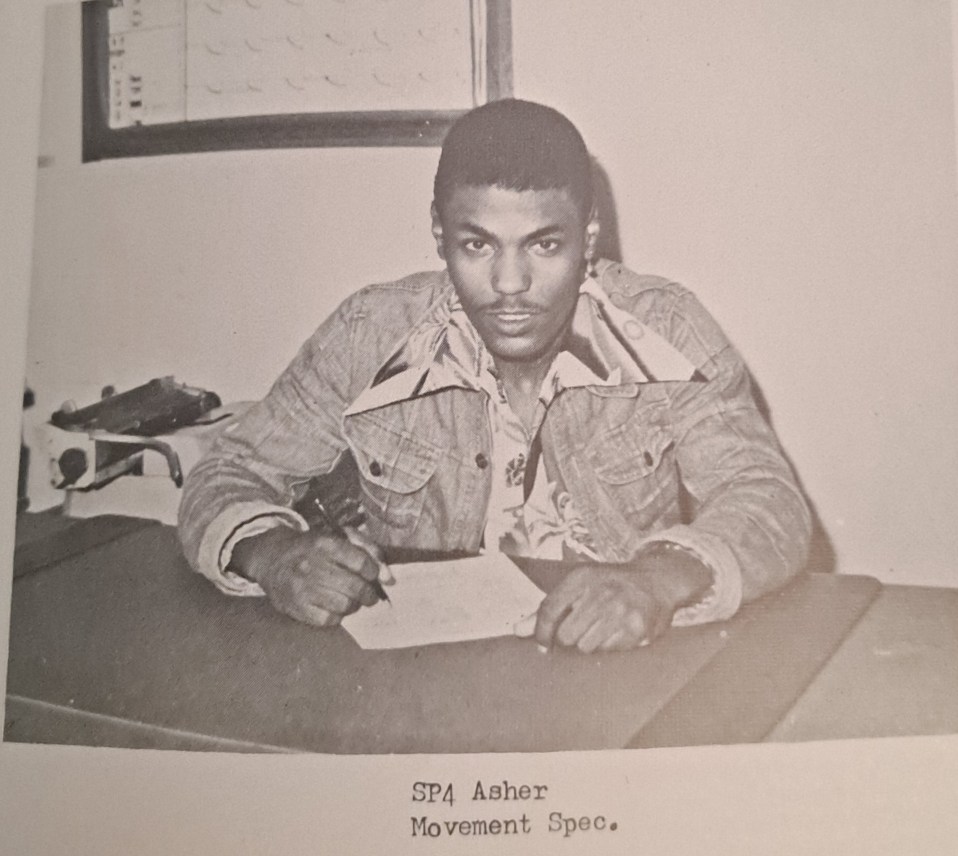
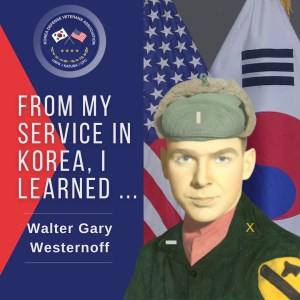
In September 1967, I was drafted into the Army and ordered for basic training at Fort Polk, Louisiana. Fort Polk is near Leesville and Lake Charles, Louisiana.  I signed for an additional year to choose a training program for Army Communications Center Specialists.  After basic training, I was sent to Fort Gordon, Georgia, near Augusta, Georgia.  After completion in February 1968, I received a promotion from private to SP4 with secret clearance and orders to report to Vietnam.

On January 23, 1968, the USS Pueblo ship was captured in international waters off the coast of North Korea by North Korean forces.  My orders and those of my unit were changed from Vietnam to South Korea.  I flew from Fort Gordon, Georgia, to Fort Lewis, Washington, then to Fort Richardson, Alaska.  Fort Richardson is adjacent to Anchorage, Alaska.  In 2010, Fort Richardson merged, with nearby Elmendorf Air Force base to form a joint base, Elmendorf-Richardson.  I flew from here to Tokyo, Japan stopover and then to Kimpo, Air Base, South Korea, 9 miles west of Seoul.  I moved on to the replacement battalion in Ascom City, Korea, to wait for my assignment.  I was assigned to the 6th Medical Depot at Ascom City, Korea in February 1968.

The 6th Medical Depot had several divisions and sections commanded by LTC Earl G. Pepmiller.  There were Headquarters Division, Optical Division, Stock Control Division, Medical Equipment Division, Maintenance Division, Motor Pool, and Unit Supply. The Detachment-Orderly Room was at a separate location from the Depot.  We normally used buses back and forth.  The Detachment area included our living quarters which were Quonset Huts. KATUSA personnel and Korean nationals were assigned throughout all divisions and units of the Depot.  They were very hard and efficient workers and motivated to achieve the mission of the 6th Medical Depot.  The Korean people are very friendly and expressed gratitude for our participation in the defense of their country.

My assignment with the Depot was as S-2/3 Security, Plans and Operations NCO at Depot Headquarters.  I was also in charge of the required Saturday morning training as a training NCO.  I had an office designated “War Room,” which contained a large safe for classified documents that I handled due to my Secret Clearance. Training on Saturday morning included all subjects required by Eighth Army and 65th Medical Group.  After leaving Korea, I received the Eighth U.S. Army Certificate of Achievement Award for performing the duties of an E-7.

There were two mess halls available, one in the detachment area and one at 121 Evacuation Hospital, which was adjacent to the 6th Medical Depot.  I usually ate lunch at this location.  On December 23, 1968, after 11 months of captivity in North Korea, the crew of the USS Pueblo was repatriated to the 121 Evacuation  Hospital located 10 miles west of Seoul at Acom City.  The Pueblo crew was flown by helicopter from DMZ to the helicopter pad at 121 Evac Hospital.  I was one of those to witness this arrival around mid-morning.  As far as I know, the USS Pueblo is still in North Korea as a tourist spot and museum.  I was in Maui, Hawaii around January 17 2018, when someone pushed the wrong button, sending out a false incoming missile alert from North Korea, oops.

In the summer of 1968, at Ascom City, the USO had a show which featured the 1968 Miss Debra Barnes, the Kansas winner from Moran, KS, and other Miss America participants.  Also, that summer, new MPC (Military Payment Certificates) were exchanged from the old issue to the new issue.  You took your old MPC money and exchanged it for a new issue in one day.  After 16 months and 2 days, I departed Korea and reported to HHC 67th Signal Battalion, Fort Riley, Kansas, 5th Army to serve out the remainder of my service.


What did you learn from serving in Korea? Let us know –

Sharing your experiences from serving in Korea can be a powerful way to connect with others who have had similar experiences. By sharing your story, you may be able to help others who are currently serving in Korea or who are preparing to do so. You can share insights about the culture, the people, and the challenges you faced while serving. Your story can also help to shed light on the sacrifices that service members and their families make in order to protect our freedoms. So, if you have a story to share, we encourage you to take the time to put it down in writing and send it to KDVA.MyServiceInKorea@gmail.com along with any photos that help to tell your story.

Your contribution may be just what someone needs to hear in order to feel connected and supported.
Read more

From My Service in Korea, I Learned – David Teichman

From My Service in Korea, I Learned – David Teichman

From my service in Korea, I learned just how strong the bond of camaraderie, caring, and concern for your fellow soldier can be. Stationed at Camp Essayons with the 6-37th FA from June 1974 to July 1975, I served as a Captain and the Battalion Motor Officer. My responsibilities included ensuring the readiness of our battalion’s military equipment, a task that required meticulous record-keeping and detailed reporting.

I worked under a battalion commander who was exceptionally detail-oriented and strict, demanding nothing short of perfection. One of my key duties was preparing the monthly 2406 report, which documented the condition status of our military equipment. The report had to be exactly nine pages long, and given the limitations of typewriters at the time, the best we could achieve was an original copy with three carbon duplicates. This meant the report had to be typed twice—for eight copies and an additional time to reach the required nine.

I had a Specialist 4 clerk who handled the typing, carefully ensuring accuracy before I reviewed it. Once I was satisfied, I would take the report to the battalion commander’s Quonset hut, where he would scrutinize it line by line, checking for typos and misspelled words. Each submission was a meticulous process, reinforcing the importance of precision and attention to detail.

During the winter of 1974-75, my clerk fell ill, and for one month, I had to type the report myself. I found myself alone in the battalion motor pool office late at night, braving the bitter cold, with only a five-gallon diesel can heater providing warmth. A blinding snowstorm raged outside as I worked diligently to complete the task.

Suddenly, the door burst open, allowing a gust of snow to swirl into the room. Through the icy blast stepped my fellow captain and hoochmate, Captain Jim Schlesinger. In his hand, he carried a thermos of hot coffee.

Surprised, I asked, “Jim, what are you doing here at this time of night, in the cold, in this blizzard?”

He simply replied, “I knew you were down here by yourself, typing on this antique typewriter, and I thought you might need some hot coffee.”

As he poured each of us a cup, he added with a grin, “I really hope this tastes okay because I couldn’t find a pan to heat the water—so I used Mr. Cho’s starch pot.”

We both had a hearty laugh. Mr. Cho was our houseboy, responsible for laundering, starching, and ironing our fatigues. At the time, heavily starched fatigues were the standard, and Mr. Cho took great care in his duties. The idea of using his starch pot for coffee water was both amusing and oddly fitting given the circumstances.

This unselfish and unsolicited act by Jim made a lasting impression on me. Even decades later, I remember it vividly. It was a simple yet profound reminder of what it means to care for one another. He left a warm, comfortable hooch, braved a blizzard, and traversed a considerable hill—all because he cared about a fellow officer. This moment has stayed with me throughout my life, influencing how I interact with others. His kindness exemplified the deep sense of brotherhood that military service fosters, a lesson I carry with me to this day.


What did you learn from serving in Korea? Let us know –

Sharing your experiences from serving in Korea can be a powerful way to connect with others who have had similar experiences. By sharing your story, you may be able to help others who are currently serving in Korea or who are preparing to do so. You can share insights about the culture, the people, and the challenges you faced while serving. Your story can also help to shed light on the sacrifices that service members and their families make in order to protect our freedoms. So, if you have a story to share, we encourage you to take the time to put it down in writing and send it to KDVA.MyServiceInKorea@gmail.com along with any photos that help to tell your story.

Your contribution may be just what someone needs to hear in order to feel connected and supported.

Read more

From My Service in Korea, I Learned – Charles Webb

From My Service in Korea, I Learned – Charles Webb

My service record in the Air Force was from September 1950 to May 20 1954 during that period of time, I was stationed at Ellington Air Force Base and was starting my navigational training during that period of time, my father passed away, and I withdrew from navigational training because I no longer wish to remain in the service. The reason for my wanting to leave was because my goal had always been to attend law school when I left the service, the cadet training and furtherance of that would have committed me to a far longer term than the four years. Accordingly, the moment I withdrew from cadet training, I was sent to Korea. As soon as I was assigned duties in Korea, based upon my background college and training, I was immediately given the duty of maintaining fifth Air Force headquarter buildings in 61/54 airbase group soul Korea. As part of those duties I was in charge of the billiting For all officers stationed for headquarters. Additionally, my duties included supervision of all Korean employees at headquarters. My reporting officer was colonel Raymond C Boyd. I served in that capacity for seven months and one Zen asked to assume the same position at Osan. That was K 55. I agreed to that position but only, if I was willing to extend my service another six months in Korea. I agreed to that and was ultimately discharged after that service which meant I was released from the Air Force four months early if you need any additional information.


What did you learn from serving in Korea? Let us know –

Sharing your experiences from serving in Korea can be a powerful way to connect with others who have had similar experiences. By sharing your story, you may be able to help others who are currently serving in Korea or who are preparing to do so. You can share insights about the culture, the people, and the challenges you faced while serving. Your story can also help to shed light on the sacrifices that service members and their families make in order to protect our freedoms. So, if you have a story to share, we encourage you to take the time to put it down in writing and send it to KDVA.MyServiceInKorea@gmail.com along with any photos that help to tell your story.

Your contribution may be just what someone needs to hear in order to feel connected and supported.

Read more