From My Service in Korea

Eiji Teragouchi – From My Service in Korea, I learned…

From My Service in Korea, I learned…

Eiji Teragouchi

1965 – 1966

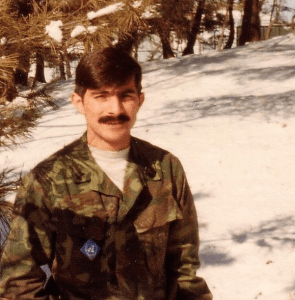
During my time stationed at Fort Carson, Colorado, in January 1965, I received orders to relocate to South Korea for a 13-month tour of duty. In February of the same year, I found myself enroute to Kempo Air Force Base, where I would begin my assignment. Upon arrival, we were directed to a military bus where we received our individual assignments for the next 13 months. I was assigned to the 5th CAV/1st CAV Division and 2nd Infantry Division mid 1965, near Paju, South Korea.

Leaving behind the cold of Colorado, I soon discovered that the winter chill near the DMZ was far more intense. As I acclimated to the cold temperatures, I also experienced the onset of the monsoon season. Despite these seasonal challenges, our duties often involved late-night searches for North Korean infiltrators crossing the frozen Imjin River, especially during the winter months. We, American soldiers and KATUSA (Korean Augmentation to the United State Army) conducted night foot patrols along the south side of the Imjin River’s dirt path, braving the elements.

During the warmer months, both American soldiers and KATUSA troops collaborated to construct concrete bunkers atop the mountains. It was during this time that I immersed myself in Korean culture, learning over 100 Korean words and the traditional song “ARIRANG” from my KATUSA counterparts.

One afternoon, while exploring a local village, I had the opportunity to observe elderly women making winter kimchi. With their permission, I sat and watched as they prepared the spicy dish, realizing that its heat came from the addition of copious amounts of crushed hot peppers. Throughout my time in South Korea, I forged many friendships with the local community.

Upon returning to the United States, I found myself working in Pittsburgh, Pennsylvania, where I had the pleasure of meeting a Korean gentleman who was a former two-time Korean Judo Champion, Mr. Kim. Our friendship blossomed as we shared stories and bonded over our shared experiences. It was during these gatherings that I would often use Korean words and join Mr. Kim in singing “ARIRANG.” Despite moving on to different projects, our friendship endured for over 50 years.

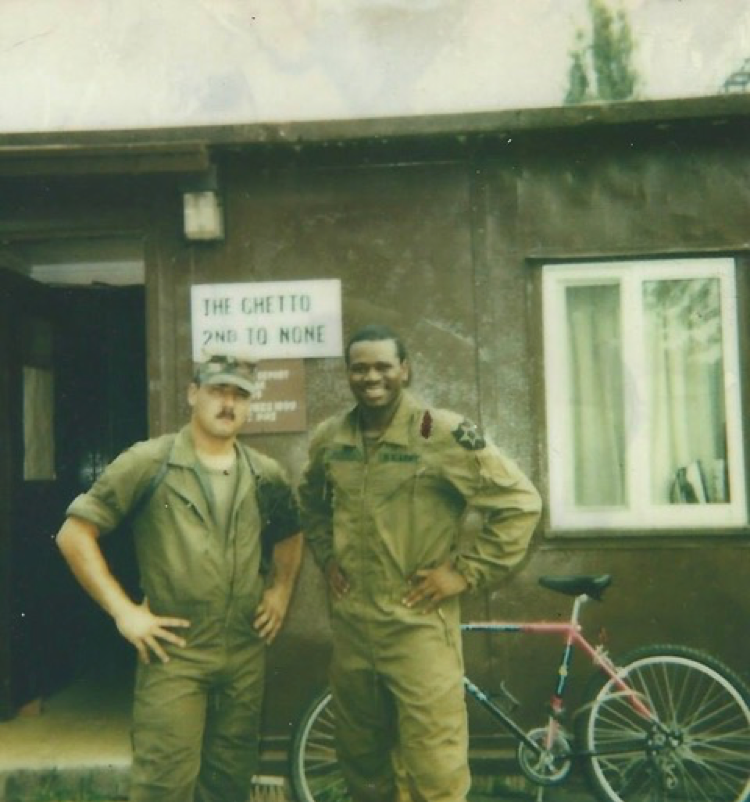
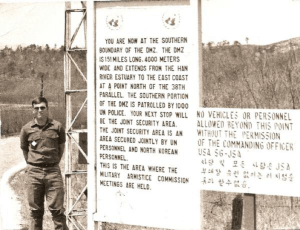
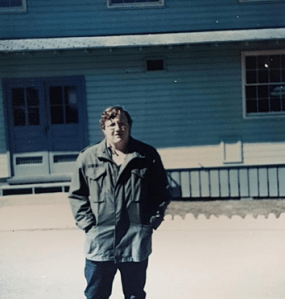
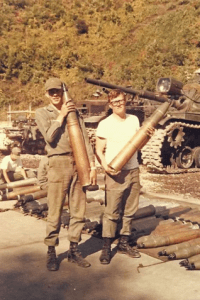
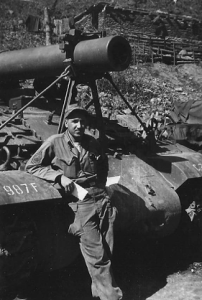
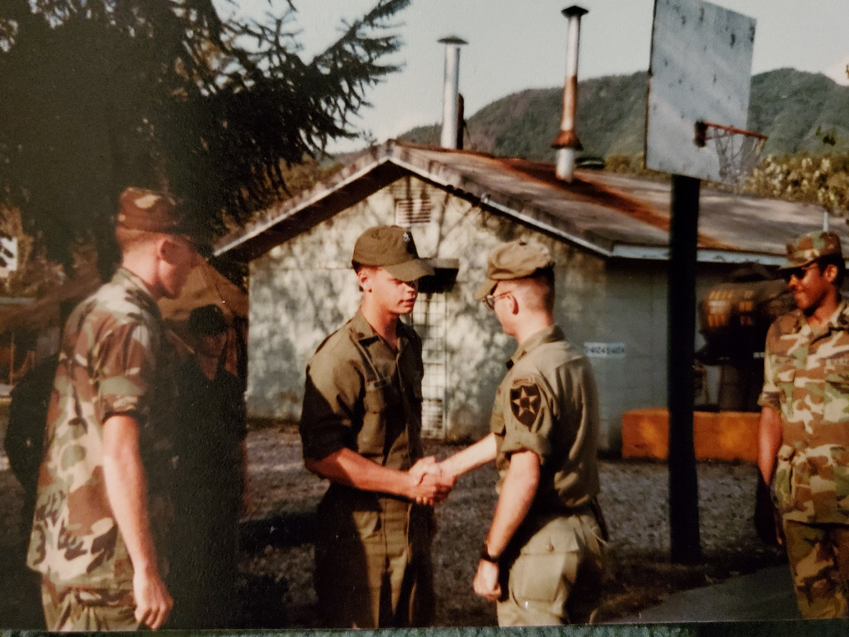
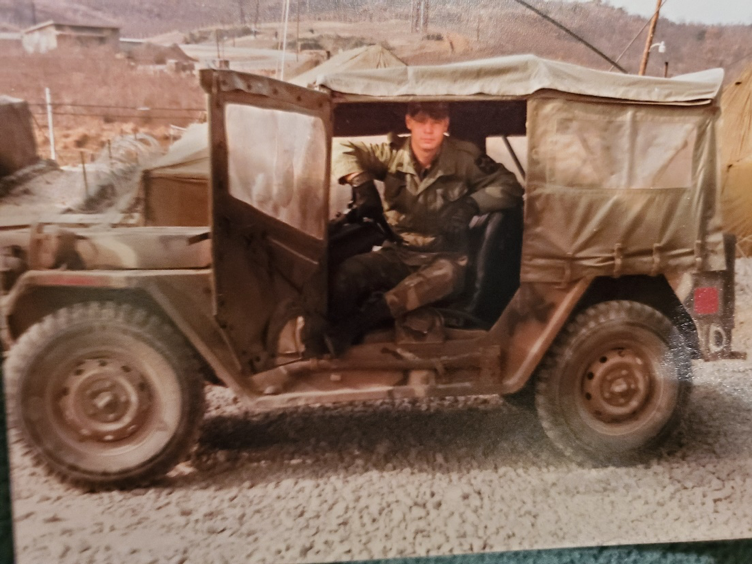
I have included pictures of me, Eiji – sp4, in the pictures with fellow soldiers, American and KATUSA.


What did you learn from serving in Korea? Let us know –

Sharing your experiences from serving in Korea can be a powerful way to connect with others who have had similar experiences. By sharing your story, you may be able to help others who are currently serving in Korea or who are preparing to do so. You can share insights about the culture, the people, and the challenges you faced while serving. Your story can also help to shed light on the sacrifices that service members and their families make in order to protect our freedoms. So, if you have a story to share, we encourage you to take the time to put it down in writing and send it to KDVA.MyServiceInKorea@gmail.com along with any photos that help to tell your story.


READ MORE STORIES HERE.
Read more

Dave Nutter – From My Service in Korea, I learned…

From My Service in Korea, I learned…

Dave Nutter

1970’s & 1980’s

My Name is Dave Nutter, I retired from the Army in 1993 as a SFC with 20 years of service. I quit high school the summer before beginning my senior year and enlisted in the Army in September of 1973, one day after my 17th birthday. My father a Command Sergeant Major who had only been back from Vietnam a little over a year only asked if I was sure that was what I wanted to do. I arrived in Korea in April of 1974. I was assigned to C Company 1/72 armor and began as the driver on the platoon sergeants’ tank; going to the field for a month for gunnery/tank crew qualifications a few days after I reported in. When my high school class was graduating, my unit was on Chipori range firing tank table VIII.

17 is an interesting age, not quite a boy and not quite yet a man. During my 18 months in the 2d Infantry, I learned a lot about myself, structure, self-discipline, and teamwork. Many of those lessons, that took a while to take, and my experiences during my military service have served me quite well in life and the corporate world.

Quite honestly, the Army immediately post-Vietnam was quite a mess and the leadership had quite a challenge on their hands and 2d ID was no different except that we had General Emerson (Gunfighter) as the division commander. Who excelled in meeting those challenges. We spent an awful lot of time training, and I would guess that between us and 2/72 armor, we expended all the 105mm, 7.62mm and 50 cal ammo in the ammo dump at Tobong Son and kept the folks there quite busy with incoming shipments. The physical training was quite challenging as well, especially during the winter as PT was not canceled unless the temperature went below zero. For a period in the summer of 74 during the fuel shortage, we were also trained as infantry.

7 years later I was serving with the 38th ADA Bde on an isolated missile site applying those lessons. Much of military service is learning how to deal with sleep deprivation and that tour was no exception to the rule. In the last couple of months of that tour, my maintenance section was down to three people with a requirement to have 2 of us on the missile site 24/7. During the Cold War air defense units pulled their wartime missions. Hawk missile systems were in various stages of alert all over the world. Systems were up, and running, and manned 24/7, 365 days a year unless in a maintenance state. Maintaining that state of readiness is quite challenging for everyone in the unit from the clerks to the tactical control officers.

During both tours, I learned to love Korea and have said many times I would have been quite happy if I could have spent all my service there. Both times it was obvious that Korea was still recovering from the war. In 1981 progress was evident. I observed how resilient and resourceful the Korean people are. There is an old saying about slaughtering a pig and using everything but the oink. I am convinced they found ways to use the oink as well. Nothing went to waste that I saw. From the less fortunate souls we had out on our ranges trying to collect what metal they could from napalm casings to shrapnel and shell casings to the street merchants using discarded paper from the base as containers for the street food they sold. Things we should be doing in today’s throwaway world. All the people I met were exceptionally nice. There were many times when we traded our c-rations with the locals for Korean food. In 1981-1982 my friends and I made it a point to try and go off the beaten path where most Americans would not.

Interestingly many members of my family served in Korea. One of my father’s brothers was assigned to Korea in 1948. Dad spent almost the entire war in Korea arriving in the late summer of 1950, his unit was attached to the 2d ID and they were up north when the Chinese entered the war, he was with the units that had to run the gauntlet to get back south. His brother was a Marine WWII veteran who was in the reserves and was called up and arrived in Korea before my father, he was at the Chosin Reservoir, and I know that haunted him for the rest of his life. The picture below is of my father at age 22 just before the armistice.

When I was in Korea the 2d time, 81-82 my older stepbrother was assigned to 2d Aviation and stationed at Camp Casey, we did manage to spend one weekend together.

Having recently visited Korea in October, it is quite evident that the alliance between in U.S and Korea has revolved exponentially, growing stronger over the years. The changes I saw in Korea make me wish I could bring my father and his brothers to Seoul so they could see what they have been a part of.


What did you learn from serving in Korea? Let us know –

Sharing your experiences from serving in Korea can be a powerful way to connect with others who have had similar experiences. By sharing your story, you may be able to help others who are currently serving in Korea or who are preparing to do so. You can share insights about the culture, the people, and the challenges you faced while serving. Your story can also help to shed light on the sacrifices that service members and their families make in order to protect our freedoms. So, if you have a story to share, we encourage you to take the time to put it down in writing and send it to KDVA.MyServiceInKorea@gmail.com along with any photos that help to tell your story.


READ MORE STORIES HERE.

Read more

Robert Jenkins – From My Service in Korea, I learned…

From My Service in Korea, I learned…

Robert E. Jenkins

March 1953 – December 1956

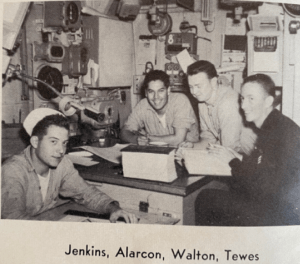
My name is Robert E. Jenkins.  I served in the U.S. Navy in the Korean War from March 1953 till December 1956.  I was in the waters around Korea on two different ships (USS Fechteler DDR870 and USS Isherwood DD520).  I was a radarman 3rd class.   It was the job of the radar crew to keep track of all the boats and planes in the area and to protect the aircraft carriers.  I learned a lot of responsibility and how to meet challenges.

I never set foot on the ground until this Revisit Korea program. So what an honor and opportunity for me to visit South Korea, especially since I have a grandson that lives in Seoul and teaches English.   I learned how much the Korean people honor our service to their country.  There were young people and their parents that wanted to shake my hand.  I was very impressed with how clean, beautiful and modern the country of South Korea is today. This trip was a dream of a lifetime and something I will always cherish.  I was treated with such honor.


What did you learn from serving in Korea? Let us know –

Sharing your experiences from serving in Korea can be a powerful way to connect with others who have had similar experiences. By sharing your story, you may be able to help others who are currently serving in Korea or who are preparing to do so. You can share insights about the culture, the people, and the challenges you faced while serving. Your story can also help to shed light on the sacrifices that service members and their families make in order to protect our freedoms. So, if you have a story to share, we encourage you to take the time to put it down in writing and send it to KDVA.MyServiceInKorea@gmail.com along with any photos that help to tell your story.


READ MORE STORIES HERE.
Read more

Bill Castro – From My Service in Korea, I learned…

From My Service in Korea, I learned…

Bill Castro

From my service in Korea, I quickly learned how to become a man of Men. Let me explain, I was 18 years old when I volunteered for service in the Far East Command, the government’s fancy name for service in the “Korean Police Action”. After 16 weeks of Basic Combat Training at Schofield Barracks Hawaii, graduating “Bravo 940” “Cum Laude”, I found myself landing at Haneda Airport, Tokyo, Japan where we were bussed to Camp Drake, the Main Replacement Depot for all assignments in the “Far East Command” and after a few days of loading us with Pile Jackets, Snow Boots, Winter Sleeping Bags and Oh yeah, Rifles with no Ammo, we were loaded unto a train to Sasebo, the southernmost Japan port and gateway to Pusan, Korea. The date was around the first week of January 1951.

After landing in Pusan, we were immediately, again, boarded onto Train Cars and sat all day without moving because, we were told, that the route we were supposed to travel on was in repairs after an attack on the train traveling before us. We all were disturbed the biggest part of the night with a Train that arrived late into the night and unloaded what seemed to us as bags of trash since they were throwing it from the top of train cars onto the platforms below. The next morning as we were heading out to breakfast with our mess kits and canteen cups, we saw that the contents in the bags were not trash but human bodies they were just unloaded and left there on the platforms and most were well on the way to decay where the stench was unbearable. We all turned around and headed to the other end of the train, most declaring, “So much for breakfast”. 3-4 days later we were in Suwan and the 3rd Infantry Division Replacement Center where we were further assigned and I went to Co. C, 1st Bn., 15th Regiment. My platoon, like the others, was extremely short-manned since they had just regrouped from being over-run and in re-treat (ops, I mean withdrawn) from the Chosin Reservoir in the North.

I was assigned as assistant B.A.R. man and carried the ammo for the B.A.R. Man. We were on a hill and the next day marched over heavy snow hills and lowland rice patties for 3 or 4 days with only the food we carried which ran out after 3 days. We had no contact that I could see with other allied units.

March 1951 with a B.A.R.

On the very early morning of the 4th day around 2 am, we were attacked and after 15 to 20 minutes under constant rifle and machine gun fire the B.A.R. man jumped out of the foxhole and left saying, we’re down here alone and can’t hold, let’s go up to the next higher position. I got so excited that when trying to put my rifle on lock, I accidentally removed the trigger housing and my rifle fell in two parts on the snow. I shouted to my partner to wait but he just kept moving on. By the time I finally dug up the two parts of the Rifle and trigger housing and put them all together the Enemy was all around my position firing all around so wildly that one of them fell into my hole with me, looked at me with a Burp gun in hand and jumped out yelling in Chinese, what, I don’t know. After that little incident, I got my wit together and stayed in the hole just firing all around, sometimes at shadows, sometimes at their white uniforms shown clearly with the help of a lighted flare from time to time. Daylight came all of a sudden, I was all alone with what seemed like dead bodies all over the place. My platoon Leader came up to me and said, “How come you didn’t follow your Gunner’s orders and moved your position” and I replied, “I thought we were supposed to remain and cover from this position you assigned us, Sir.”  He smiled and said, “Yes, you’re right.. and by the way, pick up the B.A.R. from my CP (CommandPost), you are now the B.A.R. Man for 2nd Squad. Two or three days later on, the offense attacked a hill around Uijeongbu I was bringing up the left rear of the point when Johnson, a young new replacement fresh from the States, started retreating on his own and upon passing me dropped and left the rifle. I picked it up and ordered my assistant, also fresh from the States but he followed orders to cover Johnson’s position. About a couple of hours or so later reaching the top of the hill and seeing our enemy now on the retreat I saw Johnson approaching my position and I handed him his rifle, which I was carrying along with my heavier B.A.R. The Squad Leader looked back at us and asked, “What happened?” and Johnson replied, “Well I was scared and was going back to the vehicles down the road when this guy yelled at me, “Hey you there, get your ass back up that hill to your outfit or so help me I’ll shoot you myself.”  The Man was not young or wearing a helmet instead he had this pile hat with Stars all around it and he looked like a huge giant. He scared me even more so I turned and hurried back.”

The next morning after successfully defending our position from a counterattack, at breakfast the squad Leader says, “Castro you now Assistant Squad Leader so give your BAR stuff to Johnson”….. Johnson became a pretty good B.A.R. Man, and wondered who that giant man was with the star-studded pile cap?

Several days later going through a village I heard the men shouting our Leader got hit and fell into this crater. I ordered Johnson to cover the rear field of fire I had and hurried up front to our fallen Leader, and he lays there, right arm slit open bone showing and bleeding profusely. I immediately applied a tourniquet and held it until the medics arrived. Our Platoon Lt. also arrived and told me, “You’re Squad Leader now, so get your men in order and stand by.” I always never get asked, just told and in less than 45 days in Combat, I am a Squad Leader, no longer a boy I am now responsible for the lives and actions of 9 men and our achieving success in all our combat missions. That my friend is the Mark of a Man. 1951-1952.

The Secretary of Veterans Affairs for South Korea

Then Gov. of Hawaii.


What did you learn from serving in Korea? Let us know –

Sharing your experiences from serving in Korea can be a powerful way to connect with others who have had similar experiences. By sharing your story, you may be able to help others who are currently serving in Korea or who are preparing to do so. You can share insights about the culture, the people, and the challenges you faced while serving. Your story can also help to shed light on the sacrifices that service members and their families make in order to protect our freedoms. So, if you have a story to share, we encourage you to take the time to put it down in writing and send it to KDVA.MyServiceInKorea@gmail.com along with any photos that help to tell your story.


READ MORE STORIES HERE.

Read more

Daniel McPharlin – From My Service in Korea, I learned…

From My Service in Korea, I learned…

Daniel McPharlin

7th Infantry Division, 1st Battalion 31st Regiment HHC Recon platoon

As an infantryman serving with the 7th Infantry Division in the summer of 1968 up on the DMZ, I saw and experienced the aggression towards South Korea by North Korean soldiers.

On one of our stakeouts inside the DMZ to intercept North Koreans heading south of the Military Demarcation Line a firefight started. We killed two of them feeling for our trip flares and Claymore mine wires. The other North Koreans fired at us but we were not hit. We detonated a Claymore mine and threw grenades at them and near dawn they withdrew from us.

On October 5th that night a call came over the radio that a squad inside the DMZ had been hit and they requested extraction of their wounded. The first vehicle to go through the barrier fence gate was an Armored Personnel carrier followed by a machine gun jeep. Next was an Army field ambulance then a machine gun jeep. The APC bulldozed into the woods and brought the wounded man out to the road. Two medics carried the stretcher to the ambulance. I was the driver of the rear jeep and could see they performed CPR on him before closing the ambulance doors. All three vehicles raced back to camp two miles away. Sp4 Stephen Nassani died from a North Korean grenade explosion that night.

In the winter we got ordered to go to the barrier fence where a North Korean infiltrator was killed. He was lying in a small trailer and on his face was a grimace of pain frozen in death. Rifle fire blew out his shoulder blade and knee cap. When a squad went to get him, he took his grenade and blew his chest out. They would not be taken alive if possible. Our South Korean KATUSA soldiers remarked his family must be wealthy because he was wearing thermal insulated under garments. Most other infiltrators were found with straw under their clothes to try keeping warm.


What did you learn from serving in Korea? Let us know –

Sharing your experiences from serving in Korea can be a powerful way to connect with others who have had similar experiences. By sharing your story, you may be able to help others who are currently serving in Korea or who are preparing to do so. You can share insights about the culture, the people, and the challenges you faced while serving. Your story can also help to shed light on the sacrifices that service members and their families make in order to protect our freedoms. So, if you have a story to share, we encourage you to take the time to put it down in writing and send it to KDVA.MyServiceInKorea@gmail.com along with any photos that help to tell your story.


READ MORE STORIES HERE.
Read more

Song Pak Stisher – From My Service in Korea, I learned…

From My Service in Korea, I learned…

Song Pak Stisher

“Resiliency through Building Cultural Respect, Trust and Friendship”

As a newly commissioned Second Lieutenant in 1990, my first assignment in the Army as a Medical Service Corps Officer (70B) was a Medical Platoon Leader at the 568th Medical Company (Ground Ambulance), 52nd Medical Battalion, at Camp Humphreys, Pyongtaek, Korea. Camp Humphreys was quite different back then, a fenced in perimeter of post surrounded by pig farms and rice paddies. I can still smell the pig farms as I often ran the 10 mile perimeter o dark thirty in the morning.

My unit, the 568th Med Co, was a very unique in a sense it was a multi comp TOE unit consisted of US Army active duty personnel, Korean Service Corps (KSCs) and Korean Nationals (KNs). We didn’t have any KATUSAs assigned to 568th, however, our sister company, the 560th Medical Company did. I was assigned as one of the three Platoon Leaders at the 568th and within my platoon, I was in charge of about 30 KSCs, along with my platoon sergeant. The KSCs were unique in their skill sets as medics and civilian service members, fluent in both Korean and English. They were also senior in grade and time in service. They were well trained and skilled in various medical treatment and evacuation operations. I quickly gained a tremendous respect for them as I was a brand new Lieutenant who was their new leader. But I also faced some unique cultural challenges.

I was a 22 year old, Korean American, a female US Army Officer in charge of a group of very seasoned KSCs and this was their very first experience working for a woman, someone who was half their age, without much time and grade and very “green.” They didn’t really know what to expect from me, never mind taking orders from me. I quickly realized this was a very difficult situation for the KSCs, who have traditionally reported to male leaders in a male dominant society and culture. I also realized that respect is not simply given but earned and this was a two way street. I had to first prove to them that I respected their contributions and commitment to the unit’s mission. We were able to do this through various field training exercises, team building  and leadership training. Over time and collaborations, we were able to build mutual trust, respect and acceptance of each other. We accomplished many missions and tasks throughout the 12 months we spent together at Camp Humphreys. I can honestly say that by the end of my tour in Korea, we became family.

As I look back to my time in Korea and the unique experience gained working with the KSCs at 568th, I can still remember all of their smiling faces. I will never forget friendship, culture and humanity we shared during our time together. And best of all, it truly taught me the importance of resiliency when challenged with unique cultural differences and how we can all overcome these challenges through mutual respect and trust. We believed in our motto “Katchi Kapshida” – Let’s Go Together.

This journey was very special to me as I had returned to Korea to serve since my family immigrated to the US in 1978. I hope to revisit Korea soon and walk through the journey one more time.

Thank you for allowing me to share my story.


What did you learn from serving in Korea? Let us know –

Sharing your experiences from serving in Korea can be a powerful way to connect with others who have had similar experiences. By sharing your story, you may be able to help others who are currently serving in Korea or who are preparing to do so. You can share insights about the culture, the people, and the challenges you faced while serving. Your story can also help to shed light on the sacrifices that service members and their families make in order to protect our freedoms. So, if you have a story to share, we encourage you to take the time to put it down in writing and send it to KDVA.MyServiceInKorea@gmail.com along with any photos that help to tell your story.


READ MORE STORIES HERE.
Read more

David Benbow – From My Service in Korea, I learned…

From My Service in Korea, I learned…

David Benbow

My service in Korea with Charlie Company, 3/23rd Infantry, 2nd Infantry Division, Feb 1968 to June 1969 taught me to love the Republic of Korea and its citizens. The 12-15 KATUSAs I served with in my company were outstanding soldiers. The people of the Republic of Korea were industrious and hard working. I am proud of the huge economic growth of the Republic of Korea since 1953. They love their country and so do I. I have formed life-long bonds with my brother DMZ vets and with some of the family members of Michael Rymarczuk, killed July 30, 1968 on DMZ night ambush. Everywhere I go, I carry the memories of my fellow 3rd platoon buddy, Michael Rynmarczuk and my 3rd platoon foxhole buddy, KATUSA Pvt. Kwan, who was killed in the DMZ on night ambush in August 1968.

  Army Signalman, Mike Reynolds, who was killed in my company area of the DMZ while stringing wire to our Guardpost Gladys, September 27, 1968 and new 2LT James Weeks, killed on his first patrol into the DMZ on July 20, 1968, both had family members reach out to me and we have become friends.  I found Michael Rymarczuk’s mother, brother and daughter in Philadelphia and we became friends. I told Michael’s daughter, Micki, that her father was my DMZ Brother. She calls me and several of her father’s other Charlie Company, 3rd platoon buddies, her “uncles”, because her father, who was killed before he could hold his baby girl, was our brother.  Earl Jeffery, WIA July 30, 1968 , also in my 3rd platoon, was flown home after being wounded and we never heard from him again. I found his daughter several months ago in Dennison, Texas. She told me, her father had just died last year and that even though he had survived his multiple wounds from that long night,  he had limped all his life and had nightmares. I wish I had been able to find Earl before he died. I carry my DMZ brothers’ memories with me every day. I am proud we helped defend the people of the Republic of Korea from North Korean aggression.  Whenever I have to make a public speech, or try a jury case in court, or have a serious doctor’s appointment,  I carry my  Imjin Scout patch, which I removed from my fatigue shirt, in my pocket. I would not trade that 55 year old faded green cloth patch for any other medal or military award.  It says that I served in dangerous situations with some of the best men I have ever met. David Benbow, Statesville, NC (formerly Sgt (E-5) David Benbow, Charlie Company, 3/23rd Infantry, 2nd Infantry Division.


What did you learn from serving in Korea? Let us know –

Sharing your experiences from serving in Korea can be a powerful way to connect with others who have had similar experiences. By sharing your story, you may be able to help others who are currently serving in Korea or who are preparing to do so. You can share insights about the culture, the people, and the challenges you faced while serving. Your story can also help to shed light on the sacrifices that service members and their families make in order to protect our freedoms. So, if you have a story to share, we encourage you to take the time to put it down in writing and send it to KDVA.MyServiceInKorea@gmail.com along with any photos that help to tell your story.


READ MORE STORIES HERE.

Read more

CMSgt (Ret.) Ron Eubanks – From My Service in Korea, I learned…

From My Service in Korea, I learned…

CMSgt (Ret.) Ron Eubanks

What I learned from my eight years in Korea would fill volumes, but I will touch on just a few highlights.  I learned what it’s like for a fearless and industrious population to live only 35 miles from a constant, and serious, military threat while going about their daily lives.  I learned that Korean people appear to be a bit abrupt and discourteous initially, but once they get to know you, they are in fact, a most kind and gregarious people.  I learned just how different customs and courtesies are in Korea from those in the United States.  I also learned just how much the Korean people know about the U.S. and how little most Americans know about Korea (myself included initially).  I learned that American military personnel, far from home, can frequently misjudge the people and environment without really getting beyond what they see just outside the gates of a military installation.  Likewise, I learned that many Koreans misjudge the actions of a few “ugly” Americans as being the norm.   I learned, from working with the ROK military, just how disciplined and patriotic the Korean military really is and how mutual respect is earned by working closely with each other towards a common goal. As an Intelligence Analyst, I learned what it was like to work within the highest levels of military and civilian leadership during some significant incidents that occurred during my tenure:  August 1976 nK axe murders in the JSA area, the Russian downing of KAL 007, the assassination of President Park Chung Hee and the ensuing power struggle.  I learned that applying myself to become an expert on nK Psychological Warfare brought great rewards:  being selected to write the CINC’s briefing points for President Reagan’s visit, and ultimately ascending to the pinnacle of my military career ladder (CMSgt/E-9).  But, everything I learned about Korea pales in comparison to my having met and married my wife of now 42 years and our wonderful daughter being born in the 121 hospital at Yongsan.  Obviously, my time in Korea had a significant impact on my life both professionally and personally.  It has been many years since we last visited Korea, but our bonds with the country and the Korean people can never be broken.


Ron Eubanks

CMSgt, USAF (Ret)


What did you learn from serving in Korea? Let us know –

Sharing your experiences from serving in Korea can be a powerful way to connect with others who have had similar experiences. By sharing your story, you may be able to help others who are currently serving in Korea or who are preparing to do so. You can share insights about the culture, the people, and the challenges you faced while serving. Your story can also help to shed light on the sacrifices that service members and their families make in order to protect our freedoms. So, if you have a story to share, we encourage you to take the time to put it down in writing and send it to KDVA.MyServiceInKorea@gmail.com along with any photos that help to tell your story.


READ MORE STORIES HERE.
Read more

Lt Col, USAF (Ret) Aaron D. Trimble – From My Service in Korea, I learned…

From My Service in Korea, I learned…

Lt Col, USAF (Ret.) Aaron D. Trimble

From my service in the Republic of Korea I learned what it meant to become inextricably and spiritually linked to a country and its people.

My earliest introduction to Korea and its people began at Clark Air Base in the Philippines, when in October 1983 North Korea orchestrated the Rangoon bombing intending to assassinate South Korean President Chun Doo-hwan. When wounded victims were flown to Clark for emergency treatment, my wife and I were asked to assist with their welfare and security. From these survivors, I learned first-hand about the horrors of that event along with the bravery shown by many South Koreans who rushed in to assist their wounded comrades immediately following the explosion.

When I think about my tours in Korea I remember the old Chinese curse, “May you live in interesting times.”

While assigned to USFK/J2 from 1992-1994, I began to gain a much better understanding of this astounding country, by immersing myself in its history, culture, and people. Our relationship with ROK counterparts was professional but we also developed close friendships. In June 1994, tensions began ramping up dramatically on the peninsula after North Korea shut down its nuclear reactor at Yongbyon and removed spent fuel rods containing enough plutonium to build five or six nuclear weapons. Throughout the pending crisis the resolve of the ROK military and their unmitigated trust in U.S. support was never stronger as we all prepared for the possibility of another conflict on the peninsula. Fortunately, diplomacy prevailed.

What I was unaware of at the time; however, was that the Korean People’s Army (KPA) were also taking steps to undermine the Armistice Agreement. With the collapse of communism in the Soviet Union and Eastern Bloc countries, North Korea no longer trusted the Czech and Polish Neutral Nation Security Council members and by 1993 expelled them. More significantly, in May 1994 the KPA also announced they would no longer participate in the Military Armistice Commission and subsequently the Chinese People’s Volunteers withdrew its own delegation.

It was during my final tour from 1997-1999 while assigned to the United Nations Command Military Armistice Commission (UNCMAC), that I gained the clearest perspective on the consequences of the KPA activities pertaining to the Armistice and the cruciality of the U.S. – ROK military relationship.

Despite the KPA’s effort to chip away at the very document that provided an end to hostilities in 1953, the South Korean government and military were resolute. They continued to maintain a positive attitude, worked closely with, and encouraged all UNCMAC efforts to coerce them back to the Armistice Agreement.

With South Korean support, particularly from the Republic of Korea Advisory Group, UNCMAC held intense and arduous negotiations with the KPA and eventually established a General Officer (GO) crisis management dialogue channel with the first meeting held between both sides on 23 June 1998.

During negotiations to develop meeting procedures, the KPA did everything they could to exclude the South Koreans from participation in the GO meetings. There was a great sense of accomplishment when at every one of the nine senior level GO meetings I participated in, a South Korean general officer was always sitting across the table from the KPA in a picture of solidarity with the other UNCMAC member nation representatives.

LtCol Trimble (center right) ‘on the line’ for MIA remains return ceremony at the Joint Security Area

LtCol Trimble at the DMZ with ROKA LTC Chun In-bum


What did you learn from serving in Korea? Let us know –

Sharing your experiences from serving in Korea can be a powerful way to connect with others who have had similar experiences. By sharing your story, you may be able to help others who are currently serving in Korea or who are preparing to do so. You can share insights about the culture, the people, and the challenges you faced while serving. Your story can also help to shed light on the sacrifices that service members and their families make in order to protect our freedoms. So, if you have a story to share, we encourage you to take the time to put it down in writing and send it to KDVA.MyServiceInKorea@gmail.com along with any photos that help to tell your story.


READ MORE STORIES HERE.
Read more

CPT Kim Rybak – From My Service in Korea, I learned…

From My Service in Korea, I learned…

Kim Rybak

I am a former dependent and my father served three times in Korea. The first time he went, he met my mother, fell in love for the first time and they eventually married, taking all the risks of marrying as an inter-racial couple in the 1970’s during the height of the Vietnam War.

The first time I had the privilege to move to Korea was from 1984-1986, during my elementary school years. This was the first time I was near immediate family members, and I learned from my Grandparents and Uncles the hardships of the war itself. Having fun navigating through Korea, playing with cousins and spending lots of time running up and down Mount Apsan in Camp Walker, Taegu, Korea was my true focus. I didn’t realize the impact of the threat of the Cold War and what was just 8 hours drive north of us in North Korea. The second time we moved back was just after the 1988 Olympics in Seoul. I spent my 8, and 9th grade years in Seoul, Korea at Seoul American High School. This time I was much more aware of the impact of. communism and dictatorship upon societies. We saw the Iron Curtain fall in 1989 while I was in History Class in Seoul. We visited the DMZ and saw the last bit of staunch Russian Red Umbrellas just across the border in North Korea. We drove through the South Korean College student riots proclaiming “Americans Leave Our Soil.”

This left a profound impact on me. My grandparents told us more about the horrors of war, and it was then I realized that not only I wouldn’t exist, but none of my cousins and possibly even my mother had the sacrifices that Koreans and Americans and all others from everywhere made to keep communism out!

I came back to the US with a renewed sense of preservation for continuing this story, the Forgotten War. Being more and more removed from the actual physical fighting, I delved into anything I could learn about North Korea and the tactics they take to oppress their people.

This story continues on with anyone I encounter who wants to hear it. My children are fully aware of this, and I remind them, had it not been for those sacrifices, they would not exist. Samsung, LG, Kia, Hyundai, along with so many other businesses would never be!  My hope is to take them to Korea, so they can see all the wonders of South Korea and how this would never happen without their freedom.

My children know that the war isn’t over. North Koreans live this story everyday and that is a tactic used to keep them in the military state of mind, along with isolation from the rest of the world. Many of my American colleagues do not even know this fact, and just muse over the latest Korean Netflix Drama or KPop. I remind them, that the country is still at war, that it is important that we continue to keep our forces there to work with Korean forces. We must keep this story alive so we don’t forget because the enemy hasn’t forgotten, and they are ready to restart.

Lastly, anytime I see someone with a Korean War veteran hat, I thank them and tell them, “ I wouldn’t be here without your sacrifice.”

My husband and I were both active duty US Army from 1996-2005, and he had the opportunity to serve at Camp Humphries from 1996-1997. He was the last Executive Officer for the unit that the show MASH was modeled off of!  We both had the chance to attend the ceremony!

Kim Rybak (US Army Veteran 1997-2005, CPT Army Nurse Corps)


What did you learn from serving in Korea? Let us know –

Please email us your story and photos to KDVA.MyServiceInKorea@gmail.com.

READ MORE STORIES HERE.
Read more