


From My Service in Korea, I Learned – Larry Smethers
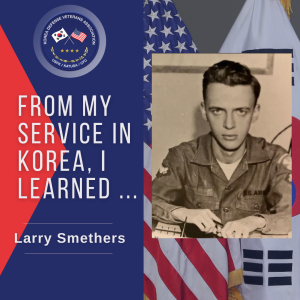
In September 1967, I was drafted into the Army and ordered for basic training at Fort Polk, Louisiana. Fort Polk is near Leesville and Lake Charles, Louisiana. I signed for an additional year to choose a training program for Army Communications Center Specialists. After basic training, I was sent to Fort Gordon, Georgia, near Augusta, Georgia. After completion in February 1968, I received a promotion from private to SP4 with secret clearance and orders to report to Vietnam.
On January 23, 1968, the USS Pueblo ship was captured in international waters off the coast of North Korea by North Korean forces. My orders and those of my unit were changed from Vietnam to South Korea. I flew from Fort Gordon, Georgia, to Fort Lewis, Washington, then to Fort Richardson, Alaska. Fort Richardson is adjacent to Anchorage, Alaska. In 2010, Fort Richardson merged, with nearby Elmendorf Air Force base to form a joint base, Elmendorf-Richardson. I flew from here to Tokyo, Japan stopover and then to Kimpo, Air Base, South Korea, 9 miles west of Seoul. I moved on to the replacement battalion in Ascom City, Korea, to wait for my assignment. I was assigned to the 6th Medical Depot at Ascom City, Korea in February 1968.
The 6th Medical Depot had several divisions and sections commanded by LTC Earl G. Pepmiller. There were Headquarters Division, Optical Division, Stock Control Division, Medical Equipment Division, Maintenance Division, Motor Pool, and Unit Supply. The Detachment-Orderly Room was at a separate location from the Depot. We normally used buses back and forth. The Detachment area included our living quarters which were Quonset Huts. KATUSA personnel and Korean nationals were assigned throughout all divisions and units of the Depot. They were very hard and efficient workers and motivated to achieve the mission of the 6th Medical Depot. The Korean people are very friendly and expressed gratitude for our participation in the defense of their country.
My assignment with the Depot was as S-2/3 Security, Plans and Operations NCO at Depot Headquarters. I was also in charge of the required Saturday morning training as a training NCO. I had an office designated “War Room,” which contained a large safe for classified documents that I handled due to my Secret Clearance. Training on Saturday morning included all subjects required by Eighth Army and 65th Medical Group. After leaving Korea, I received the Eighth U.S. Army Certificate of Achievement Award for performing the duties of an E-7.
There were two mess halls available, one in the detachment area and one at 121 Evacuation Hospital, which was adjacent to the 6th Medical Depot. I usually ate lunch at this location. On December 23, 1968, after 11 months of captivity in North Korea, the crew of the USS Pueblo was repatriated to the 121 Evacuation Hospital located 10 miles west of Seoul at Acom City. The Pueblo crew was flown by helicopter from DMZ to the helicopter pad at 121 Evac Hospital. I was one of those to witness this arrival around mid-morning. As far as I know, the USS Pueblo is still in North Korea as a tourist spot and museum. I was in Maui, Hawaii around January 17 2018, when someone pushed the wrong button, sending out a false incoming missile alert from North Korea, oops.
In the summer of 1968, at Ascom City, the USO had a show which featured the 1968 Miss Debra Barnes, the Kansas winner from Moran, KS, and other Miss America participants. Also, that summer, new MPC (Military Payment Certificates) were exchanged from the old issue to the new issue. You took your old MPC money and exchanged it for a new issue in one day. After 16 months and 2 days, I departed Korea and reported to HHC 67th Signal Battalion, Fort Riley, Kansas, 5th Army to serve out the remainder of my service.
What did you learn from serving in Korea? Let us know –
Sharing your experiences from serving in Korea can be a powerful way to connect with others who have had similar experiences. By sharing your story, you may be able to help others who are currently serving in Korea or who are preparing to do so. You can share insights about the culture, the people, and the challenges you faced while serving. Your story can also help to shed light on the sacrifices that service members and their families make in order to protect our freedoms. So, if you have a story to share, we encourage you to take the time to put it down in writing and send it to KDVA.MyServiceInKorea@gmail.com along with any photos that help to tell your story.
Your contribution may be just what someone needs to hear in order to feel connected and supported.

Leave a Reply