


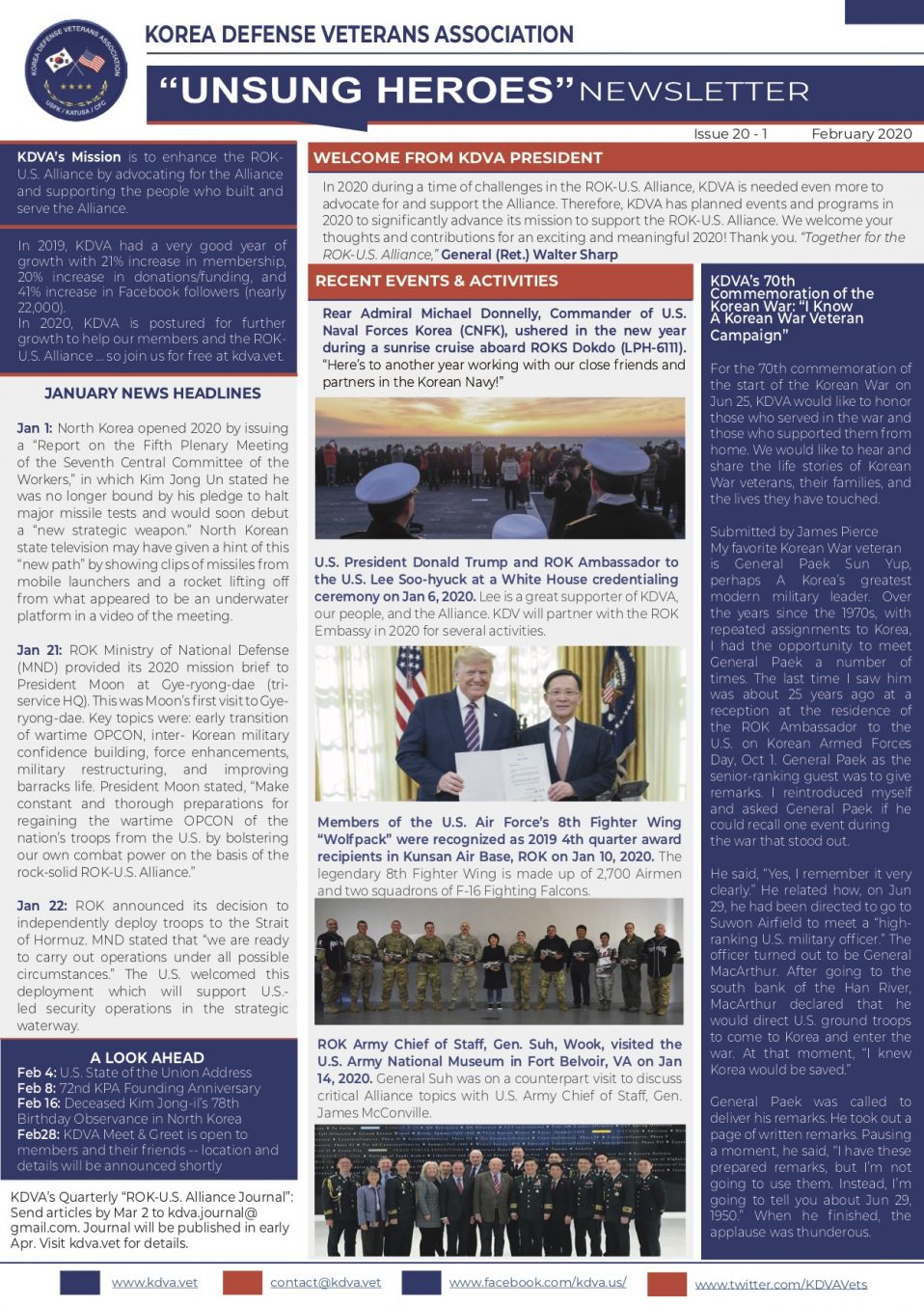
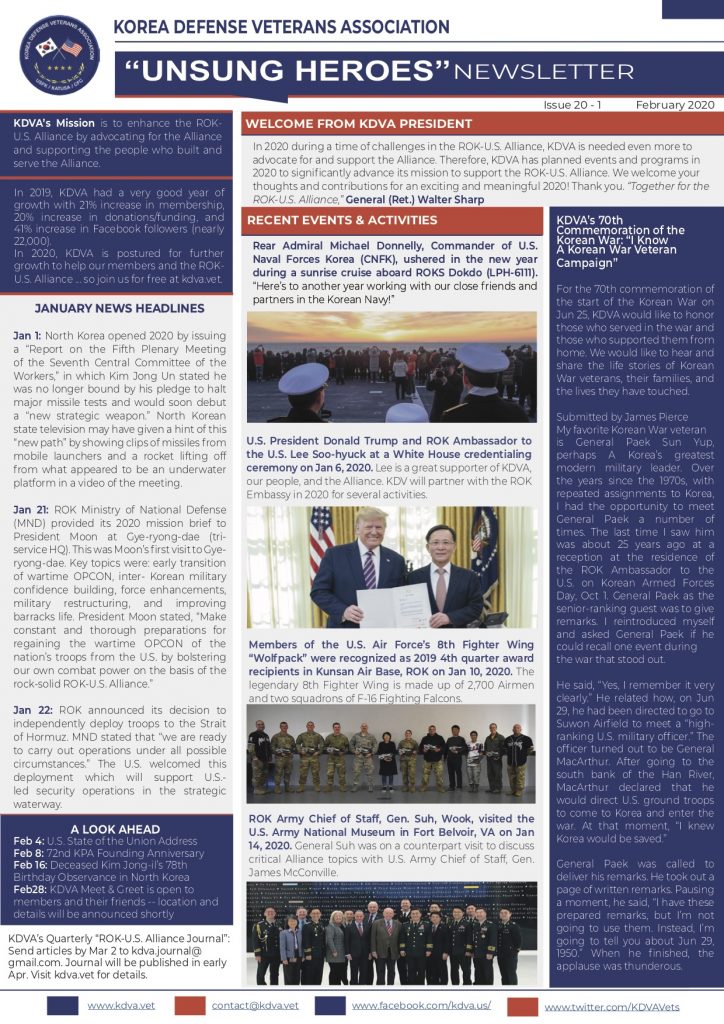
Download English Version: KDVA Newsletter Issue 20-1 Feb 2020
Download Korean Version: Coming Soon!

 For the 70th commemoration of the start of the Korean War, KDVA would like to honor those who served in the war and those who supported them from home. We would like to hear and share the life stories of Korean War veterans, their families, and the lives they have touched.
Through written stories, photos, and short videos, we hope that people will find new appreciation for our Korean War veterans and the importance of the ROK-U.S. Alliance. We also hope that veterans and their families will draw closer together as they discover new meaning and appreciation for the veterans’ experiences.
These stories will be living reminders of the immeasurable contributions of our Korean War veterans to the security and prosperity of the enduring ROK-U.S. Alliance.
We will select some of these stories to highlight them below, at KDVA events, in the monthly KDVA “Unsung Heroes” Newsletter, and quarterly KDVA “ROK-U.S. Alliance Journal.”
We ask anyone who is a Korean War veteran or knows a Korean War veteran to write short stories and share them along with pictures or videos with us. Please email your stories and photos to 70KWstories.kdva@gmail.com.
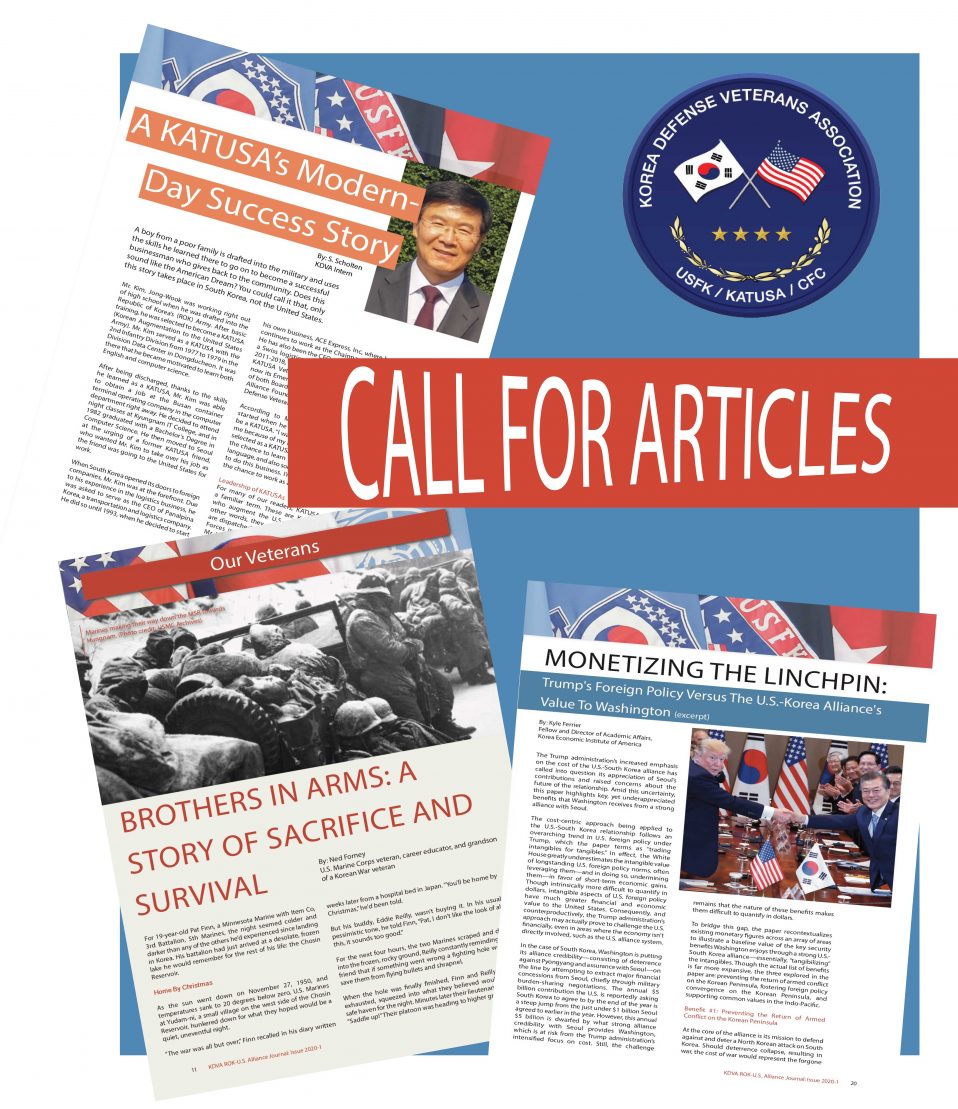
The digital journal features stories and articles by KDVA members and supporters of the ROK-U.S. Alliance. It allows our members and supporters a way to voice their expertise and opinions that add to discussions about the Alliance.
The journal will go to our members, our partner organizations, potential sponsors, Alliance experts in the ROK and U.S. governments, and U.S. and ROK think tanks.

Submission Guidelines:
Please send any questions or articles to kdva.journal@gmail.com by June 5. If your articles are selected for publication, we will contact you for further steps.

Download PDF Version: KDVA ROK-U.S. Alliance Journal 2020-1
Resumes accepted until 4:00 p.m. EST on January 9, 2020 at: eaposition.kdva@gmail.com.
The employer does not discriminate against any candidate on the basis of age, race, color, religion, disability, sex, national origin, or veteran status.
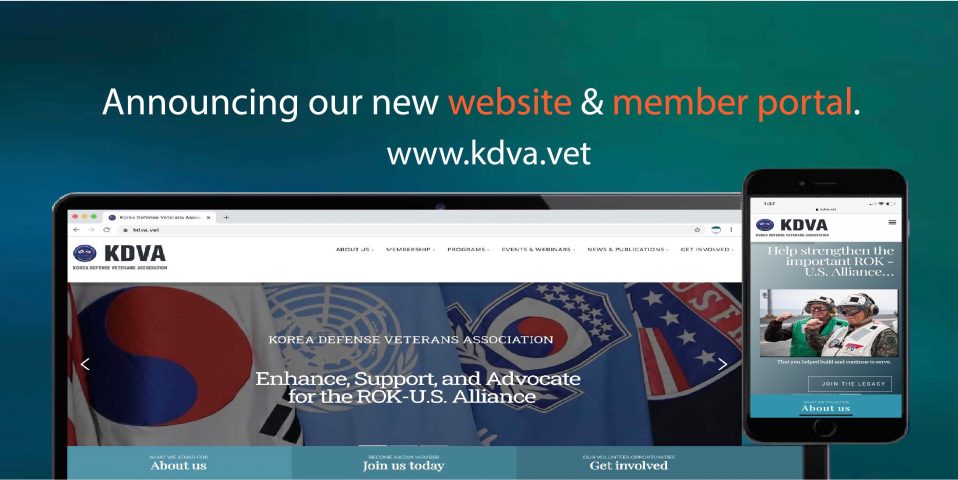
REGULAR MEMBERS:
ASSOCIATE MEMBERS:
THROUGH THIS PORTAL, REGULAR AND HONORARY MEMBERS HAVE ACCESS TO:
|
|
Manage your personal membership profile and information |
 |
Search the Member Directory and connect with other members as well as Servicemembers you served with in Korea. |
 |
Engage with committees and view resources and journals |
 |
Register for events |
On December 3rd, KDVA members received a separate email with information on how to access the new KDVA member portal, login and update your profile. If you didn’t receive this email or have questions, please email, contact@kdva.vet.
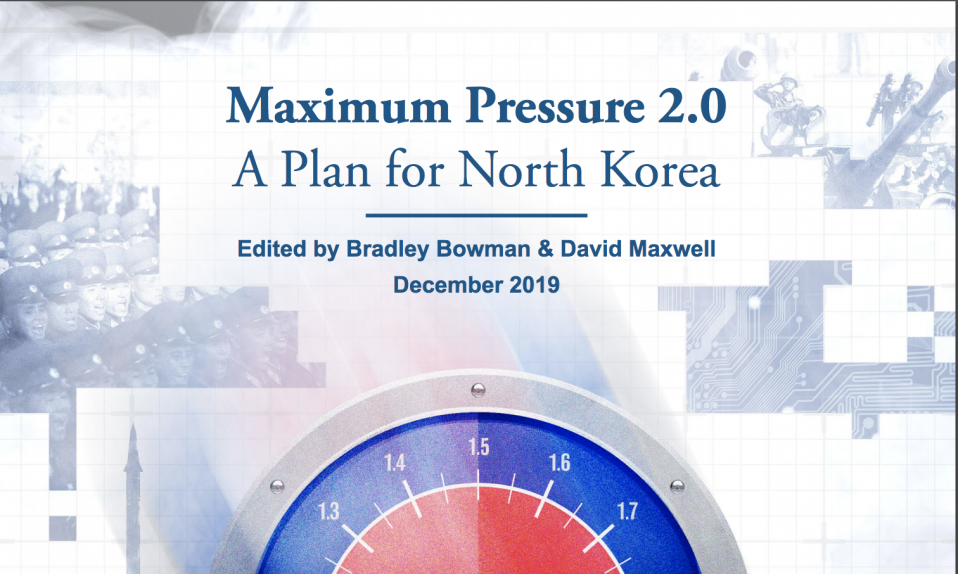
“Maximum pressure 2.0” campaign employing all tools of national power “likely represents the only way to denuclearize North Korea without resorting to war,” new think tank report finds
Includes recommendations related to diplomacy, military posture, cyber operations, sanctions, and information and influence activities
Washington, D.C., December 6 – The United States should target Pyongyang with a new “maximum pressure 2.0 campaign” that employs all tools of national power and seeks to persuade Kim Jong Un to relinquish the regime’s weapons of mass destruction, according to a new comprehensive report released today by the D.C.-based Foundation for Defense of Democracies (FDD).
In “Maximum Pressure 2.0: A Plan for North Korea,” six FDD experts explain that current U.S. policy has failed to persuade Kim to denuclearize and assess that the North Korean threat remains undiminished. Based on this, the authors recommend that the United States, working with its allies and partners, implement a “Plan B” integrating diplomacy, military posture, cyber operations, sanctions, and information and influence activities. While the experts acknowledge that this plan could increase tensions in the short-term, they suggest “such a campaign likely represents the only way to denuclearize North Korea without resorting to war.”
“Kim Jong Un’s nuclear and missile programs represent a grave threat to the U.S. and our allies, and we cannot allow him to drag-out the status quo indefinitely,” says co-editor Bradley Bowman, senior director of FDD’s Center on Military and Political Power. “In the short term, if Kim fails to demonstrate good faith with tangible steps toward relinquishing his nuclear, biological, and chemical weapons, the United States should lead an aggressive and comprehensive new pressure campaign without delay.”
“Kim will give up his nuclear program only when he concludes that its cost to him and his regime is too great – that is, when he believes possession of nuclear weapons threatens his survival,” explains co-editor David Maxwell, FDD senior fellow and former planner with the ROK/U.S. Combined Forces Command. “But external pressure alone, although important, will almost certainly fail to create the right cost-benefit ratio. It is the threat from the North Korean elite, military, and people that is most likely to cause Kim to give up his nuclear weapons.”
The anthology represents the combined work of FDD’s three centers on American power: the Center for Cyber and Technology Innovation, the Center on Economic and Financial Power, and the Center on Military and Political Power.
About FDD:
The Foundation for Defense of Democracies (FDD) is a Washington, DC-based non-partisan policy institute focusing on foreign policy and national security. Visit our website at www.fdd.org and connect with us on Twitter, Facebook, and YouTube.

North Korea’s nuclear, biological, and chemical weapons represent a grave threat to the United States and its allies. To convince North Korean leader Kim Jong Un to relinquish these weapons, the Trump administration initiated a “maximum pressure” campaign. This effort imposed significant economic costs on North Korea and incentivized Kim to come to the negotiating table. So far, however, this pressure has been insufficient to persuade him to denuclearize.
It is certainly possible that no level of pressure will persuade Kim to change course. But there is a need to test that proposition. The United States and its partners have not yet implemented a more aggressive and comprehensive maximum pressure campaign that targets Kim’s cost-benefit analysis. Such a campaign likely represents the only way to denuclearize North Korea without resorting to war.1
This monograph proposes that the United States, working with its allies and partners, implement a “Plan B” to drive Kim to relinquish his nuclear, biological, and chemical weapons. Such a campaign must integrate all tools of national power, including diplomacy, military, cyber, sanctions, and information and influence activities.
After setting the scene in the introductory chapter, this study includes a dedicated chapter on each of the five lines of effort that together should constitute a “maximum pressure 2.0” campaign. Each chapter is written by experts at the Foundation for Defense of Democracies and provides background, analysis, and specific recommendations.
In the chapter titled “Aggressive Diplomacy,” Mathew Ha, David Maxwell, and Bradley Bowman warn against falling prey again to the North Korean regime’s longstanding practice of diplomatic deception. The authors note that Pyongyang routinely makes provocations both to advance its nuclear and missile capabilities and to win valuable concessions through negotiations. They also note that Pyongyang has violated every agreement it has reached over the last 20 years. The authors caution against additional presidential-level summits. Instead, they encourage the United States to redouble its efforts to jumpstart substantive working-level dialogues that establish specific timetables for the inspection, dismantlement, and verification of each nuclear and missile facility. In order to build necessary unity with South Korea and Japan while shaming China and Russia for obstructionism, the authors emphasize the importance of a comprehensive public diplomacy campaign that provides America leverage in its standoff with Pyongyang.
In the chapter titled “Military Deterrence and Readiness,” David Maxwell, Bradley Bowman, and Mathew Ha emphasize the importance of South Korea-U.S. military readiness in deterring North Korean aggression, protecting U.S. interests, empowering effective diplomacy, and supporting a maximum pressure campaign. The authors note that the North Korean military threat has not decreased. They also note the assessment of the U.S. Department of Defense’s 2019 Missile Defense Review that North Korea has “neared the time when” it could “threaten the U.S. homeland with missile attack.” The authors propose several specific steps to strengthen allied military readiness, protect U.S. national security interests, and support a maximum pressure 2.0 campaign. In the end, they note, American power is what deters North Korea.
In the chapter titled “The Cyber Element,” Mathew Ha and Annie Fixler note that Pyongyang continues to employ an aggressive cyber campaign to generate revenue and conduct intelligence, surveillance, and reconnaissance. The authors call for a U.S.-led cyber-enabled information and offensive cyber campaign targeting North Korea. They propose specific cyber-related actions against China, Russia, and other countries to persuade them to dismantle North Korea’s cyber network. To help carry out these efforts, the authors call for the creation of a joint South Korea-U.S. cyber task force.
In the chapter titled “U.S. Sanctions Against North Korea,” David Asher and Eric Lorber detail the existing sanctions regime targeting North Korea. The authors describe Pyongyang’s efforts, working with Chinese entities and others, to circumvent these sanctions. The authors propose specific measures to increase the economic pressure on Pyongyang. Examples include revitalizing the North Korea Illicit Activities Initiative, designating the leadership of major Chinese banks that engage in prohibited transactions with North Korea, hardening small banks against North Korean sanctions evasion, and targeting joint ventures. In short, there is more room to squeeze the North Korean regime.
In the chapter titled “Information and Influence Activities,” David Maxwell and Mathew Ha argue that aggressive information and influence activities represent an essential component of a successful maximum pressure 2.0 campaign. The authors believe that external pressure alone is unlikely to persuade Kim to denuclearize. They recommend a number of specific information and influence activities targeting North Korea’s regime elite, second-tier leadership, and general population. These activities would seek to foster Kim’s perception that the security of his rule will continue to deteriorate until he decides to relinquish his nuclear weapons. Even if information and influence activities do not yield the desired outcome, these tools can prove useful in the event of renewed military conflict.

Download English Version: KDVA Newsletter Issue 19-4 Dec 2019
Download Korean Version: KDVA Newsletter Issue 19-4 Dec 2019 (Korean)
New KDVA Quarterly Journal Beginning in January 2020
The digital journal will allow our members another volunteer opportunity to voice their expertise and opinions that add to discussions about the Alliance. The journal will go to our members, our partner organizations, potential sponsors, Alliance experts in the ROK and U.S. governments, and U.S. and ROK think tanks.
Your articles in English about the ROK-U.S. Alliance are welcome until 29 November 2019. Please send any questions or articles to kdva.journal@gmail.com. If your article is selected for publication, we will contact you for further steps.
We would also like to hear what you would like to call the journal – just as a member suggested “Unsung Heroes” for our new monthly newsletter.
Thank you and “Together for the ROK-U.S. Alliance!”
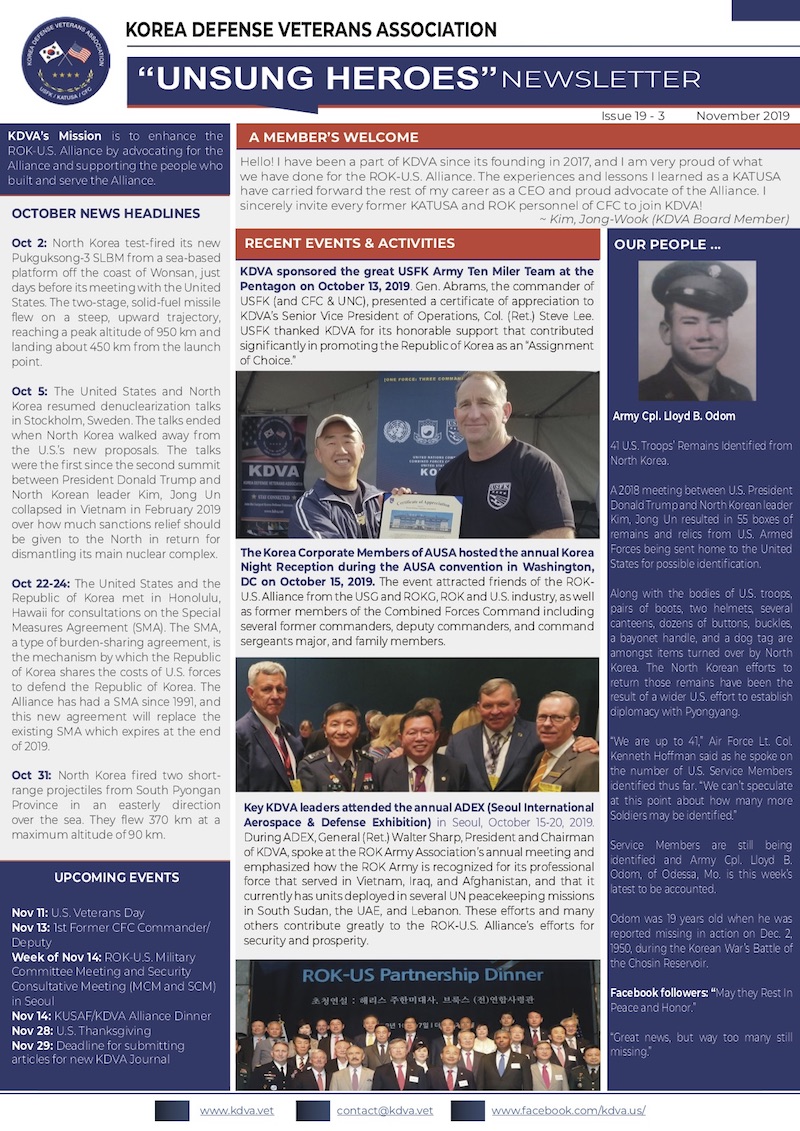
Download English Version: KDVA Newsletter Issue 19-3 Nov 2019
Download Korean Version: KDVA Newsletter Issue 19-3 Nov 2019 (Korean)
The Korea Defense Veterans Association (KDVA) is a nonpolitical, nonprofit organization dedicated to enhancing the ROK-U.S. Alliance and supporting the people who built and serve the Alliance.
Join the Largest Korea Defense Veterans Network
KDVA’s mission is to enhance the Republic of Korea – United States Alliance by advocating for the Alliance and supporting the people who built and serve the Alliance.

JOIN THE MISSION
Membership is FREE for all ROK-U.S. supporters.
