2026 2nd Quarter Edition
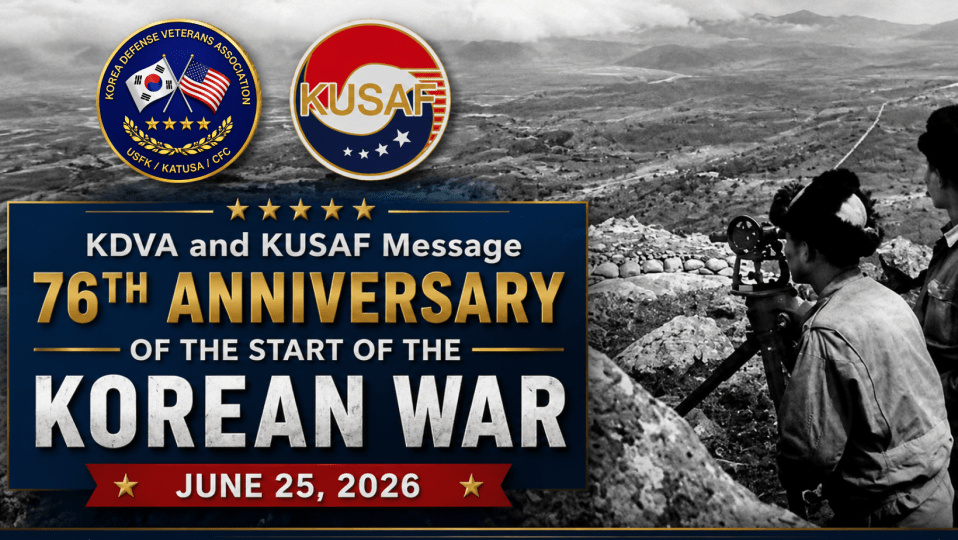
KDVA and KUSAF Message 76th Anniversary of the Start of the Korean War June 25, 2026
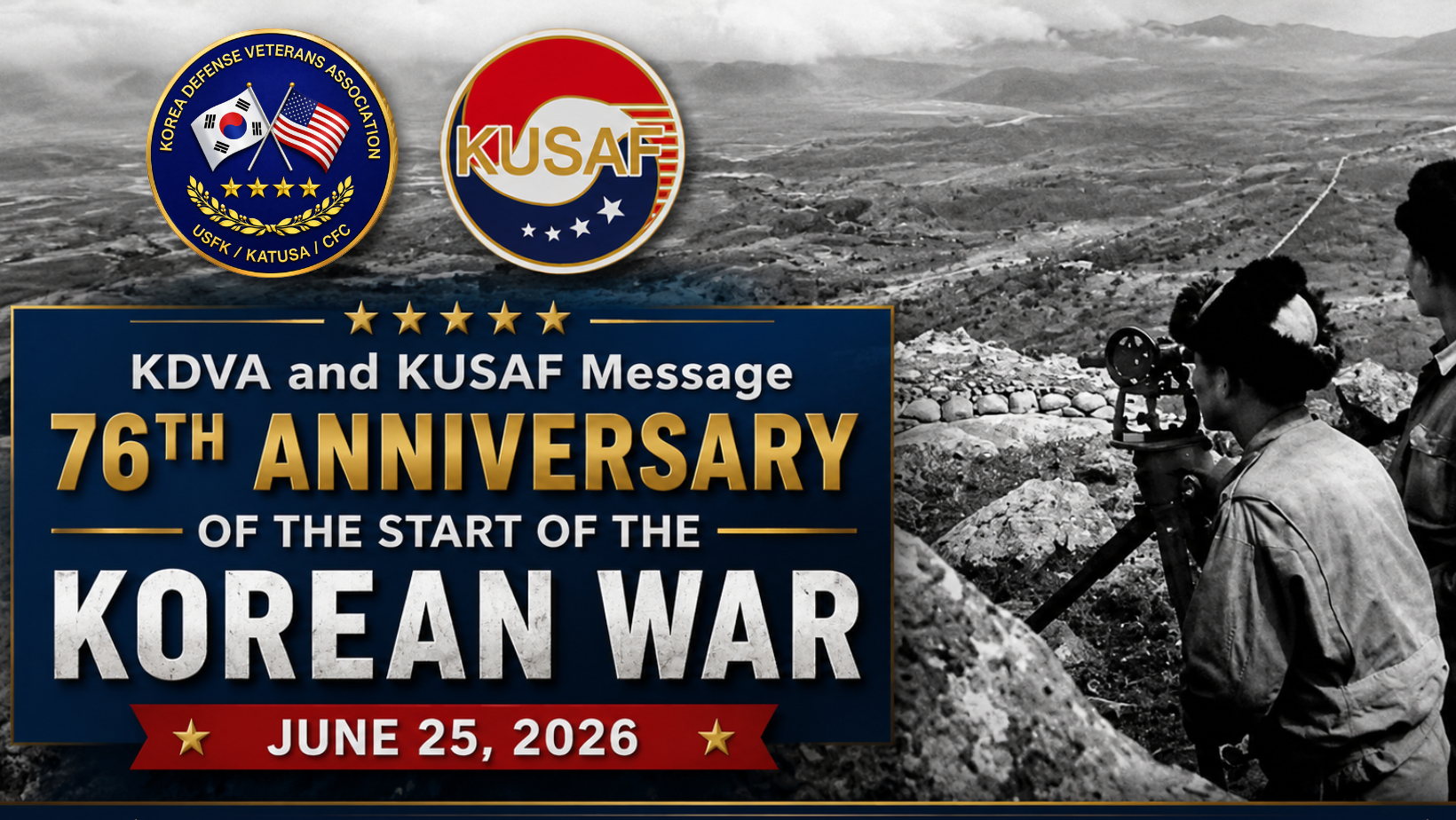
KDVA and KUSAF Message
76th Anniversary of the Start of the Korean War
June 25, 2026
Today, the Republic of Korea stands as one of the world’s leading democracies and a global economic powerhouse. The prosperity, security, and friendship that define the Republic of Korea–United States Alliance today were built upon the courage and sacrifice of a generation that answered the call when freedom was under attack.
On June 25, 1950, North Korea launched an unprovoked invasion of the Republic of Korea, beginning a war that would test the resolve of two nations and change the course of history. More than 1.8 million Americans and 2.5 million South Koreans served during the Korean War. Thousands made the ultimate sacrifice. Many more returned home carrying memories and wounds that would remain with them for the rest of their lives.
Seventy-six years later, we continue to remember and honor these Veterans and their Families not only for what they endured, but for what they achieved. They helped the Republic of Korea rise from the devastation of war to a prosperous and democratic nation that stands today as a testament to their sacrifice. Their service strengthened the bonds between two nations and established an Alliance that remains irreplaceable for the security and prosperity of Northeast Asia.
Today, the responsibility for preserving that legacy belongs to all of us.
At the Korea-US Alliance Foundation (KUSAF) and the Korea Defense Veterans Association (KDVA), we remain committed to honoring our Veterans, educating future generations, and enhancing the ROK-U.S. Alliance. Through public engagement, people-to-people relationships,1leadership development, and educational programs, we seek to ensure that the lessons and sacrifices of the Korean War are remembered.
This responsibility is especially important as the generation that fought the Korean War passes from our midst. Their stories must be preserved. Their service, courage, sacrifice, and contributions must continue to inspire future generations.
The Alliance they forged remains strong.
The freedom they defended endures.
The legacy they created is now ours to carry forward.
“Together for the ROK-U.S. Alliance”
Robert B. “Abe” Abrams
President, KDVA President, KUSAF
Leem, Ho Young
General, U.S. Army (Retired) General, ROK Army (Retired)
From My Service in Korea, I Learned – Paul Hooper
From My Service in Korea, I Learned – By Paul Hooper
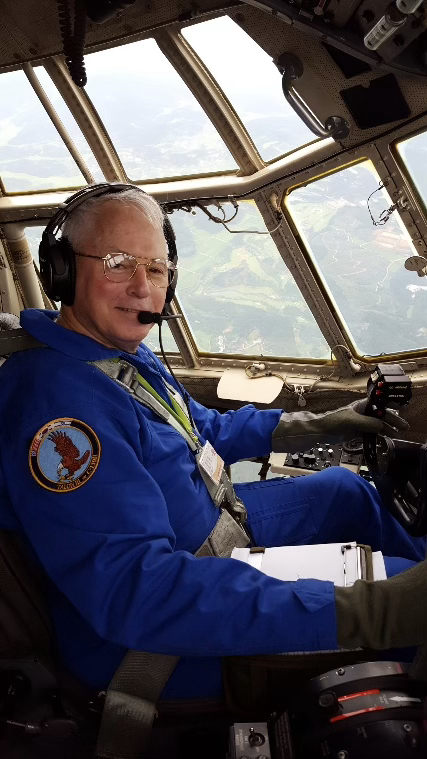
 My name is Paul Hooper. I am a retired USAF Command Pilot and Major. My first assignment out of USAF pilot training was to the 345th Tactical Airlift Squadron at Kadena AB, Okinawa as a C-130E Co-Pilot. I arrived on station in August 1974. My first operational flight was to Osan AB. There were no rooms in the “Q” so we were sent off base. At that time only the main road in Song Tan was paved. The crew bus exited the base and immediately turned right down a dirt street lined with stalls selling vegetables and other food goods. It was a short drive and we checked into the Clover Hotel.
The next day we flew from Osan up to A-222 a short field runway up near P-518. We made two trips hauling troops to Cheju Do where we were told they had rappelling training and some R&R. Flew back Kadena that afternoon.
In May we deployed to Kwang Ju AB to participate in Exercise Capstan Dragon which I believe was the precursor to the Team Spirit Exercise program. During Capstan Dragon we participated in a sixteen aircraft large troop movement from Pohang to A-222.
Over the next three plus years I flew numerous missions similar to that mission. The squadron moved to Yokota AB, Japan in September 1975 and I continued to fly to Korea for individual missions and exercises. We really enjoyed missions that required an Remain Over Night (RON) in Osan as we shopped for tailor made clothes, sneakers, old school clocks, stuffed animals, etc. I loved my time in Korea and watched Korea grow and improve in just those few short years. I knew and looked forward to returning to the Land of the Morning Calm. I was assigned to the 1st Special Operations Squadron at Clark AB, Republic of the Philippines in April 1982 flying the MC-130E aircraft. We routinely deployed to Taegu AB, Osan AB and Suwon AB to fly training missions in the mountains of Korea and support ROK Army Special Operations in blacked out airdrops. I participated in Foal Eagle 1982 and Foal Eagle 1983 operating out of Taegu AB. During those two stays I witnessed one of the most impressive examples of Korean industry and hard work. During Foal Eagle 1982 the traffic was detoured around the bridge and across the river bed. We watched the bridge being completely torn down during our stay. When we returned for Foal Eagle 1983… there was a brand-new bridge. That was fast.
We deployed to Kimhae AB for Team Spirit 1983 and were billeted in a tent city. I was the chief of the Advance Team (ADVON) and coordinated the use of Harvest Bear materials to build a Combined Air Forces Special Operations Base (CAFSOB) which supported USAF and ROKAF
My next assignment was to Headquarters Pacific Air Forces (PACAF) where I was the Chief of the Special Operations Division responsible for USAF Special Operations in the PACAF theater. I deployed to augment the operations staff at the Combined Unconventional Warfare Task Force (CUWTF) at Seong Nam during Foal Eagle, ULCHI Focus Lens, and Team Spirit exercises.
In 1990 while assigned as the AFSOF Liaison Officer to the John F. Kennedy Special Operation Center and School (JFKSWCS) I deployed to the CUWTF to augment the staff during Exercise ULCHI Focus Lens.
In January 1993 while assigned to the 1st Special Operations Wing at Hurlburt Field, Florida I made my final deployment to Exercise ULCHI Focus Lens. Visited the Tree House and said farewell to many long time friends… American and Korean. I returned to Hurlburt and retired at the end of January 1993.
I would never have imagined I would be given the opportunity to return to Korea 24 years later. I was invited to participate in the development, operational, and acceptance testing of a Terrain Following System for the ROKAF C-130H aircraft. I spent most of the summer and fall of 2017, six weeks in the summer of 2018, and six weeks in the late summer of 2019 flying out of the Korean Aerospace Industries (KAI) facility on Sacheon AB. The best job I ever had. Working with the ROKAF, KAI, and Elbit Systems was a pleasure. During our time off we traveled around Korea like tourist and were able to visit Osan/Songtan, Camp Walker, etc.
On 13 October 2017 we had what we thought was our last flight. We did not think we would be returning. The Sacheon Aerospace Expo 2017 was on-going at Sacheon AB and watched the Black Eagles demonstration from the apartment on Saturday and Sunday. On Monday afternoon, 30 October, Ed and I took the bus from our apartment and went to the base to see the demonstration. Our timing was perfect. We arrived right before the Black Eagles demonstration. We were behind the rope right in front of Black Eagle #1 for start up, taxi, and takeoff. We were in the same spot for the entire airshow.
The Black Eagles put on a great aerial demonstration. One thing that made it better than some airshows I had been to, was that the music being played over the loudspeaker system was choreographed with the flight demonstration. As the eight aircraft flew up initial for landing, an announcement was made in Korean. The Korean next to us told us he had said that two of the Black Eagles were performing their last airshow as the two pitched up while the rest of the team pitched out for landing. As they pitched up “Time to Say Goodbye” started to play. It choked me up and brought tears to my eyes.
As the main group of the Black Eagles were on downwind, the two aircraft flew over inverted, joined the team on the downwind, and landed. But that was not the end. As the aircraft were taxiing in, a ROKAF Warrant Officer came up to the rope and said “Please come with me.” He lifted the rope and took me down the line to where they were gathering people to greet the team. We walked out to the team and Black Eagle #2 gave me a Black Eagles hat.
As luck would have it we ended up returning in 2018 and 2019 and stayed at the Sacheon Grand Hotel





What did you learn from serving in Korea? Let us know –
Sharing your experiences from serving in Korea can be a powerful way to connect with others who have had similar experiences. By sharing your story, you may be able to help others who are currently serving in Korea or who are preparing to do so. You can share insights about the culture, the people, and the challenges you faced while serving. Your story can also help to shed light on the sacrifices that service members and their families make in order to protect our freedoms. So, if you have a story to share, we encourage you to take the time to put it down in writing and send it to KDVA.MyServiceInKorea@gmail.com along with any photos that help to tell your story.
Your contribution may be just what someone needs to hear in order to feel connected and supported.
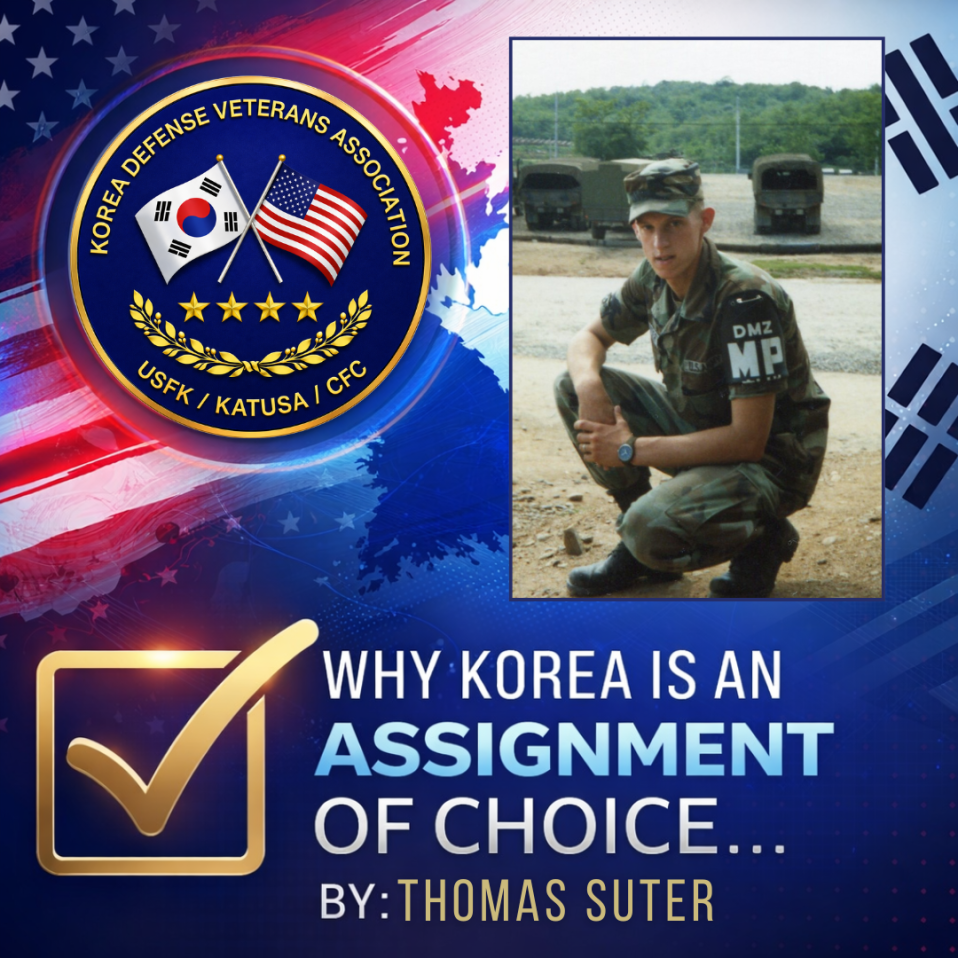
Why Korea is an Assignment of Choice – By Thomas Suter
Why Korea is an Assignment of Choice – By Thomas Suter

What was your initial reaction upon learning that you were going to Korea?
I enlisted as a 19D Cavalry Scout in 1987. When I arrived at Ft Knox all of the Bradley’s were tied up with ROTC. The army gave me a choice: they could dissolve the contract or I could be trained on the M-113. I had the impression the NCO had been told to get everyone to sign new contracts and not discharge anyone. I told the NCO I’d sign a new contract if I could have my duty station of choice. He looked skeptical and asked me where I wanted to be stationed. I told him Korea and his demeanor instantly changed and he couldn’t get that new contract written fast enough.
Why did you have that reaction?
My dad served with 4/7 Cav in 1967-1968. He was there when the USS Pueblo was seized and I’d seen a few pictures from his time in Korea. From what little I knew I felt like Korea was the last of the old Army and I wanted to patrol the DMZ because it was a real world mission. At the time it seemed like the only real world mission the U.S. Army was involved with.
What did you know about Korea?
I’d always been interested in military history, mostly WWII, but I’d read a few books about the Korean War. I was also familiar with the Pueblo and the DMZ ax murders.
Was there an “aha!” moment that made you think that being in Korea was good?
Not really. As soon as we landed and started in-processing I knew it would be a good tour. I was assigned to the Scout Platoon, HHC, 5/20, Inf, at Camp Casey. I always thought the 2ID had the best looking patch in the Army and when I saw all of the old Quonset huts I felt like I had been assigned to the last of the old army.
How did serving and living in Korea shape your career, life, or worldview? And your family’s?
After the army I became a cop and retired as a lieutenant after 30 years. Living in a country under martial law and a totally different culture definitely made me appreciate our country much more. One of my friends was a KATUSA and he took me to his house and showed me around the country. The experiences I had in Korea made it easier to interact with different cultures when I was a cop. When I look at Korea today as compared to 1987 and see the progress they’ve made, I’m proud of them, and proud that I patrolled the DMZ.
What experiences left a lasting impression, good or bad?
N Korea shot down KAL flight 858 several months after I arrived. After refueling in Japan and continuing on to Korea I looked out the window and saw a fighter off our wing. The back seater was holding up a piece of cardboard that said “Welcome to Korea, turtles”. After my assignment to the 2ID I found out pretty quickly what that meant. At the time I thought the fighter escort was a bit of overkill. After the shoot down of KAL 858 I didn’t think it was overkill. A few months after I met my wife she introduced me to a man named Alvin Plucker. My wife grew up with his kids and he was like a second father to her. I was sitting in Alvin’s den and noticed he had a picture of the Pueblo on his wall. When I asked him about it he told me he was the Quartermaster when the ship was seized by N Korea. We spent hours talking about his experiences. My wife had known Alvin all of her life and had no idea who he was. My dad was in Korea when the Pueblo was seized and had his mid-tour leave cancelled because of it. I later introduced my dad to Alvin.
Scouts Out,
Thomas Suter

Why Korea is an Assignment of Choice ? Let us know –
This initiative invites current and former Service Members, civilians, diplomats, and families to share their stories and reflections on why serving in Korea — whether with United States Forces Korea (USFK) or at the U.S. Embassy in Seoul — was one of the most meaningful and rewarding chapters of their lives.
Whether your experience involved joint operations, discovering the beauty of Korean culture, forging lifelong friendships, or contributing to one of the world’s strongest alliances, we want to hear from you!
Share Your Story by Telling Us:
- What was your initial reaction upon learning that you were going to Korea?
- Why did you have that reaction?
- What did you know about Korea?
- Was there an “aha!” moment that made you think that being in Korea was good?
- How did serving and living in Korea shape your career, life, or worldview? And your family’s?
- What experiences left a lasting impression, good or bad?
Submissions can be written, video-recorded, or even a simple quote with a photo. Selected stories will be featured on all KDVA social media platforms, our website, and Journals.
How to Submit:
Email your story to KDVAKoreaChoice@gmail.com and tag us on social media using #KDVAKoreaAssignmentOfChoice.
There is no deadline. We will keep this going because we will not run out of stories from the millions of people who have served in Korea over the past 75 years!
Help us show the world why Korea isn’t just an assignment — it can be life changing!

Master Chief Petty Officer of the Navy, James Honea, Joins KDVA Senior Enlisted Council
Master Chief Petty Officer of the Navy, James Honea, Joins KDVA Senior Enlisted Council
May 27, 2026
Please join the Korea Defense Veterans Association (KDVA) Board of Directors in welcoming Master Chief Petty Officer of the Navy (Ret.) James Honea as the newest member of the KDVA Senior Enlisted Council.
“We are honored to welcome MCPON (Ret.) James Honea to KDVA’s leadership team,” said General (Ret.) Robert B. “Abe” Abrams, KDVA Chairman and President. “He is a proven leader who has spent his career strengthening teams, building trust, and taking care of Sailors and their Families. His service in Korea and across the Indo-Pacific gave him a deep, personal understanding of the ROK–U.S. Alliance—not just as a mission, but as a relationship built between our people. That perspective is what makes him such a strong addition to our Senior Enlisted Council and to the KDVA team.”
MCPON (Ret.) Honea most recently served as the 16th Master Chief Petty Officer of the Navy, the highest enlisted position in the United States Navy. In that role, he served as the principal enlisted advisor to the Chief of Naval Operations and Secretary of the Navy, representing more than 400,000 Sailors and their families.
Prior to serving as MCPON, Honea held key senior enlisted leadership roles across the Indo-Pacific, including Command Senior Enlisted Leader for U.S. Indo-Pacific Command and Command Master Chief of U.S. Naval Forces Korea.
Beyond his distinguished service, Honea brings a deep and personal connection to Korea and the ROK–U.S. Alliance. Reflecting on his time serving alongside Republic of Korea Navy counterparts, he shared in July 2023:
“Some of my most meaningful experiences in uniform were in Korea—serving side by side with our Republic of Korea Navy partners. Those weren’t just professional interactions; they were relationships built on trust, shared purpose, and daily cooperation. That’s what makes our alliance so powerful.
Returning to Busan and reconnecting with both U.S. and ROK Sailors reminded me just how strong that bond remains. We don’t just operate together—we learn from each other, we grow together, and we become better warfighters because of it.
It was an honor to serve there, and it’s a place—and a partnership—I look forward to returning to.”
“I am honored to join KDVA and support its important mission,” said Honea. “The ROK-U.S. Alliance remains one of the most important partnerships in the world, and I look forward to continuing to support the Veterans, Service Members, and Families who have contributed so much to its success.”
Please see his complete biography at https://kdva.vet/leadership/.
KDVA is a 501C(3) non-profit organization registered in Virginia with over 61,000 members and 139,000 social media followers. KDVA is non-political. KDVA was formed to enhance the ROK-U.S. Alliance and support the people who built and serve the Alliance.
Please join KDVA for FREE – anyone interested in Korea and Veterans are welcome!
Visit us at www.kdva.vet, and follow us on Facebook (@kdva.us) and Twitter (@KDVAvets).
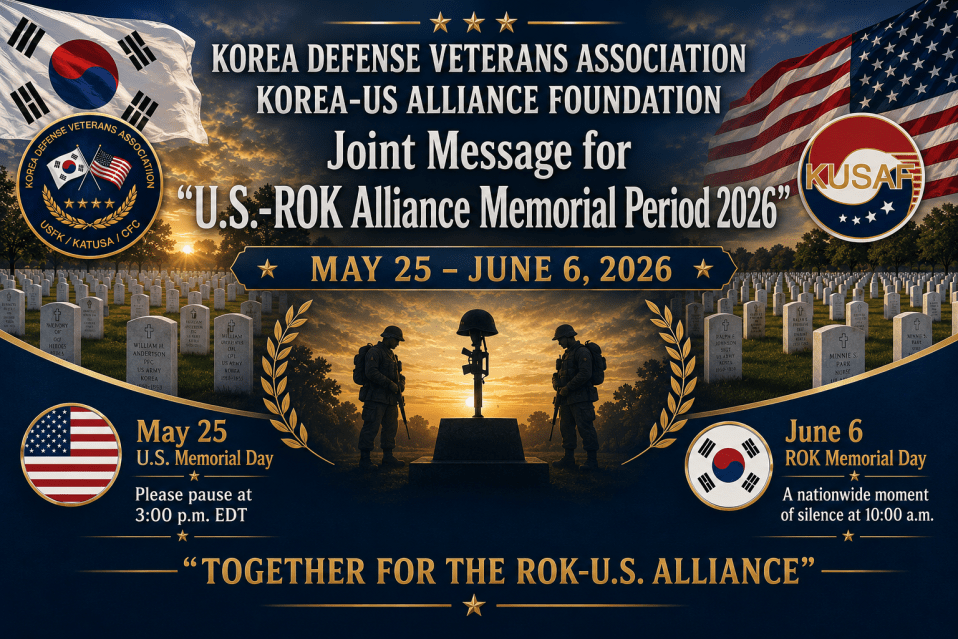
KDVA and KUSAF Joint Message for “U.S.-ROK Alliance Memorial Period 2026”
 KDVA and KUSAF Joint Message for “U.S.-ROK Alliance Memorial Period 2026”
May 25 – June 6, 2026
Remembrance is not confined to a single day. It is carried forward — in the values we uphold, the alliances we sustain, and the lives we lead in freedom.
During U.S.–ROK Alliance Memorial Period, we reflect on the men and women of the United States and the Republic of Korea who lost their lives in defense of a cause greater than themselves. Their sacrifice did more than secure a moment in history — it established a foundation for a lasting partnership between our two nations.
The Alliance they helped forge has evolved from shared sacrifice on the battlefield to a steadfast commitment to peace and security. Today, that commitment is visible not only in the Service Members who stand watch together, but also in the generations who continue to carry forward the meaning of their service.
Each life lost represents a story — of duty, of courage, and of devotion to others. Remembering them requires more than reflection; it calls on us to live in a way that honors what they gave. That is why the Korea–U.S. Alliance Foundation (KUSAF) and the Korea Defense Veterans Association (KDVA) designate May 25 to June 6, 2026, as “U.S.–ROK Alliance Memorial Period.”
We invite all Americans and Koreans to join 61,000 KDVA members in observing this time of remembrance in their own way — by visiting a memorial, attending a ceremony, sharing a story … or simply taking a moment to reflect on these days:
• On May 25, U.S. Memorial Day, please pause at 3:00 p.m. EDT.
• On June 6, ROK Memorial Day, a nationwide moment of silence is observed at 10:00 a.m.
Though separated by distance, these moments connect us in common purpose — to remember, to honor, and to remain worthy of the sacrifices made.
“Together for the ROK-U.S. Alliance”
Robert B. “Abe” Abrams
President, KDVA President, KUSAF
Leem, Ho Young
General, U.S. Army (Retired) General, ROK Army (Retired)

U.S. Military Spouse Appreciation Day
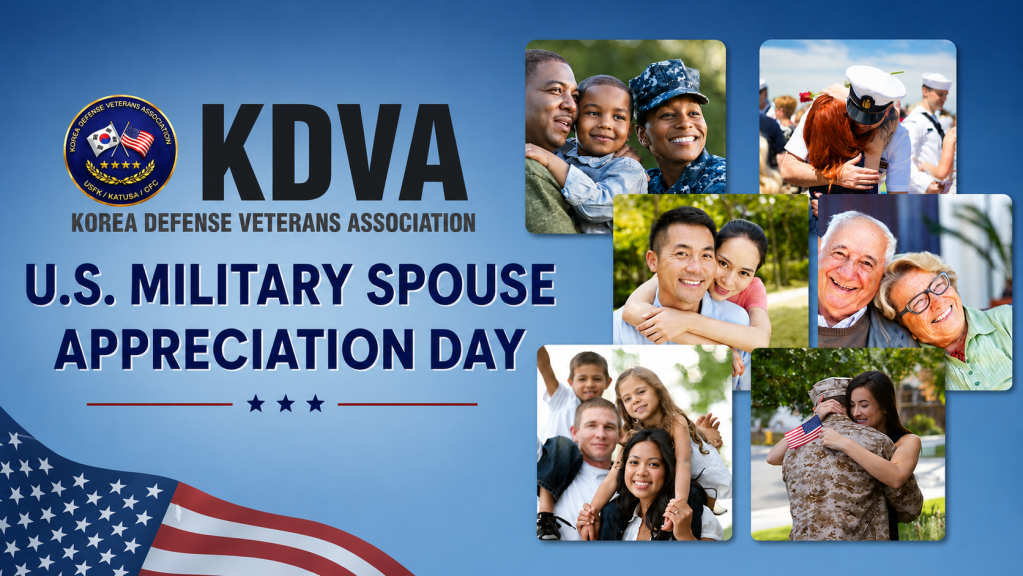
U.S. Military Spouse Appreciation Day:
Behind every assignment, every deployment, and every mission in defense of Korea, there is a constant source of strength — our military spouses.
Their support is not always visible, but it is always felt. Through moves, long separations, and the demands of service, spouses provide the stability, encouragement, and resilience that make it possible for our Service Members to serve with focus and purpose.
For those connected to Korea, that commitment often takes on an added dimension. Service on the Korean Peninsula is not just another assignment — it is part of a vital mission that has endured for generations. And alongside those who wear the uniform are spouses who share in that experience, building lives, friendships, and communities … sometimes far from home.
As KDVA continues to grow — now connecting more than 60,000 members worldwide and expanding through Chapters, Campus Clubs, and our first USFK Chapter at Camp Humphreys — we are reminded that this community is strengthened not only by those who served, but also by the families who stand beside them.
To all military spouses of our Korea Veterans and those currently serving in U.S. Forces Korea, we offer our sincere appreciation. Your sacrifices, your strength, and your unwavering support are an essential part of the ROK–U.S. Alliance.
Today is an opportunity to pause and recognize all that you do — but more importantly, it is a reminder that your contributions matter every day.
KDVA is proud to welcome military spouses as part of our community, with membership and programs available at no cost … but priceless in their impact.
Thank you for all that you do and all that you represent.

Steve Lee
Senior Vice President
Korea Defense Veterans Association

KDVA Founding Month in May 2026
KDVA Founding Month in May 2026
May 1, 2026
Each May, KDVA marks its founding by recognizing the people who give this community its identity — those who served in defense of Korea and those who continue to support and carry that legacy forward. What began as a way to connect Korea Veterans and their supporters has grown into something much larger: a dynamic, expanding movement that reflects the enduring importance of the ROK–U.S. Alliance.
Today, that growth is clear:
- More than 60,000 members worldwide
- Over 133,000 social media followers
- 7 U.S. Chapters, with 4 more launching in 2026
- 5 KDVA Campus Clubs (KCCs) engaging the next generation
- The first KDVA USFK Chapter at Camp Humphreys, connecting those currently serving with those who came before them
This is more than growth in numbers — it is a strengthening of the ties that bind our members across generations, geography, and service. For many, service and living in Korea leave a lasting mark. As one member reflected:
“Living in South Korea changed my life, shaping my worldview…”
— Mr. Dave Harris, KDVA Digital Library
That experience — shared by millions — is what continues to drive engagement, connection, and purpose within KDVA today.
We are especially grateful to our fundraising partner, the Korea–U.S. Alliance Foundation (KUSAF), whose support ensures that KDVA membership and programs remain free and accessible to all.
As we look ahead, our focus remains clear: to grow KDVA, to enhance the Alliance, and to ensure that the legacy of service in Korea continues to inspire future generations.
Whether you have been part of KDVA for years or are just joining us, your voice matters — and your continued engagement helps shape what comes next. Thank you for being part of this effort — “Together for the ROK-U.S. Alliance.”
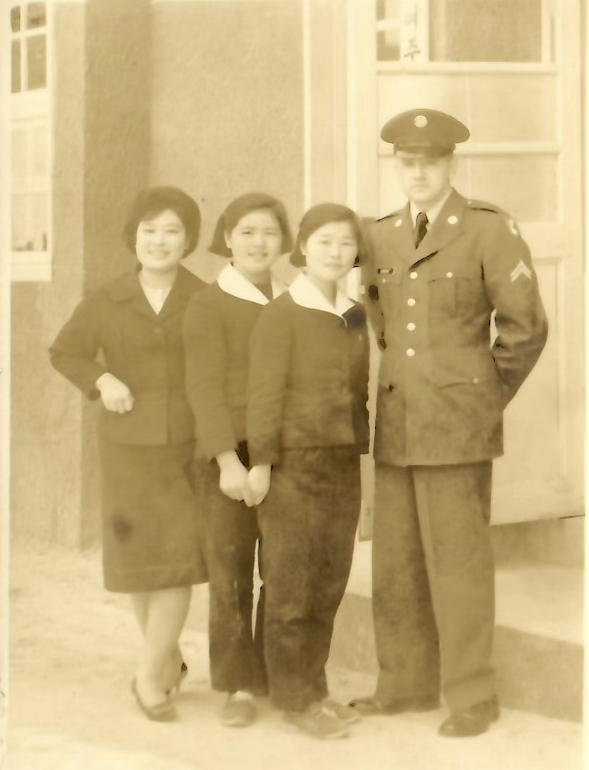
From My Service in Korea, I Learned – Samuel Perryc
From My Service in Korea, I Learned – By Samuel Perry
I was working as a teacher in a small rural school in southcentral Kentucky when I received my invitation to serve in the American armed forces. Although I could have obtained a deferment from the draft board because of my job, I did not, preferring to serve my country instead as a citizen soldier. I reported for duty in September 1962 and received Basic Combat Training at Fort Knox, Kentucky followed by eight more weeks at the Military Police School in Fort Gordon, Georgia. Following graduation, I received orders for Korea.
On February 5, 1963, I boarded the troop transport, Gen. Hugh J. Gaffey, and embarked for Inchon, Korea with stops enroute at Pearl Harbor, Yokohama, and Taiwan. On February 26, 1963, after 21 days at sea, the ship entered Inchon harbor in the middle of a ferocious and blinding blizzard and was struck midship by a South Korean freighter. Chaos ensued as the hundreds of troops on board were hastily evacuated onto landing craft. The freezing temperature, blowing snow, and confusion during the landing made my arrival in country an event that seared into my memory and is something I have never forgotten. I shiver just thinking about it. At the Army Support Command (ASCOM), we were fed and given as much hot coffee as we wanted and bedded down for the night. The next day, we were dispersed by rail to our temporary duty stations. Mine was at Camp Humphreys, a dirty little Army post located outside the town of Pyeongtaek. There, I spent three days before being trucked in the back of a deuce-and-a-half to Camp Huston, a Nike-Hercules air defense missile site some four miles west of the town of Yeoju on the Han River. Camp Huston was under construction and was the HQ of Delta Battery, 4th Missile Battalion, 44th Artillery. Military Policemen provided security.
Although my MOS was 951 and I had been trained as a Military Policeman, my duty as such ended when the 1st Sergeant learned that I was a college graduate and knew my way around a typewriter. Soon, I found myself sitting at a desk in a warm Quonset hut, out of the fierce Manchurian wind, pecking out numbers on the Morning Report and typing up letters from the Battery Commander. a physical fitness fanatic named Capt. Cole B. Whaley. However, my desk job did not exempt me from those arduous runs and endless side-straddle-hops he ordered for all personnel.
Capt. Whaley rotated back to the States and was replaced by Capt. Leo P. Hobbs, a West Point graduate and Army Ranger. Although now deceased after a long career in the Army, Capt. Hobbs, became, and remains, one of my heroes and I will be forever grateful to him for serving as a role model at a time when I most needed one.
In June, Captain Hobbs asked me if I would like to get out of the office for a few hours each day and teach school again. The new commander of Eighth Army was revisiting an old Army program to improve relations between the Army and local communities and needed soldiers of exemplary standing to serve as boots on the ground. I jumped at the chance and following a crash course in the Korean language, soon found myself on the faculty of Yeoju Primary School. Another soldier was being sent to a similar school in I’chon, two miles east of Camp Huston. His name was Sgt. Dale Perkins, who was later KIA in Vietnam.
My mentor, and South Korean counterpart at Yeoju Primary School, was Mr. Park Kyong Sik, and I learned much from him about Korean culture, student behavior, and the rigid code of conduct that governed the children. I must have done a good job in the classroom because as the new school term began again in September, I was asked to move up to the high school level. I then started teaching at Yeoju Girl’s Home Economical High School, under the supervision of Principal Yun Suk Je. I taught there until I rotated back to the States in February 1964, serving in that capacity while also continuing to work as Battery Clerk.
My work in the Korean school system required not only classroom instruction, but participation in teacher meetings. There, I got to know my fellow teachers personally and learn of the challenges they faced in restoring the educational framework that had been demolished by the war. As a Seonsaeng Nim (Honored Teacher), I also got invited to social functions and celebrations. Through these, I learned to appreciate the rich Korean heritage, the spicy cuisine, and especially the music, which to most Westerners probably sounded like noise. Not me, though. I loved it. Most enjoyable of all my activities, however, were the visits to the homes of my students.
My active duty in the Army ended in September 1964 and I returned to civilian life as a Reservist until 1968. However, I continued to regard myself as a soldier, becoming a charter member of an American Legion post in Arizona and a charter member of a VFW Post in Kentucky when Korea veterans became eligible for the Korea Defense Service Medal. At the latter, I served in many offices at the Post, District, and Department levels.
Six decades have passed since I returned home from Korea. My career as an educator was a rewarding one and I officially retired from the teaching profession after 31 years. Thousands of young faces have graced my classrooms, and I have spent countless hours counseling and seeking to serve as a positive role model, much as Capt. Hobbs did for me. But I have never forgotten the seven months I taught in the South Korean school system. Shortly after I returned home, Peace Corps volunteers arrived at the schools. They were followed, in turn, by American teachers of English who labor there to this day.
The Republic of Korea today bears no resemblance to the fledgling nation I saw when I served there. When I see photos of Seoul or any of the countryside there, I have to force myself to accept that they are real. So much has changed. Camp Humphreys has morphed into something hard to recognize. Camp Huston is long gone. I suspect that the students in the schools are also different. They are products of modernity. It was their grandparents, the ones I taught, the ones who had witnessed the horrors of the North Korean invasion, the ones who had to endure classrooms heated by charcoal burners on frigid winter days, the ones who walked four miles along rice paddy dikes to get to school, the ones who competed for allotted spaces on the school roster, and the ones who listened intently to tall Americans in green uniforms who sought to show them that soldiering was not always about waging war.
I fell in love with the Korean people while I was there and that love is as strong now as it ever was. Arirang still brings tears when I hear it and kimchi is still one of my favorite foods. When I looked out from the door of my barrack on that day in 1963 and saw a bleak land of bare mountains stripped of vegetation by the ravages of war and villages of mud huts, thatched roofs, and dirt roads, I thought I had stepped back into the 15th century. But that landscape is no more. The incredibly strong, dedicated, and patriotic men, women, and children who lived there at that time have worked hard over the past sixty years to rebuild their nation and have bequeathed to future generations a homeland of which anyone could be proud. I am just so happy and thankful to have played a small part in the transformation.


What did you learn from serving in Korea? Let us know –
Sharing your experiences from serving in Korea can be a powerful way to connect with others who have had similar experiences. By sharing your story, you may be able to help others who are currently serving in Korea or who are preparing to do so. You can share insights about the culture, the people, and the challenges you faced while serving. Your story can also help to shed light on the sacrifices that service members and their families make in order to protect our freedoms. So, if you have a story to share, we encourage you to take the time to put it down in writing and send it to KDVA.MyServiceInKorea@gmail.com along with any photos that help to tell your story.
Your contribution may be just what someone needs to hear in order to feel connected and supported.

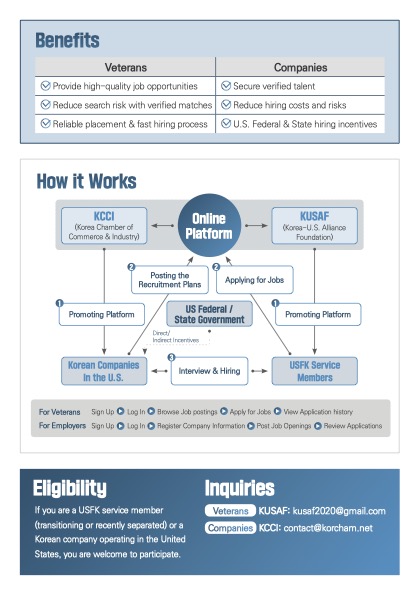
USFK personnel looking for jobs with Korean companies in the U.S.?
USFK personnel looking for jobs with Korean companies in the U.S.?
Visit the www.USFKJobs.com website to explore openings and apply.
KDVA thanks our partner, KUSAF, for creating this platform to help USFK as they leave service or former USFK personnel.