


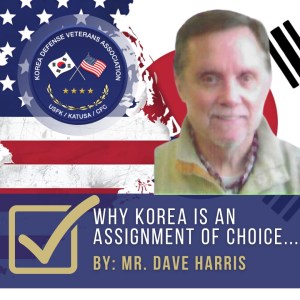
Why Korea is an Assignment of Choice – By Mr. Dave Harris
What was your initial reaction upon learning that you were going to Korea?
I cried. I had my heart set on Germany, mainly because of my German roots and the two years of German I had taken in high school. Korea was not something I had ever imagined for myself.
Why did you have that reaction?
In 1978, the United States was only five years removed from its involvement in Vietnam and less than three years from the fall of South Vietnam. I knew absolutely nothing about South Korea. Growing up, no one ever talked about the Korean War. It felt forgotten. I had never even watched MASH*, partly because I didn’t understand Army rank structure and partly because Korea was not part of my mental world.
What did you know about Korea?
Almost nothing—only that it was somewhere near Japan and China.
Was there an “aha!” moment that made you think being in Korea was good?
Yes. The moment I passed through the gate at Camp Walker in Daegu, I saw Apsan Mountain to the south of the base. For reasons I still can’t fully explain, that view brought me an immediate sense of calm, anchoring my feelings in a way I couldn’t ignore. The base layout was unlike anything I had ever seen, and both the installation and the surrounding area struck me as unexpectedly beautiful. That was the first moment I felt I might be okay there.
How did serving and living in Korea shape your career, life, or worldview—and your
family’s?
Living in South Korea changed my life, shaping my worldview and sparking a curiosity about Korea’s history that continues to influence me today. I wanted to understand the country beyond the base—to explore its past, its people, and its place in the world. I tried to meet every day Koreans my own age—I was about 20 at the time—but the language barrier made that problematic. Even so, the desire to understand never left me. Decades later, I am still trying to learn the Korean language and stay informed about current events there. While stationed in Korea, I took college courses through the University of Maryland and Los Angeles Community College, earning 27 semester hours over two years. Education became part of my daily life even then. During that time, I also met two Peace Corps volunteers who worked at a leper colony operated by a Catholic Sister on the outskirts of Daegu. I visited the site once—a visit that left a lasting and sobering impression. Korea was also where I first experienced history unfolding in real time. President Park Chung-hee’s assassination and the subsequent military coup made me realize how history is lived and felt, shaping my understanding of the human side of political change. This experience encouraged me to reflect on the importance of understanding the human impact of history, which continues to shape my perspective today.
All of these experiences shaped how I viewed the world and, later, how I raised my family—emphasizing curiosity, humility, and an awareness that history and politics are lived realities, not distant abstractions.
What experiences left a lasting impression, good or bad?
Korea gave me what I can only describe as a “big world” perspective. I witnessed what I later came to recognize as the “Ugly American” syndrome. I saw Americans who viewed themselves as superior to Koreans, particularly as South Korea was emerging from what many outsiders still labeled as Third World status around 1980. Over time, as I learned more about Korean life and culture, such as its 3,000-year-old history and resilience, I came to understand how deeply misguided that attitude was. That realization was profoundly humbling and enriched my appreciation for Korea’s rich cultural heritage.
After leaving the Army in 1980, I watched Korea from a distance while building my own life—going to college, raising a family, and working. Then, during COVID in 2020, I discovered Korean dramas (K-dramas) on Netflix. I have been hooked ever since. Recently, events unfolding in Minneapolis–St. Paul reminded me of the Gwangju Massacre of May 18–27, 1980. Back then, I heard very little about what was happening in Gwangju. Most Americans were focused on the Iran hostage crisis, the failed rescue attempt in April 1980, and the eruption of Mount St. Helens on May 18.
In recent weeks, I have read books and watched documentaries about Gwangju. I even contacted a former Peace Corps volunteer, Paul Courtright, who had worked at a leper colony near Gwangju and witnessed the atrocities firsthand. Learning about this horrifying chapter of history—one that left a deep mark on me, even decades later-has deepened my understanding of Korea’s struggles and resilience, fostering empathy and awareness among readers.
Right now, I am in the final year of a doctorate program (Ed.D. in Career and Technical Education Leadership) at the University of Wisconsin-Stout, hoping to graduate in May 2026. Once I’m done with school, I plan to teach myself Korean (Hangul) to reinforce my ongoing connection and deepen my understanding of Korea.
What began with tears in 1978 ended with lifelong reflection and gratitude. I plan to return to Korea for the first time in over 50 years in 2027—not as a frightened young soldier, but as someone shaped in lasting ways by the country I never expected to matter so much to me.
Why Korea is an Assignment of Choice ? Let us know –
This initiative invites current and former Service Members, civilians, diplomats, and families to share their stories and reflections on why serving in Korea — whether with United States Forces Korea (USFK) or at the U.S. Embassy in Seoul — was one of the most meaningful and rewarding chapters of their lives.
Whether your experience involved joint operations, discovering the beauty of Korean culture, forging lifelong friendships, or contributing to one of the world’s strongest alliances, we want to hear from you!
Share Your Story by Telling Us:
- What was your initial reaction upon learning that you were going to Korea?
- Why did you have that reaction?
- What did you know about Korea?
- Was there an “aha!” moment that made you think that being in Korea was good?
- How did serving and living in Korea shape your career, life, or worldview? And your family’s?
- What experiences left a lasting impression, good or bad?
Submissions can be written, video-recorded, or even a simple quote with a photo. Selected stories will be featured on all KDVA social media platforms, our website, and Journals.
How to Submit:
Email your story to KDVAKoreaChoice@gmail.com and tag us on social media using #KDVAKoreaAssignmentOfChoice.
There is no deadline. We will keep this going because we will not run out of stories from the millions of people who have served in Korea over the past 75 years!
Help us show the world why Korea isn’t just an assignment — it can be life changing!


Leave a Reply