


Why Korea is an Assignment of Choice – By Mr. Rick Bogusky
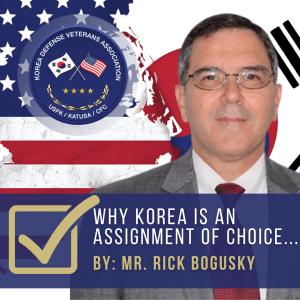
I am writing this nearly 50 years after getting my initial assignment to Korea, and I could not have imagined the lifelong journey it would become. Prior to graduating from West Point, I selected Field Artillery as my branch and desired an overseas base for my first assignment. Although the 4th Missile Command in Korea was available, I wanted to be in a tube artillery unit (versus missiles) and ultimately chose Fort Sill, OK. The Field Artillery Officer Basic Course (FAOBC) was also at Fort Sill, and upon graduation, I would remain at one of the battalions there. Halfway through FAOBC, there was a call for volunteers for overseas assignments to Greece, Turkey, Italy, and Korea. Along with many others, I submitted my name and within days was notified that I was going to Korea but would first spend a year at the Defense Language Institute (DLI) learning Korean. Korea, and the Orient in general, was fascinating to me simply because I knew next to nothing about it—it was totally foreign in every sense of the word, and I was excited to go there. The year at DLI introduced me to the Korean culture, people, and food. My native Korean instructors were amazing and taught me more than just the language. Their sincere friendship and mentoring made me realize that volunteering (they say ‘Never volunteer for anything in the Army’) and subsequently being selected for the Korea assignment was a Godsend. Little did I know then how true that would be.
In Korea, I was assigned to the Weapons Support Detachment-Korea (WSD-K) in Camp Page, home of the 4th Missile Command. As fate would have it – although 4th Missile Command had deactivated prior to my arrival – I ended up at the very place I initially dismissed. Camp Page was a small installation in the beautiful city of Chuncheon, the capital of Kangweon Province, the northeastern province of South Korea. When I left the replacement center in Seoul and took the long bus ride on a narrow, winding road to Camp Page, I marveled at the natural beauty of the countryside. While assigned to WSD-K, I saw much more of the country and would travel the dirt and gravel roads from coast to coast in the northern area near the DMZ. Because our unit worked exclusively with Republic of Korea (ROK) artillery units, our training missions had us drive or fly to designated ROK sites to jointly conduct fire missions. An Army UH1 battalion was located at Camp Page and getting a flying mission was always preferable to going by land, but I enjoyed traveling the beautiful countryside either way. The opportunity to work with the ROK Army as a young officer instilled in me how professional and hard working these brothers in arms are. That impression continued to build over the decades of working side by side with my ROK colleagues, and some of those friendships continue to this day.
Not long after arriving at Camp Page, an officer who was about to depart asked if I would be interested to taking over his English class at a small institute in town. It was a great opportunity to get out into the community and interact with college students preparing for post-graduation jobs. Since all ROK males were drafted and normally did their military time in the middle of their college years, most of the men in the class were my age. In Korean organizations, even informal ones, there is always someone in charge, and I became good friends with the class leader, Kim Myong-Soo, better known as Michael. Initially I taught two evenings a week at the institute, and Michael soon asked if I would also teach his classmates at the Business Administration Department at Kangweon National University. I agreed and added another weekday evening and Saturday afternoon. This was mostly done gratis and when it did not interfere with my military duties. Halfway through my tour, the head of the Korean Department at DLI visited Korea and met his old classmate who was President of Kangweon National Bank in Chuncheon. He invited me to dinner with him and upon his suggestion, I began teaching English to the bankers. During my first tour, I had more opportunities and interactions with the ROK military and civilian community than I could ever have imagined.
One day Michael mentioned that I probably knew his sisters. I asked how that could be, and he said they both attended the chapel services on Camp Page. One sister was a music major and was contracted to play the piano at all the services. The other sister and a few more classmates served as the choir. The next Sunday, I introduced myself and asked them to join our English class at the university. It is a long story for another time, but I eventually got engaged to the sister who sang in the choir (Joanna) and a year after my first Korean tour ended, I returned to Korea on leave for her college graduation and our wedding. Now, after nearly 46 years we enjoy life with our two boys and their families with five grandchildren.
After Korea I went to Fort Carson and from there, I went to the Officer Advanced Course (OAC). I commanded a battery at Fort Carson and was therefore able to request—and was approved for—early entry into the Foreign Area Officer (FAO) career field. Following OAC I went to Fort Bragg for the FAO course and graduate school. From there my first FAO assignment was the Deputy G5 in the 2nd Infantry Division at Camp Casey, Korea. At that time, the G5 was responsible for civil affairs, and thus I was involved with working with the local governments in the 2ID area and resolving issues such as maneuver damage with the Korean citizens. The most trying experience during that year came one evening when I went to Uijongbu to meet with a family of a young woman who had been murdered that day on a US installation. My Korean cultural experiences were expanded in the blink of an eye.
As a field artillery officer and a FAO, Korea was the ideal “assignment of choice.” Following my time in the G5 at Camp Casey, I extended my tour for another battery command with the 6/37th FA Battalion at Camp Essayons in Uijongbu. (The same camp where the young woman was murdered.) I had two more military assignments in Korea—in ’91-’92 as Executive Officer (XO) with the 1/15th FA Battalion at Camp Casey and ’96-’98, for one year as XO for the ROK Deputy Commander, Combined Forces Command (CFC), and one year as an Army War College Fellow at the Korea Institute for Defense Analyses in Seoul.
My stateside FAO assignments offered many opportunities to return to Korea on TDY, and in my last active duty assignment, I escorted two different Army Chiefs of Staff on official visits to Korea. As fate would have it, GEN Kim Dong-Shin was the ROK Army Chief of Staff at the time, who was previously my boss when he was the Deputy Commander, CFC. I had stayed in contact with him so preparation for the U.S.-ROK counterpart meetings was easy. GEN Kim and I remain close to this day. I consider him more than anyone as my professional mentor and someone I deeply respect and care for.
After military retirement and another civilian career, I returned to Korea as a civilian contractor supporting CFC from 2013 to 2017. During that time, both of my sons who are Air Force officers also served in CFC. For a six-month period, all three of us overlapped in serving the Command.
Korea has been the center of my career, my life, and my family. Little did I know that when I volunteered back in 1976 for an overseas tour that I was in for the most life-altering and wonderful years ahead. Yes, Korea has been an assignment of choice for me in so many ways, and I know many others have similar experiences. I still have family and friends in Korea and this past April, Joanna and I returned with our two oldest granddaughters in time to participate in the spring cleanup of the family’s mountain gravesite with Michael and other brothers and their families. It is a duty I cherish in honoring Joanna’s parents and other deceased family members. I am bound to that hallowed ground, because etched on a granite pillar at the gravesite is a family history going back generations including the names in Hangul: “Rick and Joanna Bogusky and their sons Andy and Richie.” In many ways, that inscription captures what service in Korea has meant to me beyond professional fulfillment—it represents the living bond between two nations that gave me purpose, perspective, and the people I hold most dear. What began as a simple assignment became a lifelong journey, one that shaped not just my career, but my life. For me, Korea is more than an assignment of choice; in so many ways it chose me.

Photo caption: Granddaughters pointing to the Bogusky name on gravesite marker.
Why Korea is an Assignment of Choice ? Let us know –
This initiative invites current and former Service Members, civilians, diplomats, and families to share their stories and reflections on why serving in Korea — whether with United States Forces Korea (USFK) or at the U.S. Embassy in Seoul — was one of the most meaningful and rewarding chapters of their lives.
Whether your experience involved joint operations, discovering the beauty of Korean culture, forging lifelong friendships, or contributing to one of the world’s strongest alliances, we want to hear from you!
Share Your Story by Telling Us:
- What was your initial reaction upon learning that you were going to Korea?
- Why did you have that reaction?
- What did you know about Korea?
- Was there an “aha!” moment that made you think that being in Korea was good?
- How did serving and living in Korea shape your career, life, or worldview? And your family’s?
- What experiences left a lasting impression, good or bad?
Submissions can be written, video-recorded, or even a simple quote with a photo. Selected stories will be featured on all KDVA social media platforms, our website, and Journals.
How to Submit:
Email your story to KDVAKoreaChoice@gmail.com and tag us on social media using #KDVAKoreaAssignmentOfChoice.
There is no deadline. We will keep this going because we will not run out of stories from the millions of people who have served in Korea over the past 75 years!
Help us show the world why Korea isn’t just an assignment — it can be life changing!


Leave a Reply