


From My Service in Korea, I learned… Dr. USA SFC (Ret) William Sawvel & USAF Sgt Ronald Sawvel 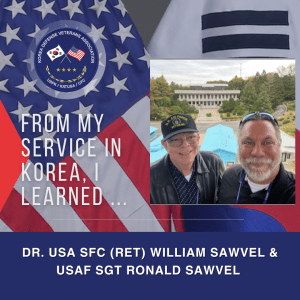
Walking down the dark hallway towards the TA50 storage room, I felt like I was in an episode of The Twilight Zone as a homogenously bouncing glow peeked out from under the door crack of every other soldier’s room. From the nearly synchronous noise of reporter dialogue, I realized we were all watching the same thing – two commercial jets had just crashed into the World Trade Center buildings within twenty minutes of each other. In South Korea, it was 11 pm on September 11th, 2001, and half of our soldiers were still enjoying the night out in town while the other half of us stayed in. The purpose for gathering my equipment while I had no idea what would happen next. I knew it wasn’t good when the first aircraft hit, I briefly wondered, “Now, what idiot was flying that plane?” It was as I watched the second plane collide on live television that I instantaneously knew… we were going to war.
Serving in the Second Infantry Division under the command of Major General Russel L. Honoré (aka “The Ragin’ Cajun”) – a famously animated leader who seemed to enjoy torturing us with regular 3 AM sirens to respond to an imaginary Democratic People’s Republic of Korea (DPRK) surprise invasion – I was thoroughly convinced staff duty would be beating on our doors at any moment. Except, this time, the threat would be real. While that alarm never came, the last several months of my time in South Korea included my unit moving up along the Imjin River and pulling guard alongside our Republic of Korea (ROK) Army counterparts, in the event North Korean leader Kim Jong Il decided he would take advantage of our distraction. I realized that even developing conflicts thousands of miles away had a global impact on, not just the United States, but our partner nations. I also realized just how much of a dedicated ally South Korea was.
I remember hearing stories as a child about how my grandfather, already a WWII veteran and then a flight engineer for a major airline, helped to transport ROK Army soldiers (and their family members) from South Korea into Vietnam to fight alongside American counterparts. At 320,000 the Republic of Korea sent the largest contingent of any U.S. ally in the war. While deployed to Afghanistan in 2013, I often walked past a tiny ROK compound situated along the outer perimeter of Bagram Airfield – near what later became the site of an intense firefight against breaching Taliban fighters. We recently heard that ten thousand soldiers of the number one enemy of South Korea joined in the fight in Ukraine alongside one of our own largest opponents, the Russian Federation.
In 2021, Admiral Philip S. Davidson, commander of the U.S. Indo-Pacific Command (INDOPACOM), testified before the U.S. Senate Armed Services Committee that the People’s Republic of China (PRC) intended to invade Taiwan by 2027. If ADM (Ret) Davidson’s testimony was accurate, the threat to South Korea is irrefutable. In vicinity alone, North Korea, an ally of China, is the only country by land separating the PRC from ROK. During the 20th century, DPRK assisted the Chinese Communist Party (CCP) in the Chinese Civil War; and China reciprocated by sending 260,000 of its own soldiers in to reinforce the North Koreans in the Korean War.
From a U.S. perspective, South Korea (and Japan) sit close enough to the Bering Sea and Arctic, an extremely important strategic region, that Chinese and Russian vessels heading towards or leaving the Northern Sea Route are likely to come near the peninsula, if not stop at Busan (South Korea’s largest port and a major global logistics hub). Chinese military and commercial vessels (who regularly impede on sovereign territorial waters) leaving ports in Dalian, Shandong, and even Shanghai are likely to be seen by South Korea before leaving the Yellow and East China Seas.
As far as the largest elephant in the room, China and North Korea both pose a nuclear threat to the United States, as well as South Korea and Japan. Should China invade Taiwan, and should the U.S. and its allies become involved, both South Korea and Japan would be perfectly positioned to give early warning and rapid logistical support. However, there must always be give and take.
During the 2024 ROK-US Alliance Conference, I listened with intense concentration as General (Ret) Leem, Ho-Young eloquently and accurately mentioned that the U.S. must realize that South Korea has needs and expectations of its own, which cannot go ignored. While rapidly developing technology has made it easier for mortal enemies to achieve global reach, there are just four kilometers of concertina wire and landmines that separate North and South Korea and, according to RAND Corporation’s Arroyo Center, there are nearly six thousand North Korean artillery systems within range of heavy population centers that could kill more than ten thousand civilians within an hour. The people of South Korea are in constant threat of attack with hardly any warning. Yet, they have never ceased to be a staunch ally of a nation over five thousand miles away (to the continental U.S.) on the other side of the Pacific.
Taking into consideration the Department of Defense’s model on the instruments of national power (Diplomatic, Information, Military, and Economic – DIME), we simply cannot afford to ignore the needs of South Korea, in addition to our own, and the extreme advantage of having them as an ally in realizing strategic effects against China.
Generally speaking, we are culturally dissimilar; we come from different backgrounds and experiences; our immediate needs and expectations may differ; and our ideas for achieving victory might be distinct. However, our reliance on each other is undeniable. With today’s adversaries simultaneously threatening our individual homelands, we must expand and reinforce the alliance and collaboration between our two nations.
Dr. USA SFC (Ret) William Sawvel with His Father, USAF Sgt Ronald Sawvel (Panmunjom JSA, 2024)
 What did you learn from serving in Korea? Let us know –
Sharing your experiences from serving in Korea can be a powerful way to connect with others who have had similar experiences. By sharing your story, you may be able to help others who are currently serving in Korea or who are preparing to do so. You can share insights about the culture, the people, and the challenges you faced while serving. Your story can also help to shed light on the sacrifices that service members and their families make in order to protect our freedoms. So, if you have a story to share, we encourage you to take the time to put it down in writing and send it to KDVA.MyServiceInKorea@gmail.com along with any photos that help to tell your story.
READ MORE STORIES HERE.


Leave a Reply