


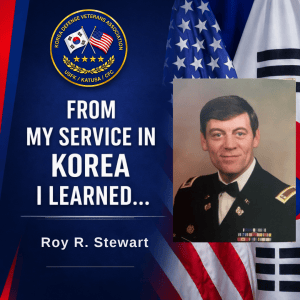
 I am Roy R. Stewart, CW2, USA (retired)
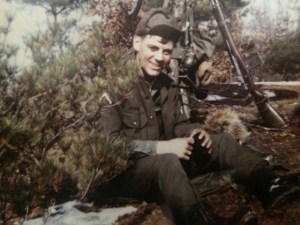
Korea was my first assignment in 1967 following Infantry AIT at Ft. Ord California. I was assigned to Charlie Company, 1/9th Infantry, 2nd Infantry Division. After reporting to my unit and going on sick call the first day, I spent my first month in Korea hospitalized with double pneumonia. I suspected the pneumonia wasn’t from the cold in Korea, but from the endless formations we stood in at Ft. Lewis, WA where it was very cold and wet. During the first few months following release from the hospital, I was still weak and not really interested in going into Yonjugol, or Paju-ri, the village immediately outside South Camp Custer, so I had little interaction with the Korean people there. I did however become friends with the Koreans working inside the camp and found them warm and friendly. It appeared that they truly appreciated us and the American presence in their country. I felt their friendship was honest and genuine since there was no other benefit to them. Later, I started going into the village with other soldiers and found Koreans there that were extremely nice, and I doubt it was solely for the revenue they made from us Americans. Our unit alternated with other Army units for assignment on the DMZ, and I truly hated leaving my Korean friends when we went North.
We had a Korean barber at our camp near the DMZ, but that was about the limit of my association with the Korean people for the next 3 or 4 months, except for the KUTUSAs in our unit. I became friends with a KUTUSA by the name Yoo Y.C. – He was friends with the entire platoon; we joked with him a lot since his name sounded like “You Young Child” and we called him our platoon baby. Yoo was always smiling and laughing, and he knew we were all fond of him and we enjoyed in our association. Yoo was simply one of us; we did not consider him solely as a Korean, but as a fellow soldier. In the months that followed we learned that Yoo was not only a good man and a friend, but a good soldier and a fierce fighter as well. In the early months of 1968 we were tested as soldiers in combat; Yoo and the KATUSA’s were right there with us.
Right before Christmas 1968 our patrol was temporarily assigned (TDY) to a unit near Panmunjom. It was a strange assignment since it was only for one day; we were ordered to set up an ambush for the night, then return to our unit the next day. It was very cold that night and although we expected an engagement with North Koreans, especially after hearing small arms fire and explosions near our ambush site, we welcomed the morning dawn without an enemy encounter. While walking back into the camp that morning, we saw a jeep transporting the bodies of American soldiers, those who had not been as fortunate during the night. While our patrol leader was arranging transportation back to our unit, the rest of us were just looking for some place to get warm after laying out in the elements all night. Near us was a canvas looking Quonsen hut that reeked of kimche. We saw an older looking Korean gentleman leaving the hut and he noticed us standing around shaking from the cold.
Although he didn’t speak English, he saw that we were frozen, and motioned for us to come inside the hut. The kimche was so strong it made our eyes water, but it also had a warming affect. There were 2 or 3 other Koreans inside who were amused by our reaction. They motioned for us to come near their heater. Naturally, there was very little conversation as we only knew a few words in the Korean language, among them, “thank you” which we expressed, as we were very truly grateful for the warmth. Eventually we even had a bite of the kimche they offered, which warmed us from the inside out. We noticed a small scarcely decorated Christmas tree sitting on a 55 gallon drum in the hut. One of our group pointed to the tree, and said “Jesus” and the Koreans said something in response which we assumed was either Merry Christmas, or maybe it meant they agreed with what we said, assuming they even understood us. Our visit was very brief, but we all felt we had made some friends. Before we departed, they all individually said thank you in Korean. It’s a fond memory that I have retained over the past 50 years. I was always impressed how the Korean people with nothing, were always happy, caring and generous to others.
When the unit came off the DMZ and returned South, relinquishing our area of the American sector of the DMZ to another unit, I was assigned as the 1st Sergeant’s driver. “Top” was expected to surrender his jeep anytime an officer needed it and during the summer one of the Platoon Leaders was required to go to Kimpo for a short visit. During that time the route to Kimpo required going through sections of Seoul. The jeep I was driving started having a mechanical problem on the return trip. The LT decided to take a bus back to the unit, telling me to just guard the jeep and he would send somebody to get me, and repair or retrieve the jeep as soon as he returned to the unit. As I was sitting with the jeep, apparently in a Korean residential area, people started gathering around the jeep. All I could understand from their comments was “Imjim” and “DMZ” – I had become accustom to people in Munsan, a city full of “slicky boys” and wasn’t sure if the people there in Seoul were interested in the jeep, or if they were just curious Korean citizens; I wasn’t sure how to react. I was doing my best trying to keep those that had gathered away, without much success and none of the people spoke English well enough for me to get anybody to understand that I was waiting for others.
However, there was one serious looking Korean gentleman that spoke just a few words of English that insisted on checking out the jeep. I thought I had finally run him off at one point, but he returned a short time later carrying a tool box. All he said at the time that I understood was, “I fix.” I was exhausted from just trying to keep people back by that time and decided to let him try, thinking some guys from the unit would be arriving soon and they could run him off. However, the gentleman was finished with the repair (greasing a wheel bearing) in practically no time. He rode with me a few blocks to make sure the jeep was okay, motioned for me to stop, then grabbed his tool box and started walking away. I stopped him and offered him money for fixing the jeep, but he shook his head no, pointed at my Imjim Scout patch and said “No money, DMZ warrior.” I drove back to the unit, arriving before the LT who had taken the bus from Seoul. There was some serious discussion about me leaving the LT in Seoul when I first arrived, but soon everything turned out alright and we all got a laugh – Besides, I didn’t leave the LT, he left me. But, through the kindness and expertise of a kind Korean gentleman, I was able to return to the unit first!
I was a young PFC when I arrived in Korea with some ideas that came with immaturity, having not associating with many people different from those I had lived around all my life. I had not traveled and didn’t know much about other countries and their people. My time in Korea taught me many things about survival in cold climates and combat, but mainly about people. In Korea I learned that kindness and respect outweigh, money, rank, possessions, and social status, or anything else outside of our God. Since returning to the US, I’ve come to know several Koreans who have become US citizens over the years. I’ve found them just as warm, friendly, honest, and genuine as those I became friends with in Korea. I also learned that there are some nations that have not forgotten America’s sacrifice in keeping them free – Korea is certainly one of those nations, and the mutual respect between Korea and the USA has continued over the past 75 years!

Post a comment