


From My Service in Korea, I learned…


Darrell Lake
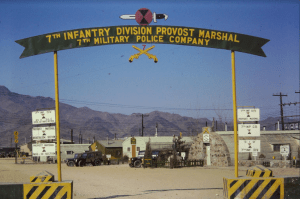
I left McCord Air Force Base at 3:00 AM on January 17, 1968. I arrived at Kimpo Air Force Base in Korea at noon on January 19th losing one day flying over the International Dateline and was bused to Ascom City Army Depot for further processing and then bused up to Camp Casey near the DMZ in South Korea. I was assigned to the 7th MP Company of the 7th Infantry Division, was assigned to a platoon, and immediately started working regular military police duties patrolling the streets of Tongduchon outside the gates to Camp Casey. Shortly thereafter, I was called into the Provost Marshal’s Office and LTC. Marion Glover told me he wanted to assign me to a new Physical Security Inspection Team under the Office of the CID. What a great opportunity working without rank insignia and having to travel all over South Korean inspecting various army facilities?! I was sent to a rigorous two-week training at the Eighth Army Physical Security School in Seoul and was then assigned my vehicle and private quarters. I almost felt like an officer.
Although Korea was no Vietnam, things were becoming heated there too during my tour of duty. The U.S.S. Pueblo, a Navy intelligence ship was boarded and captured by North Korean forces just a few days after my arrival on January 23, 1968, in what was known as the Pueblo Crisis. It seems we were on alert a good deal of the time and conducted a lot of maneuvers and various war games in the region. As a side note, the Pueblo is still held by North Korea today and officially still remains a commissioned vessel of the U.S. Navy. She is moored along the Taedong River in Pyongyang, North Korea, and used as a museum ship. The Pueblo is the only ship of the U.S. Navy currently being held captive. I was still there when they were released 11 months later.
On a lighter note, I have to share a rather embarrassing incident. My mother had heard of a local girl Jeanne, from Idaho who was serving in the Peace Corps in a southern province in South Korea and suggested I look her up sometime. Why not give it a try since I was given my own set of wheels? Early one Saturday morning I set off for this little village that I only vaguely knew where it was. I drove on dirt roads and trails crossing streams and rice patties going through village after village having to stop and ask the Korean Police directing traffic the direction to the address I had on an envelope in Korean and they would point in some direction and off I would go to the next village. After nearly 5 hours I arrived in the little village and then directed to the Korean home where this young lady was living. She was a bit surprised to see me and we had a nice visit. The Korean family playing host to her fixed a lovely lunch and it was nearing the time that I needed to start back. She had asked to see my handcuffs so I handed them over to her and somehow we got handcuffed together. I was not concerned at the time as it was easy enough to unlock them and be on my way and then suddenly panic set in as I had lost my handcuff key. I tried to pick it to no avail and finally decided we would have to visit a village police station as surely they would have a key. It was not easy to explain what we needed since they could not understand a word of English and our Korean was extremely limited but we kept pointing to the handcuffs and twisting our fingers like we had a key. Unfortunately, their handcuffs were different and their keys would not fit. Finally, after a couple of hours of incredible stress thinking about how I was going to explain this to the Provost Marshal, having to take her back to the base with me, they were able to unlock us. Not exactly the way I wanted to meet a young lady. Lesson here of course is a no-brainer. “Make sure you have the key to the lock before locking it.”
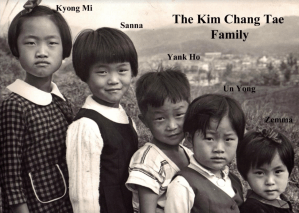
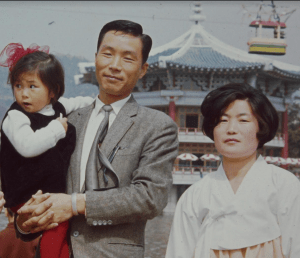
My working partner, Inspector Everton, and I got along great during our tour in Korea. We worked hard during our working hours and played hard during our off time visiting a good part of Korea and taking thousands of pictures. We were somewhat adopted by the Kim Chang Tae family. Mr. Kim was an artist who painted beautiful pictures and spoke pretty good English so he served us well as an interpreter and tour guide. Whenever we wanted to purchase anything (which I did often) we let Mr. Kim buy it for us and he would argue and negotiate for the very best price. Mr. Kim had a lovely wife and six children Kyong 8, Sanna 7, Yangho 5, Un Young 4, Zema 3, and Angel was born during my time there. They lived with his brother Kim Chang Sop, his brother’s wife, and their mother in a very small hooch of less than 200 square feet in Tongduchon. I spent nearly all of my holidays and a great deal of my time off with the Kim’s. I was even invited there for Christmas 1968 and what a wonderful Christmas we had. It was so fun giving all the kids gifts and watching them open them and how thankful and appreciative they all were. Then it was time for dinner, and I was afraid that we would be served Kimchi (that I never did acquire a taste for) but they wanted to make dinner very special and had bought and fixed us chicken. Christmas 1968 was certainly different than what I was acquainted with on the farm in Idaho but was wonderful. After all the guys were fed the women ate and then the children all sat on the floor in their hooch. I came to love them all dearly and still wonder how they are doing today.
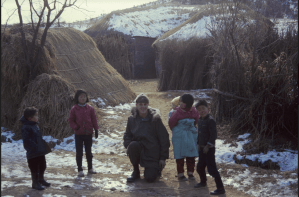
Korea was an incredible experience that I will never forget. I learned so much from my time there watching how children can be happy just playing kick the can or playing with a block of wood. Women smiling as they were washing their clothes in the dirty rivers and scurrying about to care for their families. Life has not been easy for the Korean people but they have pulled themselves up by their bootstraps and to see how their country has changed since my time there is unbelievable, they are a very thriving industrialized country. The people there are not afraid of working hard in difficult situations, and their standard of living has greatly improved. Perhaps our country could learn a lot from them. Visiting the DMZ, seeing the bunkers and foxholes, and knowing that our country lost thousands of soldiers fighting to gain just inches of barren ground I cannot even imagine what it was like to be there during the Korean War. What sacrifices were made by so many for the freedom they all enjoy today!



Sharing your experiences from serving in Korea can be a powerful way to connect with others who have had similar experiences. By sharing your story, you may be able to help others who are currently serving in Korea or who are preparing to do so. You can share insights about the culture, the people, and the challenges you faced while serving. Your story can also help to shed light on the sacrifices that service members and their families make in order to protect our freedoms. So, if you have a story to share, we encourage you to take the time to put it down in writing and send it to KDVA.MyServiceInKorea@gmail.com along with any photos that help to tell your story.
READ MORE STORIES HERE.